South Africa has deployed heavy security across major cities ahead of planned anti-migrant protests, as fears grow that demonstrations over undocumented immigration could turn violent.
The protests are linked to an unofficial deadline set by anti-immigration campaigners demanding that undocumented foreign nationals leave the country. The deadline has caused anxiety among migrant communities, forced many people into temporary shelters and triggered repatriation efforts by several African governments.
President Cyril Ramaphosa has urged those planning to protest to do so peacefully and within the law. His message has tried to strike a careful balance: acknowledging public concern over immigration enforcement while warning that frustration cannot justify intimidation, threats, vandalism or violence.
The issue has placed South Africa at the centre of a wider African debate about migration, unemployment, border control, urban poverty and xenophobia. The country remains one of the continent’s biggest economic magnets, attracting people from Zimbabwe, Malawi, Mozambique, Nigeria, Ghana, the Democratic Republic of Congo and other countries seeking work, refuge or better opportunities.
But migration has also become a politically explosive issue. In communities facing joblessness, crime, housing shortages and weak public services, foreign nationals are often blamed for deeper failures of governance and economic inequality.
The result is a tense national moment: one in which the right to protest, the need for immigration reform and the protection of migrants’ rights are all being tested at once.
Ramaphosa Warns Against Threats and Intimidation
President Ramaphosa has made clear that South Africans have a constitutional right to protest, but that this right comes with responsibility.
His warning is important because the planned demonstrations are not ordinary policy protests. They are taking place in a climate where migrants say they have faced harassment, threats, evictions and attacks. Shops in some areas have closed, families have sought shelter and foreign nationals without secure documentation have rushed to leave before the deadline.
Ramaphosa has reminded citizens that some foreign nationals are in South Africa lawfully. They work, study, raise families, invest in the economy and contribute to society. These individuals, he said, are entitled to the protection of South African law and the Constitution.
This distinction matters. Immigration enforcement is a function of the state, not vigilante groups. A democratic society can debate border control, work permits, asylum systems and deportations. But no private group has the right to threaten people, force them out of communities or decide who belongs in the country.
Ramaphosa’s message is therefore aimed at preventing lawful protest from turning into mob action.
Cities on Alert as Protest Deadline Arrives
Authorities have prepared for possible disruption in several cities, including Johannesburg and Durban, where anti-migrant demonstrations have drawn significant attention.
Johannesburg, South Africa’s economic hub, has been unusually quiet in areas where marchers were expected to gather. Some shops near protest routes closed as a precaution, reflecting fears that demonstrations could spill into looting, intimidation or attacks on foreign-owned businesses.
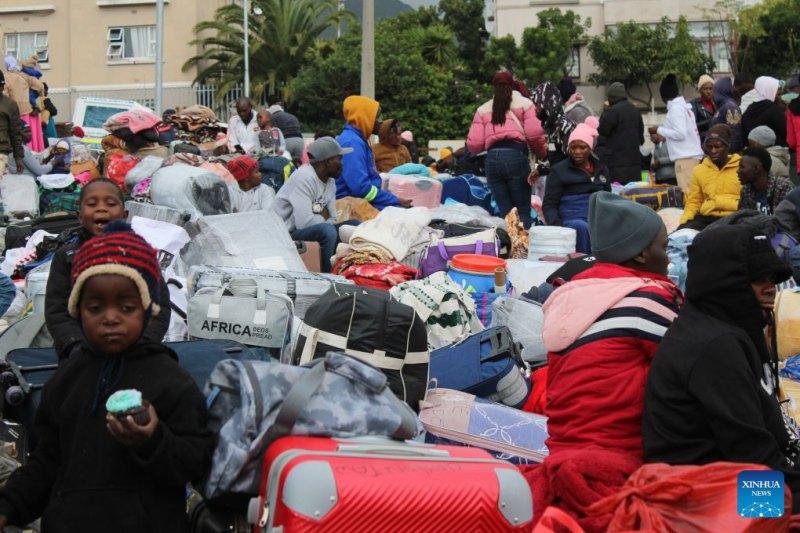
Durban has been another major focus. Temporary camps have housed migrants, many of them Malawians, while authorities and foreign governments arrange transport and processing for those seeking to return home. In some locations, tents have been dismantled as officials move people out of transit sites.
The situation is also being watched closely in Cape Town, where Zimbabwean nationals have gathered near their consulate seeking assistance. Other countries have organised or discussed repatriations by bus or air as migrants weigh whether it is safer to leave South Africa temporarily.
Police have warned that they are prepared to respond to criminality. Authorities have also cautioned that protesters must obey the law, avoid violence and refrain from carrying items that could escalate tensions.
Migrants Leave Families, Jobs and Homes Behind
Behind the political slogans are deeply personal stories.
Many undocumented migrants came to South Africa to work and support families back home. Others built lives in South African cities over many years. Some have South African-born children. Some are married or in long-term relationships. Some fled poverty, conflict or instability elsewhere.
For these families, repatriation is not a simple journey home. It can mean leaving children behind, losing income, abandoning belongings or returning to countries where jobs are scarce.
Some migrants say they are leaving not because they want to, but because they fear violence. Others say they are tired of being called names, accused of crime or treated as if they are responsible for South Africa’s economic problems.
A Malawian migrant quoted in the original report said he accepted returning home because he lacked the correct documents, but his words captured the sadness of many: he had come to South Africa to support his family and now felt he had no choice but to leave.
Another Malawian appealed for African unity, saying that Africa cannot be Africa without South Africa, Malawi and other countries standing together. That message cuts to the heart of the crisis. The issue is not only legal status. It is also about dignity, belonging and the meaning of African solidarity.
The Immigration Question South Africa Cannot Avoid
South Africa does face real immigration-management challenges. The country has long struggled with porous borders, slow documentation systems, asylum backlogs, corruption allegations, labour-market abuses and weak enforcement.
Many South Africans are frustrated by what they see as an immigration system that does not work. Employers may hire undocumented migrants cheaply. Criminal networks may exploit gaps in enforcement. Public services may be stretched in poor communities. Border management has often been criticised as inadequate.
These concerns cannot simply be dismissed. A functioning state must know who enters, who works, who qualifies for asylum and who is unlawfully present. Immigration systems must be fair, efficient and enforceable.
But the danger comes when legitimate policy concerns become collective punishment. Undocumented status does not make someone a target for violence. Migration pressure does not justify xenophobia. Economic frustration does not give citizens the right to attack foreign nationals or destroy property.
South Africa’s challenge is to reform immigration without normalising hatred.
Why Migrants Become Scapegoats
Anti-migrant sentiment often grows in places where people feel abandoned by the state.
South Africa has high unemployment, especially among young people. Many communities struggle with poor housing, crime, unreliable services, inequality and slow economic growth. In such conditions, migrants can become easy targets.
But blaming migrants can hide more difficult questions. Why has job creation remained weak? Why do some employers exploit undocumented workers? Why are public services failing? Why is border control ineffective? Why is corruption allowed to continue? Why are poor communities left to compete for scarce resources?
Foreign nationals may be visible in townships, informal trading, domestic work, construction, transport and small business. That visibility can make them targets. But the roots of South Africa’s crisis are larger than migration alone.
Scapegoating migrants may produce anger and headlines, but it does not build houses, create jobs, improve policing, fix schools or reform border systems.
A Long History of Xenophobic Violence
South Africa’s current tensions are not new. Xenophobia has been a recurring problem since the end of apartheid, with periodic outbreaks of violence targeting migrants, refugees, asylum seekers and foreign-owned businesses.
The 2008 attacks remain one of the darkest moments in the country’s democratic history, when more than 60 people were killed and tens of thousands were displaced. Further outbreaks followed in later years, including attacks linked to anti-migrant mobilisation, economic frustration and local political tensions.
The latest protests have revived painful memories of those earlier waves of violence. Civil society organisations, migrant-rights groups and African governments are watching closely because they know how quickly anti-foreigner rhetoric can turn into physical attacks.
This history is why the state response matters. Visible policing can reduce immediate risk, but long-term prevention requires more than security deployment. It requires political leadership, community dialogue, prosecution of perpetrators, immigration reform and honest engagement with economic grievances.
The Role of Social Media in Escalating Tension
Government concern about violent incitement online shows how migration tensions have entered the digital space.
Messages about the June 30 deadline have spread through social media, messaging platforms and local networks. In some cases, online posts can amplify fear, spread false claims or encourage intimidation. Rumours can move faster than official information, especially in communities where distrust of government is already high.
Authorities have said they are engaging social media platforms over content linked to incitement. This is a necessary step, but it must be handled carefully. The goal should be to prevent violence, not silence legitimate debate about immigration policy.
South Africans should be able to discuss border control, labour laws and public services. But calls to harm, threaten or forcibly remove people cross a dangerous line.
In a tense environment, responsible communication is essential. Political leaders, activists, journalists and community organisers all have a role to play in avoiding language that inflames fear or dehumanises migrants.
African Governments Step In
The crisis has drawn responses from several African governments whose citizens live and work in South Africa.
Countries including Malawi, Zimbabwe, Mozambique, Ghana and Nigeria have been involved in repatriation discussions or assistance for nationals who want to leave. Some migrants have gathered at consulates or temporary camps seeking transport, documents or safety.
This creates a diplomatic challenge for South Africa. The country is a major regional power and a leading member of the African Union and Southern African Development Community. Its economy depends on continental trade, labour mobility, investment and political relationships.
When African migrants are targeted in South Africa, the effects are felt beyond its borders. Neighbouring governments face pressure from citizens asking why their nationals are unsafe. South African businesses operating elsewhere on the continent can also face reputational risks.
The crisis therefore has a regional dimension. It is not only a domestic law-and-order issue. It is a test of South Africa’s leadership role in Africa.
What Protesters Are Demanding
Anti-immigration groups say they want stronger action against undocumented migration. Their complaints often include claims that migrants take jobs, strain public services, commit crimes or operate businesses illegally.
Some protesters argue that the state has failed to enforce immigration laws and that communities are forced to live with the consequences. They say their frustration is directed at undocumented migration, not law-abiding foreign nationals.
But in practice, anti-migrant mobilisation can easily become broader and more dangerous. Legal migrants, asylum seekers and even South Africans perceived as foreign have previously been targeted during xenophobic violence. Accent, language, appearance or nationality can become grounds for suspicion.
This is why the government and police have warned that protests must remain lawful and peaceful. A march about immigration policy cannot become a licence to identify, threaten or expel people.
The Law Must Remain in the Hands of the State
One of the clearest principles in this crisis is that immigration enforcement belongs to the state.
Police, Home Affairs officials, courts and legal processes exist for a reason. They may be imperfect, slow or under-resourced, but replacing them with vigilante action would weaken the rule of law.
If someone is undocumented, there must be a lawful process. If someone is accused of crime, there must be evidence and due process. If an employer hires workers illegally, labour inspectors and prosecutors must act. If border controls are weak, the state must reform them.
Allowing private groups to issue deadlines, threaten removals or police communities would create a dangerous precedent. Today the target may be undocumented migrants. Tomorrow it could be another vulnerable group.
A constitutional democracy cannot allow citizenship, safety or dignity to be determined by mobs.
Security Deployment Is Only a Short-Term Answer
Heavy security may prevent violence in the immediate term, but it will not solve the underlying problem.
Police can monitor marches. They can protect vulnerable communities. They can arrest those who attack people or destroy property. They can maintain order during protests. But once the demonstrations end, South Africa will still face the same structural questions.
The immigration system must be made more credible. Labour law enforcement must be strengthened so employers cannot exploit undocumented workers. Local service delivery must improve so poor communities do not feel abandoned. Political leaders must avoid using migration as a convenient election tool.
Civil society and community leaders also need space to rebuild trust between South Africans and foreign nationals. Many migrants live peacefully alongside South Africans, contribute to local economies and support families both inside and outside the country. Their stories are often lost in moments of crisis.
Security is necessary when violence is feared. But social repair requires more than police lines.
The Human Cost of the Deadline
The unofficial deadline has already had consequences.
People have left jobs. Families have been separated. Children may be left behind. Shops have closed. Communities have become fearful. Temporary camps have filled with people unsure what will happen next.
For migrants who have lived in South Africa for years, leaving can feel like losing a second home. For those who return to countries with limited economic opportunity, repatriation may not bring stability. For those who remain, fear may continue long after the protests end.
South Africans also pay a price when xenophobia rises. Communities become less safe. Local economies are disrupted. International reputation suffers. Regional relationships are strained. The country’s constitutional values are weakened.
A society built after apartheid cannot afford to normalise exclusion and intimidation.
What Should Happen Next?
South Africa needs a two-track response.
First, the immediate security threat must be managed firmly and lawfully. Protests should be allowed if they are peaceful. Violence, looting, threats and intimidation must be prevented. Migrants in vulnerable areas must be protected. Those who commit crimes must be prosecuted regardless of nationality.
Second, the government must address the immigration system in a serious and credible way. That means faster documentation processes, better border management, stronger labour inspections, action against corrupt officials, protection for legitimate asylum seekers and clear communication with the public.
Regional cooperation is also essential. Migration is not only South Africa’s issue. Economic instability, conflict, climate stress and unemployment across the continent push people to move. African governments need better systems for labour mobility, documentation, repatriation, refugee protection and cross-border cooperation.
Above all, political leaders must avoid language that turns migrants into enemies. Immigration policy can be firm without being hateful. Border control can be strengthened without undermining human rights.
Conclusion: South Africa Faces a Test of Law, Leadership and Humanity
The anti-migrant protests have placed South Africa at a crossroads.
On one side is a legitimate public debate about immigration control, border management, jobs and public services. On the other is the dangerous risk that frustration turns into xenophobic intimidation and violence.
President Ramaphosa’s warning is therefore not just a political statement. It is a test of whether South Africa can defend both the right to protest and the rights of vulnerable people.
The state must enforce immigration laws, but it must also protect human dignity. It must listen to citizens’ concerns, but it must not allow vigilantes to decide who belongs. It must reform broken systems, but it must not permit migrants to become scapegoats for deeper national failures.
South Africa’s strength has always rested on its constitutional promise: that all who live within its borders are protected by law.
In the days ahead, that promise will be tested in the streets.
FAQs About South Africa’s Anti-Migrant Protests
Why are anti-migrant protests taking place in South Africa?
The protests are linked to anger over undocumented immigration, unemployment, crime, pressure on public services and frustration with border control. Anti-immigration groups have set an unofficial deadline for undocumented foreign nationals to leave the country, but the deadline is not an official government order.
What has President Cyril Ramaphosa said?
President Ramaphosa has said South Africans have a right to protest, but that protests must be peaceful and lawful. He warned against intimidation, threats, vandalism and violence. He also reminded citizens that lawful foreign nationals are protected by South African law and the Constitution.
Are all foreign nationals in South Africa undocumented?
No. Many foreign nationals live in South Africa legally. They work, study, run businesses, raise families and contribute to the economy. The current tensions are officially framed around undocumented migration, but past xenophobic violence has often affected both documented and undocumented migrants.
Which migrants are most affected?
Migrants from other African countries have been most affected, including people from Malawi, Zimbabwe, Mozambique, Nigeria, Ghana and the Democratic Republic of Congo. Some are undocumented workers, while others are asylum seekers, refugees, students, business owners or family members of South African residents.
Why are some migrants leaving South Africa?
Some migrants are leaving because they fear violence, intimidation or forced removal. Others are seeking government-assisted repatriation because they do not have secure documents or believe it is safer to return home temporarily. Many are leaving under pressure rather than by free choice.
What cities are affected by the protests?
Major cities including Johannesburg and Durban have been closely watched, with authorities preparing for possible unrest. Cape Town has also seen migrants gathering near consulates for assistance. Protest activity and security preparation may vary by province and city.
Is the South African government deporting migrants?
South Africa regularly deports undocumented migrants through official processes. However, the current unofficial deadline was set by anti-immigration groups, not the government. Immigration enforcement remains the responsibility of the state, not private campaigners or protesters.
Why is xenophobia a concern in South Africa?
South Africa has a long history of xenophobic violence, including deadly attacks in 2008 and later outbreaks. Migrants have previously been attacked, displaced or had businesses looted. This history makes authorities and civil society groups concerned that anti-migrant protests could escalate.
What is Xenowatch?
Xenowatch is a monitoring project run by the African Centre for Migration & Society at the University of the Witwatersrand. It tracks incidents of xenophobic discrimination and violence in South Africa, helping researchers, journalists and policymakers understand patterns over time.
What should South Africa do about immigration?
South Africa needs a stronger, fairer and more efficient immigration system. That includes better border management, faster documentation, protection for legitimate refugees and asylum seekers, stronger labour inspections and action against corruption. But reform must be lawful and must not involve violence or intimidation against migrants.