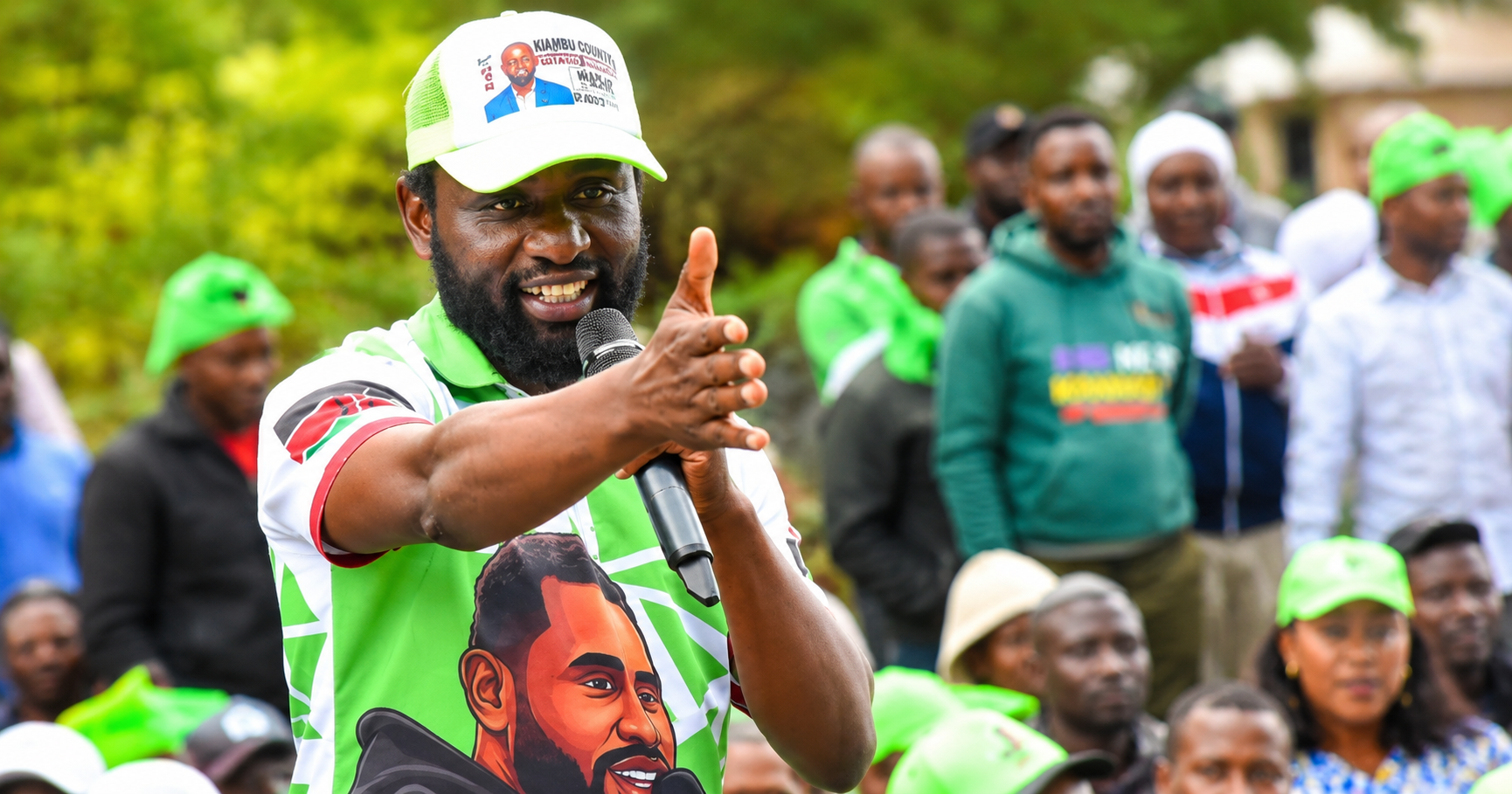
The Ol Kalou by-election has delivered a decisive political victory for Sammy Douglas Kamau Waweru, popularly known as Sammy Kamau Ngotho, after the Democracy for Citizens Party candidate established an overwhelming lead over his main opponent, Samuel Muchina Nyagah of the United Democratic Alliance.
The parliamentary vote was held on Thursday, July 16, 2026, to fill the vacancy created by the death of Ol Kalou MP David Njuguna Kiaraho in March. The contest attracted national attention because it developed into a direct test of political influence between President William Ruto’s ruling UDA and former Deputy President Rigathi Gachagua’s DCP.
Results circulated during the constituency tally showed Ngotho receiving 33,937 votes, compared with 5,304 for Muchina. The remaining seven candidates received fewer than 400 votes each, according to the reported figures.
The numbers gave Ngotho an unassailable advantage and positioned him to become Ol Kalou’s next Member of Parliament.
Beyond the choice of a constituency representative, the result carries wider political significance. Nyandarua is part of the vote-rich Mt Kenya region, where UDA performed strongly in the 2022 general election but where new political alliances have emerged following Gachagua’s departure from the deputy presidency.
The scale of Ngotho’s reported victory will consequently be interpreted as more than a local result. It provides DCP with a significant parliamentary breakthrough and gives Gachagua’s political organisation an opportunity to demonstrate that it can translate campaign crowds, grassroots networks and dissatisfaction with the governing party into votes.
However, the published tally reviewed for this report contains inconsistencies between the raw vote totals and some of the accompanying percentages. The raw candidate figures should therefore be treated as the more reliable numbers until the Independent Electoral and Boundaries Commission publishes or confirms the final constituency declaration.
Ol Kalou By-Election Delivers Commanding Win for Ngotho
Sammy Kamau Ngotho emerged as the dominant candidate in a nine-person race for the Ol Kalou parliamentary seat.
The reported constituency tally gave the DCP candidate 33,937 votes. His nearest challenger, UDA’s Samuel Muchina Nyagah, received 5,304 votes.
Stephen Wanyoike of the National Liberal Party placed third with 391 votes, while Jubilee Party candidate Wilson Mwaniki received 172 votes.
Timothy Kamau of the People’s Renaissance Movement secured 43 votes. Edwin Muchiri of the Party of National Unity received 21, while Abdifatah Hussein of the Federal Party of Kenya obtained 15.
Kenya Moja Movement candidate Edward Mathenge Mwaniki received 13 votes, while Rachael Wangui Njoroge of the Peoples Democratic Party received seven.
The reported candidate totals are as follows:
| Rank | Candidate | Party | Reported votes |
|---|---|---|---|
| 1 | Sammy Douglas Kamau Waweru | DCP | 33,937 |
| 2 | Samuel Muchina Nyagah | UDA | 5,304 |
| 3 | Stephen Wanyoike Waithaka | NLP | 391 |
| 4 | Wilson Mwaniki Kigwa | Jubilee | 172 |
| 5 | Timothy Kamau Kariuki | PRM | 43 |
| 6 | Edwin Kariiri Muchiri | PNU | 21 |
| 7 | Abdifatah Hussein Abdullahi | FPK | 15 |
| 8 | Edward Mathenge Mwaniki | KMM | 13 |
| 9 | Rachael Wangui Njoroge | PDP | 7 |
The nine candidates’ reported votes add up to 39,903. The source tally lists total votes cast at 40,278, leaving a difference of 375 votes that may represent rejected, disputed, unmarked or otherwise unaccounted-for ballots.
The accompanying percentages also do not align fully with the raw figures. For example, 33,937 votes out of 40,278 would amount to about 84.3%, rather than the listed 83.6%.
Because of those inconsistencies, definitive percentages should await the formal IEBC constituency return.
What is not in doubt from the reported raw figures is the size of Ngotho’s lead. He finished 28,633 votes ahead of Muchina, giving DCP a decisive advantage in a constituency that both major campaigns had treated as politically important.
IEBC had identified 144 polling stations for the contest and said Ol Kalou had 73,480 registered voters. Before polling day, the commission issued preparedness information and confirmed that voters would be required to present a national identity card or valid passport.
Based on the reported total of 40,278 ballots cast, turnout would be approximately 54.8%. That figure should also be considered provisional until IEBC publishes its final election statistics.
Background: Why This Story Matters
The Ol Kalou vote was triggered by the death of David Njuguna Kiaraho, who had represented the constituency in the National Assembly.
A parliamentary by-election is ordinarily focused on local representation, development priorities and the performance of individual candidates. However, the political circumstances surrounding this contest gave it a wider national dimension.
Ol Kalou is located in Nyandarua County, one of the counties forming the larger Mt Kenya political region. The area has historically played an important role in national elections because of its large voter population and its tendency to support presidential candidates and political movements associated with Central Kenya.
UDA entered the contest as Kenya’s governing party and as the organisation that had dominated much of the region during the 2022 election cycle.
DCP, by contrast, is a newer political vehicle associated with former Deputy President Rigathi Gachagua. The party has been seeking to establish grassroots structures and position itself as an alternative political home for voters dissatisfied with UDA.
The by-election therefore became a practical test of two competing political arguments.
UDA presented itself as the party best placed to connect Ol Kalou residents with the national government and advance development projects through cooperation with the executive.
DCP framed the contest around local political independence, dissatisfaction with the governing establishment and support for a candidate portrayed as having deep roots in Ol Kalou.
Ngotho had already demonstrated substantial organisational strength during the DCP nomination process. He won the party’s May 2026 primary with 12,957 votes, defeating Paul Waiganjo, who received 4,978.
That primary performance gave the campaign an early indication that Ngotho possessed a functioning local network capable of mobilising voters across the constituency’s wards.
The general by-election result, based on the reported figures, suggests that the network extended beyond DCP’s registered or committed supporters.
The outcome will be examined closely by political parties preparing for Kenya’s 2027 general election. By-elections cannot automatically predict a national contest because they involve fewer voters, highly localised issues and unusually concentrated campaign resources.
Even so, they can reveal shifts in voter enthusiasm, party organisation and the public standing of leading political figures.
Key Details From the Development
Ngotho Built a Lead Across a Crowded Field
Although nine candidates contested the Ol Kalou seat, the race effectively became a two-party competition between DCP and UDA.
Ngotho and Muchina received almost all the votes cast for candidates. The seven other contestants collectively obtained fewer than 700 votes according to the supplied tally.
That level of concentration indicates that most voters treated the by-election as a choice between two major political camps rather than as an open contest among several local leaders.
It also reflects the national attention and campaign resources directed toward the DCP and UDA candidates.
The contest featured senior political leaders, party organisers and elected officials campaigning for their preferred candidates. As election day approached, both sides portrayed the vote as an important judgment on their political direction.
DCP supporters argued that a Ngotho victory would show that voters in the region were prepared to move away from UDA.
UDA supporters maintained that the ruling party remained the most effective route for delivering government-backed development and ensuring political stability.
The result strongly favoured the DCP argument within Ol Kalou, although conclusions about the entire Mt Kenya electorate would require evidence from a broader range of constituencies.
The Campaign Became a Ruto-Gachagua Proxy Contest
President William Ruto and Rigathi Gachagua were elected together in 2022, with strong support across much of Mt Kenya.
Their political relationship later broke down, culminating in Gachagua’s removal from the deputy presidency. The split reshaped alliances within the region and created competition over who could most credibly claim its political support.
The Ol Kalou by-election was among the clearest electoral opportunities to test those rival organisations directly.
UDA nominated Muchina, a candidate with experience in constituency administration and links to the late MP’s political operation.
DCP selected Ngotho, a former ward representative and political organiser who had previously worked in Gachagua’s office.
The candidates consequently represented not only themselves but also two different political networks.
For UDA, retaining influence in Ol Kalou would have reinforced its argument that the ruling party’s support base in Mt Kenya remained intact despite internal political disagreements.
For DCP, victory would establish that the party could compete effectively in an official election rather than functioning only as a platform for rallies and political messaging.
The reported margin gives DCP the stronger immediate argument.
Nevertheless, national political strategy will require more than one parliamentary seat. The party must build structures across constituencies, recruit viable candidates, protect votes and develop a policy programme capable of appealing to voters beyond opposition to UDA.
IEBC Managed 144 Polling Stations
The Independent Electoral and Boundaries Commission organised voting across 144 polling stations serving 73,480 registered voters.
IEBC announced that polling stations would open at 6 a.m. and close at 5 p.m., while allowing voters already in queues at closing time to cast their ballots.
Reports during the morning indicated that biometric voter verification was slow at some polling centres. IEBC said time lost through such delays would be recovered where necessary.
The commission had issued formal notices and conducted planning activities ahead of the July 16 vote. It also accredited observers and media practitioners for the exercise.
The by-election carried institutional significance for IEBC because public confidence in election management will be crucial ahead of the 2027 general election.
Every by-election gives the commission an opportunity to test technology, polling procedures, personnel deployment, voter education and results transmission.
Questions about the numerical inconsistencies in the widely circulated tally underline the importance of publishing complete and accessible official forms.
Transparent documentation allows voters, candidates, observers and journalists to reconcile candidate totals, rejected ballots and turnout.
The Vacancy Followed Kiaraho’s Death
The parliamentary seat became vacant following David Njuguna Kiaraho’s death in March 2026.
Muchina had worked closely with the late legislator and was presented as a candidate who understood ongoing constituency programmes.
According to the source material, he had served as a Constituency Development Fund manager and as a longtime aide to Kiaraho.
That experience gave him familiarity with constituency administration, education bursaries and development projects.
UDA sought to use that continuity as a campaign advantage. Party leaders argued that electing a government-aligned MP would make it easier for the constituency to cooperate with the national executive.
However, voters appear to have prioritised Ngotho’s candidature and the wider DCP political message.
The result demonstrates that association with an incumbent political structure or a late office-holder does not guarantee electoral continuity.
Candidates must still persuade voters that they have an independent mandate, credible local networks and a programme that responds to current political and economic concerns.
Who Is Sammy Kamau Ngotho?
Sammy Douglas Kamau Waweru, commonly known as Sammy Kamau Ngotho, is a politician and former ward representative from Ol Kalou Constituency.
He comes from the Karau-Kaimbaga area and attended AC Primary School before joining Utumishi Boys High School.
The source material states that he later studied Agricultural Economics at the University of Nairobi.
Ngotho entered elective politics in 2013, when he won the Karau Ward seat and became its first Member of County Assembly under the devolved system established by Kenya’s 2010 Constitution.
He was elected on a TNA-linked ticket during the political period that produced the Jubilee coalition government.
In 2017, he contested the ward seat as an independent after disagreements over party nominations. He narrowly lost, reportedly by fewer than 200 votes.
The defeat did not end his political activity. Ngotho continued building relationships within Ol Kalou and later served as a protocol officer and political adviser in the Office of the Deputy President during Gachagua’s tenure.
Following Gachagua’s impeachment and removal from office, Ngotho became associated with the emerging DCP structure.
He served as the party’s Nyandarua County coordinator, placing him at the centre of efforts to recruit members, organise local branches and prepare for future elections.
His profile as a former MCA helped distinguish him from candidates entering politics without prior elective experience.
Ward representation also gave him direct exposure to county budgeting, local roads, water projects, public participation, health facilities and other issues commonly raised at the grassroots level.
His campaign highlighted those local ties. Ngotho’s official campaign material described him as a grassroots leader and former Karau Ward MCA with an agricultural economics background.
His campaign also attracted attention after supporters raised small contributions to purchase him a suit following an alleged insult from political opponents. Citizen Digital reported that more than 2,800 supporters contributed KSh10 each to the initiative.
The episode helped reinforce the campaign’s attempt to present Ngotho as a candidate supported by ordinary residents rather than powerful financial interests.
Whether that image translates into effective parliamentary leadership will now depend on his performance in office.
Who Is Samuel Muchina Nyagah?
Samuel Muchina Nyagah was the UDA candidate and Ngotho’s main opponent.
He was born and raised in Nyandarua County and, according to the supplied profile, studied Agricultural Economics at Mount Kenya University’s Nairobi campus.
Before seeking elective office, Muchina worked as a Constituency Development Fund manager and served as an aide to the late Ol Kalou MP David Kiaraho.
Those responsibilities exposed him to the management of bursaries, local development programmes and constituency administration.
Following Kiaraho’s death, Muchina emerged as a leading contender to succeed him.
He secured the UDA nomination in May 2026 after a party primary and was formally presented as the governing party’s candidate.
UDA based part of its campaign on the argument that Ol Kalou would benefit from electing an MP belonging to the governing party.
The approach emphasised access to national officials, cooperation with ministries and continuity in projects associated with the late MP.
The scale of the reported defeat will lead to questions within UDA about whether the campaign relied too heavily on the advantages of incumbency and national government association.
It may also prompt examination of candidate selection, voter mobilisation, local grievances and the party’s relationship with Mt Kenya voters.
Muchina’s administrative background may have given him detailed knowledge of constituency projects, but it did not overcome Ngotho’s political momentum.
Impact on Kenya’s Government and Political Parties
DCP Gains Electoral Credibility
The most immediate beneficiary of the Ol Kalou result is DCP.
New parties often struggle to convert public attention into electoral victories. They may attract large rallies or extensive social-media engagement but lack the ward-level agents, voter databases, transport arrangements and polling-station structures necessary to win elections.
Ngotho’s performance gives DCP evidence that it can organise effectively in at least one constituency.
The win can help the party attract potential candidates, donors, organisers and members ahead of the 2027 election.
Politicians considering whether to remain in UDA, join DCP or move to another party will assess whether the result reflects a durable shift.
DCP will probably use Ol Kalou as proof that it has become a serious electoral organisation in Mt Kenya.
However, the party must avoid assuming that the same strategy will work automatically elsewhere.
Ngotho was a locally known candidate with previous elective experience and an established constituency network. Other seats may require different candidates, messages and alliances.
UDA Faces Questions About Mt Kenya Support
The result is a setback for UDA because of both the defeat and the size of the reported margin.
A narrow loss could have been explained through candidate-specific factors or local divisions. A result in which the main opposition candidate receives more than six times the votes of the UDA nominee is harder to dismiss.
The governing party will need to determine whether the defeat resulted mainly from local conditions or whether it signals broader dissatisfaction.
Relevant questions include whether UDA supporters turned out, whether party structures were united and whether national political tensions influenced voter behaviour.
Economic conditions may also affect political sentiment.
Voters often evaluate governing parties through the cost of living, employment opportunities, agricultural earnings, taxes and the quality of public services.
Nyandarua is an important agricultural county, and residents are directly affected by farm-input costs, produce prices, transport infrastructure and access to markets.
The available results do not reveal why each voter selected a candidate. UDA will therefore need constituency-level analysis rather than relying on assumptions.
Gachagua Strengthens His Position
The victory strengthens Rigathi Gachagua’s claim to political influence in his home region.
Gachagua supported Ngotho and had previously congratulated him after he won the DCP primary.
A DCP victory allows the former deputy president to argue that his political break with UDA has not isolated him from voters.
The result may increase his bargaining power in discussions about coalitions and presidential alignments ahead of 2027.
However, the broader test remains unresolved.
Mt Kenya contains numerous counties, constituencies and competing political interests. Leadership in the region cannot be established through a single by-election.
Gachagua must demonstrate support across urban and rural constituencies, among younger voters, business owners, farmers and professionals.
He will also need to show whether DCP can develop a national agenda and work with leaders outside Central Kenya.
Smaller Parties Struggle for Attention
The seven candidates outside DCP and UDA secured only a small share of the vote.
Their performance illustrates the challenges smaller parties and independent-style campaigns face when a by-election becomes nationalised.
Media attention, financial resources and political messaging tend to concentrate around the leading camps.
That can make it difficult for less prominent candidates to communicate their programmes, recruit agents and persuade voters that they can win.
Nevertheless, smaller parties remain relevant to Kenya’s political system. They can raise local issues, influence coalition negotiations and offer platforms to candidates excluded from larger party nominations.
The Ol Kalou result shows that their presence on the ballot did not substantially disrupt the two-candidate race.
Economic and Development Issues Facing the New MP
The new Ol Kalou MP will enter office with a limited period before the 2027 general election.
That creates pressure to demonstrate progress quickly while avoiding unrealistic promises.
Members of Parliament do not directly manage every government project. Their main constitutional roles include legislation, representation, oversight and participation in national budget decisions.
MPs also influence the use of National Government Constituencies Development Fund resources, subject to Kenya’s legal and administrative framework.
Ngotho will be expected to address several development priorities.
Agricultural Production and Farmer Incomes
Nyandarua’s economy is heavily linked to agriculture.
Farmers require reliable access to seeds, fertiliser, veterinary services, storage facilities, markets and affordable transport.
Although many agricultural responsibilities are assigned to county governments, national policies affect fertiliser programmes, agricultural financing, taxation, trade and major infrastructure.
The MP will be expected to represent farmers’ concerns in Parliament and engage relevant national agencies.
His agricultural economics background may give him technical familiarity with production costs, farm-gate prices and agricultural value chains.
However, academic training must be converted into practical legislative and oversight work.
Roads and Market Access
Road quality affects the ability of farmers and traders to move goods to markets.
Poor transport links can increase vehicle costs, cause post-harvest losses and reduce the prices farmers receive.
Residents will expect the MP to pursue funding and coordination for national roads while working with county leaders on local routes.
Clear communication will be important because responsibilities for roads are divided between national and county institutions.
Education and Bursaries
Education support is one of the most visible functions associated with constituency offices.
Students and parents frequently depend on bursary programmes to meet school and college expenses.
The new MP will inherit expectations regarding fair beneficiary selection, transparency and timely distribution.
The constituency will also require attention to classroom infrastructure, technical training and links between education and employment.
Youth Employment
Young people form an important part of Kenya’s electorate and face persistent challenges in accessing stable employment.
An MP cannot create jobs solely through constituency spending.
However, Parliament shapes business regulation, taxation, public procurement, training programmes and national economic policy.
Ngotho will be judged partly on whether he advocates policies that support entrepreneurship, agricultural processing, small businesses and vocational skills.
Accountability and Constituency Management
The by-election campaign focused heavily on political affiliation, but governance performance will determine the durability of Ngotho’s support.
Residents will expect transparent use of public funds, accessible constituency offices and regular communication.
The large victory margin gives him a strong mandate. It also raises expectations.
Failure to distinguish parliamentary responsibility from campaign rhetoric could weaken public confidence before the next general election.
Market, Policy and Political Context
Political stability and public confidence matter to businesses and investors.
A single constituency by-election does not alter Kenya’s national economic policy. However, electoral shifts can influence legislative alliances, political messaging and government priorities.
The addition of a DCP-aligned MP may marginally change opposition numbers in the National Assembly, although one seat is insufficient to transform the overall parliamentary balance.
Its symbolic effect could be larger than its numerical impact.
If more politicians conclude that UDA is losing ground in Mt Kenya, they may reposition themselves before 2027. Such movements can affect coalition negotiations and legislative discipline.
Businesses typically watch political developments for signs of policy continuity, taxation changes, protest risks and election-related uncertainty.
The Ol Kalou exercise appears to have produced a clear result without evidence in the reviewed material of a nationwide security disruption.
The more significant economic question is whether political competition will focus on practical policy issues.
Residents and businesses need credible proposals concerning agricultural productivity, electricity costs, infrastructure, access to credit, taxation and public services.
Parties that treat elections only as personality contests may struggle to address those concerns.
DCP’s victory gives it a platform from which to articulate economic policy. UDA, meanwhile, must decide whether to respond through political mobilisation, changes in policy communication or more visible delivery of government programmes.
What Comes Next
The first matter to watch is the formal IEBC declaration.
While the raw figures circulated during tallying clearly placed Ngotho ahead, the official constituency result form remains the authoritative record.
It should state valid votes, rejected ballots, candidate totals, turnout and the declared winner.
Publication of the formal numbers would resolve the inconsistencies found in the reported table.
The second step will be gazettement and swearing-in.
After completion of the legal election process, Ngotho will take the oath of office and begin representing Ol Kalou in the National Assembly.
He will need to establish a constituency office, engage ongoing development structures and identify legislative priorities.
The third issue is whether any candidate challenges the result.
Kenyan election law provides procedures for disputing parliamentary results. There was no confirmed petition in the material reviewed at the time of publication.
The size of the reported margin may reduce the political effect of minor disputes, but any legal challenge would depend on evidence concerning electoral procedure rather than the margin alone.
The fourth development will be the response from UDA.
The governing party may conduct an internal review of its campaign and seek to rebuild support in Nyandarua.
It will also need to decide whether to treat the defeat as an isolated constituency result or as evidence of a broader political problem.
The fifth issue is DCP’s expansion strategy.
The party will seek to use the victory to recruit candidates and organisers in other parts of Mt Kenya.
Its ability to repeat the performance will depend on the strength of local candidates, party unity and the development of a clear policy platform.
Finally, attention will shift to Ngotho’s performance.
Winning a by-election and governing effectively are different tasks.
His political future will depend on whether he can represent constituents, manage expectations and demonstrate measurable progress before the 2027 election.
Expert Analysis
The Ol Kalou result should be interpreted carefully.
It is clearly a major victory for Ngotho and DCP. The margin is too large to be described merely as a narrow protest vote or a technical campaign success.
The outcome indicates that DCP achieved superior mobilisation and that its candidate connected strongly with the electorate that participated.
It also represents a substantial rejection of UDA’s candidate within this specific contest.
However, it would be premature to conclude that the entire Mt Kenya region has shifted permanently from UDA to DCP.
By-elections are shaped by local candidates, turnout differences and the concentration of national political resources in a single area.
Ngotho’s personal history matters. He had previously served as an MCA, contested another election, worked in the deputy president’s office and organised DCP structures in Nyandarua.
The result may therefore reflect both party support and candidate strength.
The turnout level is another consideration.
Using the reported total of 40,278 ballots and 73,480 registered voters, more than 33,000 registered voters did not participate.
The preferences of non-voters cannot be assumed.
For DCP, the strategic opportunity is clear. It can use the win to build credibility, but it must strengthen its organisation beyond constituencies where Gachagua or individual candidates already have strong networks.
For UDA, the central risk is denial.
Treating the outcome as politically meaningless would prevent the party from identifying local concerns and rebuilding voter trust.
The most effective response would involve detailed analysis of turnout by polling station, campaign organisation and the economic issues raised by residents.
The result also demonstrates the importance of candidate legitimacy.
National endorsements and party resources remain valuable, but voters may favour candidates they believe have stronger local connections.
Ngotho’s background as a former MCA and grassroots organiser appears to have given him that advantage.
The next test is delivery.
A commanding victory creates political momentum, but it also creates high expectations. If the incoming MP does not provide accessible leadership and effective representation, the same electorate can reassess him in the next general election.
Frequently Asked Questions
Who won the Ol Kalou by-election?
Sammy Douglas Kamau Waweru, popularly known as Sammy Kamau Ngotho, established an unassailable lead in the July 16, 2026 Ol Kalou parliamentary by-election.
He contested on the Democracy for Citizens Party ticket.
The reported tally gave him 33,937 votes, far ahead of UDA candidate Samuel Muchina Nyagah, who received 5,304.
Why was the Ol Kalou parliamentary seat vacant?
The by-election followed the death of Ol Kalou MP David Njuguna Kiaraho in March 2026.
IEBC scheduled the vote to elect a representative to complete the remaining parliamentary term.
How many registered voters were in Ol Kalou?
IEBC reported that Ol Kalou Constituency had 73,480 registered voters.
Voting took place at 144 polling stations across the constituency.
What was the turnout in the Ol Kalou by-election?
The supplied results listed 40,278 total votes cast.
Compared with 73,480 registered voters, that would represent turnout of approximately 54.8%.
The figure remains subject to confirmation through the final official IEBC constituency return.
How many votes did Sammy Kamau Ngotho receive?
The reported tally credited Ngotho with 33,937 votes.
The published percentages contain an arithmetic inconsistency, so the raw vote figure should be used until IEBC confirms the final totals.
Why was the Ol Kalou election politically important?
The race was viewed as a test between President William Ruto’s UDA and former Deputy President Rigathi Gachagua’s DCP.
It was also an early indication of how political loyalties may be changing within Nyandarua and the broader Mt Kenya region ahead of the 2027 general election.
Who was the UDA candidate?
UDA nominated Samuel Muchina Nyagah.
He had previously served as a Constituency Development Fund manager and worked as an aide to the late MP David Kiaraho.
Muchina won the UDA nomination in May 2026.
Conclusion
Sammy Kamau Ngotho’s commanding performance in the Ol Kalou by-election gives DCP an important electoral breakthrough and delivers a significant political setback to UDA in Nyandarua County.
The reported result places Ngotho far ahead of Samuel Muchina Nyagah and the seven other candidates who contested the parliamentary seat.
For DCP, the victory demonstrates that the party can translate grassroots organisation into votes.
For Rigathi Gachagua, it strengthens the argument that he retains meaningful influence within parts of Mt Kenya following his political break with President William Ruto.
For UDA, the result raises difficult questions about candidate selection, campaign strategy and voter sentiment in a region that was central to its 2022 victory.
Still, one constituency cannot determine the political direction of an entire region.
The wider significance of the result will depend on whether DCP can repeat the performance elsewhere, whether UDA successfully rebuilds its support and whether Ngotho delivers effective representation after taking office.
The incoming MP now moves from campaigning to governance.
Ol Kalou residents will expect him to address agricultural concerns, education support, infrastructure, employment and accountability.
His victory provides a powerful mandate. His record in Parliament and within the constituency will determine whether that mandate becomes a lasting political achievement.