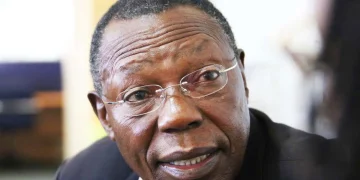
Nonini, born Hubert Mbuku Nakitare on 2 October 1982, is a Kenyan rapper, singer, and radio personality, widely celebrated as the “Godfather” of Genge music. With a career spanning over two decades, he is credited with pioneering the Genge sound, bringing urban Kenyan hip hop to mainstream audiences. He is also the founder of P-Unit, one of Kenya’s most successful rap groups.
Early Life and Education
Nonini was born in California Estate, Nairobi, and is of Luhya descent. He attended Kawethei Secondary School in Machakos County, where his passion for music developed. Growing up in Nairobi’s vibrant urban culture, he was influenced by Sheng language, everyday street life, and diverse musical styles, which later shaped his identity as one of Kenya’s most influential rappers.
Music Career
Nonini began his career at Calif Records, later moving to Homeboyz Productions. His breakout single “Nonini ni Nani?” introduced him to Kenya’s urban scene, but it was “Manzi wa Nairobi” (2002) that made him a national sensation. The track, which praised the beauty of Kenyan women, became an anthem.
He followed this with “Weh Kamu” and later released his debut album Hanyaring Game (2004), featuring the smash hit “Keroro”, a Sheng term for alcohol. These releases cemented his status as a pioneer of the Genge genre, a Kenyan style blending hip hop beats, Sheng lyrics, and local urban culture.
In 2007, he released Mwisho ya Mawazo, featuring hits like “Si Lazima” with P-Unit, a track that sparked conversations about relationships and intimacy. His third album, Godfather (2009), further solidified his influence in East African music.
Beyond music, Nonini launched Pro Habo Entertainment, a production company that birthed P-Unit, and Mgenge 2RU, a clothing line that blends fashion with his music brand.
P-Unit and Collaborations
As the founder of P-Unit (Pro-Habo Unit), Nonini worked with rappers Bonnie, Frasha, and Gabu, producing major hits like “Si Lazima” and “Kushoto Kulia”. P-Unit went on to win awards and dominate Kenyan airwaves.
He has also collaborated with Juma Nature, Nameless, Nyota Ndogo, Mercy Myra, Professor Jay, Q-Chief, Diamond Platnumz, and Ommy Dimpoz, showing his versatility across East Africa.
His track with Nameless, “Furahi-Day”, became one of Kenya’s most recognizable Friday anthems.
Recognition and Awards
Nonini’s biography is marked by numerous accolades and recognition for his contribution to Kenyan music and culture.
Major Awards Won:
- 2004 Chaguo La Teeniez Awards – Best Male Artist
- 2007 Chaguo La Teeniez Awards – Best Song (Si Lazima), Best Collaboration (Si Lazima), Best Group (P-Unit)
- 2007 Kisima Awards – Boomba Group (P-Unit)
- 2008 Chaguo La Teeniez Awards – Best Music Video (Mtoto Mzuri), Best Group (P-Unit)
- 2008 Kisima Awards – Best Collaboration (P-Unit & DNA – Una), Boomba Group (P-Unit)
- 2009 Limkokwing University, Malaysia – International Lifestyle Ambassador
- 2012 MCSK Awards – Cross Over Artiste Award, Best Hip Hop Song, Best Director (Colour Kwa Face)
Nominations:
- 2008 MTV Africa Music Awards – Listener’s Choice (Una)
- 2008 Pearl of Africa Music Awards – Best Male (Kenya)
- BEFTA Awards UK – Best International Afrobeats Act
In 2007, he was also listed among the 100 most influential Kenyans by The Standard newspaper.
Personal Life
Nonini became a father in 2012, welcoming a son. Beyond music, he is known for championing artists’ rights. In 2013, he was elected as a director representing the Audio Visual Sector at the Performance Rights Society of Kenya (PRSK), advocating for better royalty collections and fair treatment of musicians.
Discography
Albums
- Hanyaring Game (2004)
- Mwisho ya Mawazo (2007)
- Godfather (2009)
Notable Singles
- Nonini ni Nani?
- Manzi wa Nairobi
- Keroro
- Weh Kamu
- Si Lazima (with P-Unit)
- Furahi-Day (with Nameless)
- Colour Kwa Face
Legacy
Nonini remains a pioneer of Genge music and one of Kenya’s most influential rappers. Beyond his hits, he has nurtured new talent, shaped urban culture through music and fashion, and fought for artists’ rights. Known as the “Godfather of Genge”, his impact continues to influence both the music scene and the creative industry in East Africa.