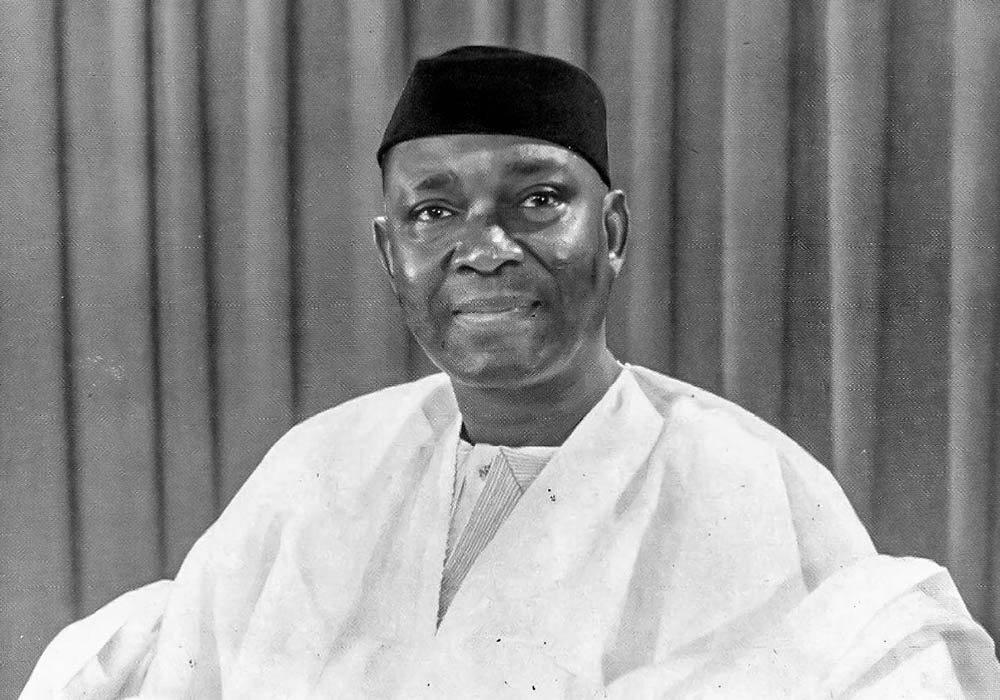
Nnamdi Benjamin Azikiwe, GCFR PC, commonly referred to as Zik of Africa, was a Nigerian politician, statesman, and revolutionary leader who served as the 3rd and first black governor-general of Nigeria from 1960 to 1963 and the first president of Nigeria during the First Nigerian Republic.
Quick Facts
| Attribute | Details |
|---|---|
| Full Name | Nnamdi Benjamin Azikiwe |
| Also Known As | Zik Azikiwe |
| Born | November 16, 1904, Zungeru, Nigeria |
| Died | May 11, 1996, Enugu (aged 91) |
| Title / Office | President of Nigeria (1963–66) |
| Political Role | Nationalist, founder of NCNC |
| Major Works | Renascent Africa (1937), My Odyssey (1970) |
Early Life and Education
Nnamdi Azikiwe, popularly known as “Zik of Africa,” was born on November 16, 1904, in Zungeru, Nigeria. He attended mission schools in Onitsha, Calabar, and Lagos before traveling to the United States in 1925.
In America, he pursued higher education at Lincoln University and the University of Pennsylvania, earning bachelor’s and master’s degrees in economics and political science. By the early 1930s, he had established himself as a skilled writer, intellectual, and outspoken advocate of Pan-African nationalism.
Journalism, Politics, and the Rise of the NCNC
Azikiwe’s career took off in the Gold Coast (now Ghana) in 1934, where he founded a nationalist newspaper and mentored Kwame Nkrumah, later the first president of Ghana. Returning to Nigeria in 1937, Azikiwe launched and edited newspapers that became powerful tools in mobilizing nationalist sentiment against colonial rule.
In 1944, he co-founded the National Council of Nigeria and the Cameroons (NCNC), which became one of the country’s most influential political movements. By the 1950s, the NCNC increasingly represented the Igbo population of southeastern Nigeria.
Elected to the Nigerian Legislative Council in 1948, Azikiwe later served as premier of the Eastern Region (1954–59), consolidating his influence as a national leader.
Presidency and Nigerian Independence
With independence on the horizon, Azikiwe led the NCNC into the pivotal 1959 federal elections. Though unable to secure the premiership, he entered into a coalition with the Northern People’s Congress, which made Abubakar Tafawa Balewa prime minister.
Azikiwe became Nigeria’s first president in 1963, following the country’s transition to a republic. His presidency was largely ceremonial, but symbolically crucial, as he embodied the aspirations of a newly independent Nigeria.
Later Career and the Biafra Conflict
During the Nigerian Civil War (1967–70), Azikiwe initially supported Biafra’s secession but later urged reconciliation, calling for peace when it became clear that victory was unattainable.
He attempted to return to power during the Second Republic, running for president in 1979 and 1983 as the candidate of the Nigerian People’s Party (NPP), though he was unsuccessful both times.
Legacy
Nnamdi Azikiwe remains a towering figure in Nigerian history. Beyond politics, he served as chancellor of the University of Nigeria at Nsukka (1961–66) and promoted sports across the country, heading football, boxing, and table tennis organizations.
His writings, including Renascent Africa (1937) and his autobiography My Odyssey (1970), continue to inspire scholars of African nationalism.
Azikiwe died in Enugu on May 11, 1996, but he endures in memory as one of the architects of African independence and unity.