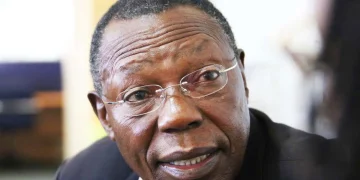
Michel Aoun, officially Michel Naim Aoun (also spelled Mīshāl ʿAwn), was born on September 30, 1935, in Ḥārat Ḥurayk, Baʿabdah district, Lebanon. He was raised in a Maronite Christian family and joined the Lebanese Military Academy in 1955, graduating as a lieutenant. Aoun later studied military science in France and the United States, enhancing his strategic and leadership skills.
During the Lebanese Civil War (1975–1990), Aoun quickly rose through the ranks. By 1976, he was commander of the artillery corps, and in 1977 he formed a brigade that included both Christians and Muslims, a rare display of unity in the war’s sectarian climate. His leadership was recognized, and in 1984 he became commander of the Lebanese Army, part of an effort to stabilize the fractured nation.
Prime Ministership and Exile
In 1988, as President Amin Gemayel’s term ended, Aoun was appointed prime minister, though the appointment was controversial. According to the Lebanese National Pact of 1943, the prime minister had to be a Sunni Muslim, making his role as a Maronite Christian contentious. This led to a divided government, with Aoun in East Beirut and Salim al-Hoss leading a rival government in West Beirut.
In 1989, Aoun’s government launched a military campaign against the Lebanese Forces, the most powerful Christian militia, and later attempted to push Syrian troops out of Lebanon. These confrontations intensified violence until the Ṭāʾif Accord of October 1989 was signed, paving the way for peace but allowing Syria to retain troops in Lebanon. Aoun rejected the deal, which led to his ouster in 1990 by Syrian-led forces. He fled to France, where he lived in exile while campaigning against Syrian influence in Lebanon.
Return and Presidency
The assassination of former prime minister Rafiq al-Hariri in 2005 triggered massive protests against Syria’s presence in Lebanon. Following Syria’s withdrawal in April 2005, Aoun returned home in May and revitalized his Free Patriotic Movement (FPM). His party quickly became the largest Christian faction in parliament after the June 2005 elections.
In a surprising political turn, Aoun allied with Hezbollah in 2006, signing a memorandum of understanding with its leader Hassan Nasrallah. This alliance placed him in the pro-Syrian March 8 bloc, despite his earlier opposition to Syrian dominance.
After years of political deadlock, progress was made in 2016 when Samir Geagea, Aoun’s former civil war rival, endorsed him for the presidency. Following a deal with the March 14 bloc, Aoun was elected as President of Lebanon on October 31, 2016, with Saad al-Hariri appointed prime minister.
Challenges in Office
During Michel Aoun’s presidency, Lebanon remained deeply divided between the March 8 and March 14 blocs. The 2018 parliamentary elections, the first in nearly a decade, were followed by nine months of political gridlock before a new cabinet was formed.
The country soon faced severe crises, including an economic collapse, rising debt, and widespread corruption allegations against politicians, including Aoun’s son-in-law Gebran Bassil, who was sanctioned by the United States in 2020.
The 2019 mass protests further weakened the government, leading to the resignation of Prime Minister Hariri. Aoun then appointed Hassan Diab to lead a new cabinet, but his government struggled amid worsening financial turmoil. In August 2020, a devastating Beirut port explosion killed over 200 people, further fueling public outrage.
Aoun’s term ended in October 2022 amid continued political paralysis, with parliament unable to elect a successor.
Key Facts at a Glance
| Year | Event | Outcome |
|---|---|---|
| 1935 | Born in Ḥārat Ḥurayk, Lebanon | Maronite Christian family |
| 1955 | Entered Lebanese Military Academy | Commissioned as lieutenant |
| 1976 | Promoted during civil war | Commander of artillery corps |
| 1984 | Appointed Commander of Lebanese Army | Key role in reconciliation efforts |
| 1988 | Appointed Prime Minister | Legitimacy contested under National Pact |
| 1990 | Ousted by Syrian-led forces | Fled to France in exile |
| 2005 | Returned after Syrian withdrawal | Rebuilt Free Patriotic Movement |
| 2006 | Formed alliance with Hezbollah | Joined March 8 bloc |
| 2016–2022 | Served as President of Lebanon | Faced political and economic crises |