


In the late 1950s, as Kenya’s independence movement gained momentum, British intelligence grew increasingly concerned about the rise of a young, charismatic, and ideologically savvy politician: Tom Mboya.
A recently surfaced declassified MI5 document reveals that Mboya was being closely watched by British intelligence, not just for his political activism—but also for his romantic relationships, friendships, and racial associations. The surveillance tactics and motives draw striking parallels to the FBI’s controversial targeting of Martin Luther King Jr. during the American civil rights movement.
A Rising Star Under the Spyglass
Tom Mboya was one of Kenya’s most prominent independence-era figures.
A Labour unionist, Pan-Africanist, and internationalist, he had strong ties to both British trade unions and American civil rights circles.
This made him a man of interest to MI5, which feared that his rising popularity, multi-racial relationships, and growing global profile could threaten British control over Kenya’s political transition.
What the MI5 Files Reveal
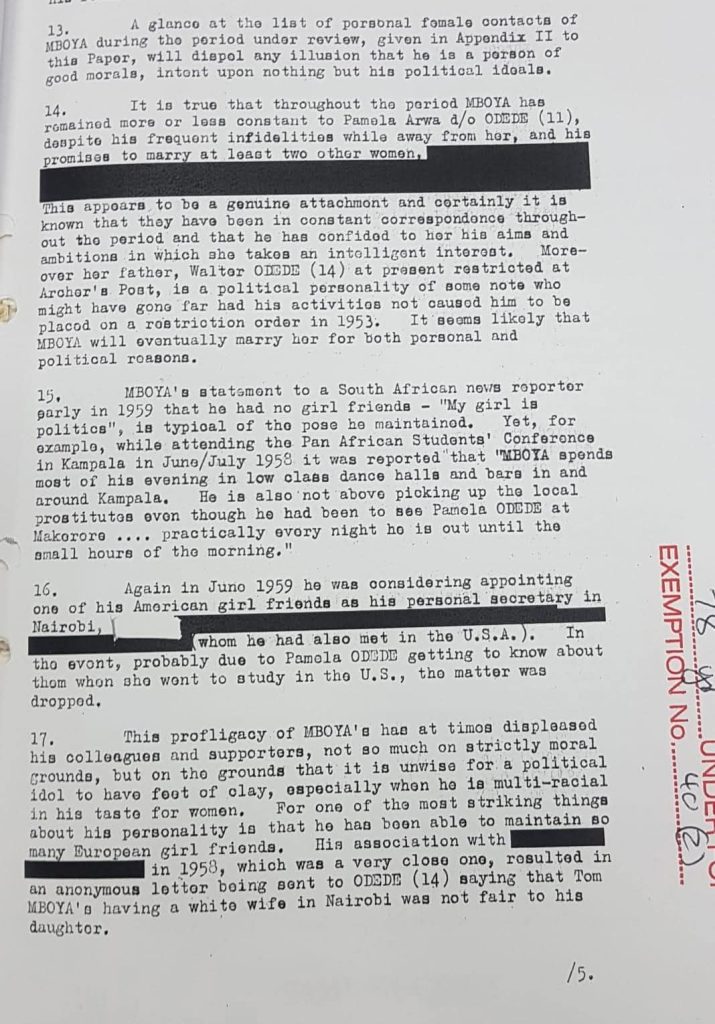
The document reveals detailed observations of Mboya’s private life, including:
1. Romantic Attachments and “Moral Character”
- Mboya was reportedly in a long-standing relationship with Pamela Arwa Odede, daughter of Walter Odede.
- Despite this, the file states he was “frequently unfaithful” and had promised marriage to at least two other women.
- MI5 noted he had considered appointing an American girlfriend as his personal secretary in Nairobi, but the plan was dropped when Pamela Odede found out.
“A glance at the list of personal female contacts… will dispel any illusion that he is a person of good morals, intent upon nothing but his political ideals.”
2. “Profligacy” and Racial Sensitivities
The report criticized Mboya’s “multi-racial taste for women”, claiming that while it wasn’t necessarily immoral, it was politically risky for someone with his status.
“One of the most striking things about his personality is that he has been able to maintain so many European girl friends.”
One anonymous letter was reportedly sent to Pamela Odede’s father in 1953, complaining that Mboya’s white girlfriend in Nairobi was “unfair” to his daughter.
3. Social Habits in Kampala and Beyond
MI5 monitored Mboya’s activities during the Pan-African Students’ Conference in Uganda (1958), reporting that he spent evenings in bars and dance halls, often out until “the small hours of the morning.”
This echoed tactics used by the FBI under J. Edgar Hoover, who sought to discredit Martin Luther King Jr. by tracking his private movements and leaking information about his personal life.
Why Was MI5 So Concerned About Mboya?
Mboya’s profile was international and progressive:
- He worked with John F. Kennedy to organize the “Airlift Africa” education program, sending East African students to American universities.
- He was a master orator, able to mobilize workers and inspire youth.
- He commanded cross-ethnic support and had access to foreign funding and press coverage.
To colonial intelligence, this made him dangerous—not for criminal reasons, but because he symbolized modern African leadership that could no longer be manipulated.
Parallels with Martin Luther King Jr.
Just as the FBI feared MLK’s influence among Black Americans, MI5 feared Mboya’s pan-Africanism, charisma, and anti-colonial ideology. In both cases, intelligence agencies sought to undermine reputations, track personal movements, and exploit private relationships to dilute public trust.
Conclusion: Surveillance as a Tool of Colonial Control
The MI5 surveillance on Tom Mboya reveals how deeply colonial governments relied on psychological profiling and personal invasion to manage their “subjects.”
That Mboya was surveilled for his relationships, nightlife, and race-blending lifestyle shows the extent to which colonialism viewed African autonomy and interracial alliance as a threat.
Like MLK, Mboya was ultimately assassinated—though not by a state agency, his death in 1969 removed a powerful voice for unity, modernization, and reform in post-independence Kenya.




