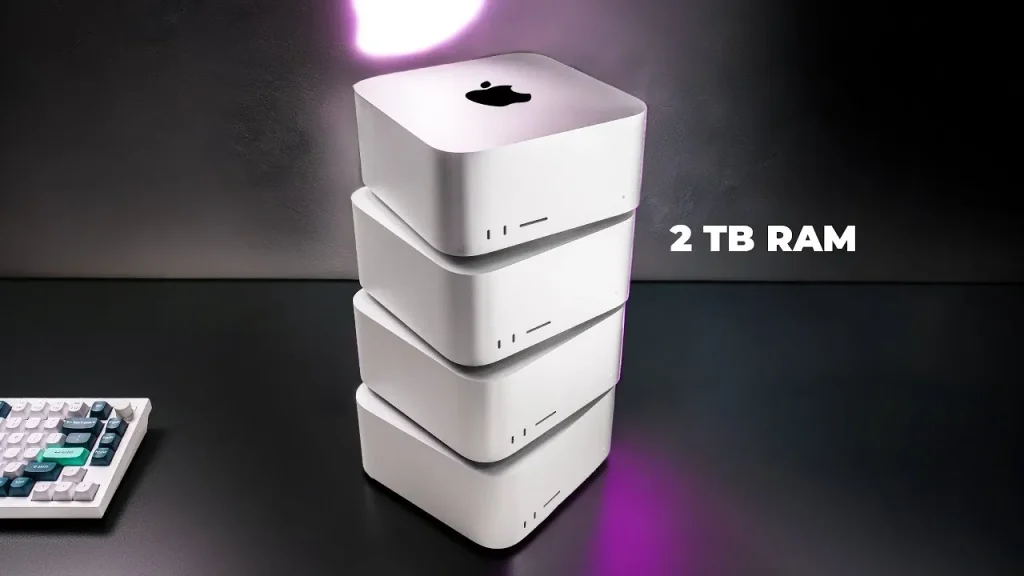
Apple’s M4 Pro Macs, combined with the macOS 26.2 update, are reshaping the way artificial intelligence workflows operate on local hardware. By integrating RDMA over Thunderbolt 5 and Exo 1.0, Apple has significantly boosted the AI performance of its Mac Studios and Mac Minis, making powerful, trillion-parameter models accessible without relying on costly cloud infrastructure. In this article, we’ll dive into the cutting-edge technologies behind this leap forward and explore how they enhance scalability, accessibility, and performance for developers, researchers, and AI enthusiasts alike.
Apple’s AI Clustering Breakthrough: A New Era for Local AI
Apple has introduced a revolutionary approach to running AI workloads locally with its AI Clustering Breakthrough. By combining the power of Exo 1.0, the MLX Distributed Framework, and RDMA over Thunderbolt 5, Apple’s ecosystem now supports large-scale machine learning tasks directly on Apple Silicon devices, such as the M4 Pro Mac Studio and Mac Mini.
With these innovations, developers can now cluster multiple Apple devices to process AI models that were previously only feasible in cloud environments. This eliminates reliance on expensive cloud computing resources and gives AI developers the ability to run and scale their models locally, with impressive speed and efficiency.
Exo 1.0: Simplifying AI Clustering for Developers
Exo 1.0, Apple’s new AI clustering solution, is at the heart of this update, enabling users to set up and manage AI clusters with minimal effort. The custom installer and intuitive interface make it easy for both novice and expert developers to launch distributed machine learning workflows.
Key features of Exo 1.0 include:
- Tensor Parallelism: This method divides large AI models into smaller segments, allowing simultaneous processing across multiple devices. This approach improves model sharding, ensuring complex models run efficiently without bottlenecks.
- Real-Time Performance Monitoring: Developers can track the performance of their clusters in real time via Exo’s dashboard, providing clear insights into model execution.
With these advancements, Exo 1.0 simplifies the process of running large-scale AI tasks, making it an essential tool for anyone working with machine learning models.
RDMA over Thunderbolt 5: Lightning-Fast Data Transfers
The integration of Remote Direct Memory Access (RDMA) over Thunderbolt 5 offers another major performance improvement for Apple Silicon devices. RDMA enables communication between devices at speeds up to 10x faster than traditional methods, reducing latency and eliminating bottlenecks that typically occur during multi-machine AI tasks.
For AI clustering, this means that massive data transfers between devices are no longer a limitation. RDMA ensures that large AI workloads can be executed quickly, even across multiple Mac Studios or Mac Minis. Whether you’re training massive models or processing real-time data, this technology provides the necessary bandwidth to keep your AI tasks running smoothly.
MLX Distributed Framework: Optimizing AI Performance on Apple Silicon
The MLX Distributed Framework is another powerful addition to Apple’s AI ecosystem. It’s designed to maximize the performance of AI models on Apple Silicon devices, including the M4 Pro Macs.
MLX enhances both model training and inference by supporting:
- Dense Models: These high-accuracy models are now more efficient, allowing tasks that require precision to be processed with greater speed.
- Quantized Models: By reducing computational demands, quantized models are ideal for environments with resource constraints, making them suitable for edge computing and smaller devices.
The MLX framework, paired with RDMA and Exo 1.0, creates an optimized AI environment, ensuring that Apple’s hardware can handle AI workloads with unparalleled efficiency.
macOS 26.2: Unified Memory and RDMA Integration for Seamless AI Workflows
The release of macOS 26.2 enhances Apple Silicon’s already powerful capabilities by introducing native support for RDMA, creating a cohesive connection between hardware and software. One standout feature is unified memory, which allows memory to be shared seamlessly across clusters of devices. This integration ensures that larger models can be run efficiently on machines like the M4 Mac Mini, offering cost-effective local AI workflows without the need for cloud computing.
By leveraging macOS 26.2’s unified memory and RDMA support, Apple’s ecosystem provides a powerful and scalable AI platform that rivals traditional cloud-based solutions, offering AI development on your desk with impressive performance.
Real-World Applications: AI Development on Apple Silicon
The combination of Exo 1.0, RDMA, and MLX opens up a range of exciting possibilities for AI developers. Large language models (LLMs) used for natural language processing, chatbots, and content generation systems can now be run locally on Apple devices, significantly reducing cloud infrastructure costs and improving data privacy by keeping sensitive information on-premises.
For researchers and businesses, this breakthrough allows for more control over AI projects while achieving high-performance results without incurring the ongoing costs of cloud computing. Whether you’re experimenting with new models or fine-tuning existing ones, the power of Apple’s ecosystem makes it easier to push the boundaries of AI development.
Performance and Scalability: Unmatched Efficiency
Apple’s innovations in tensor parallelism, RDMA, and unified memory contribute to substantial performance improvements for AI workflows. One of the key metrics that has seen enhancement is the token generation rate, which measures the efficiency of large-scale AI models. Thanks to these technologies, M4 Pro Macs can handle demanding AI workloads with faster processing times and greater accuracy.
By allowing you to scale AI tasks across multiple nodes seamlessly, Apple has created a platform where AI models with trillions of parameters can be processed efficiently, without relying on cloud infrastructure.
Conclusion: Apple’s Breakthrough in AI
Apple’s M4 Pro Macs and macOS 26.2 update represent a significant shift in the capabilities of local AI development. By integrating RDMA over Thunderbolt 5, Exo 1.0, and MLX, Apple has enabled developers to run large-scale AI models on their own hardware with remarkable speed and efficiency. These innovations provide a cost-effective, scalable, and high-performance solution for AI workflows, making advanced AI accessible to more people than ever before.
As AI development continues to evolve, Apple’s ecosystem stands at the forefront, offering developers the tools they need to create cutting-edge applications and redefine the future of artificial intelligence.