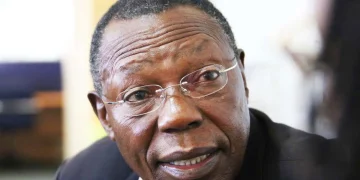
In addition to working briefly as a secretary in the two years between 1945, when he graduated from Alliance High School, and 1948, when he enrolled at Fort Hare University in South Africa, John Njoroge Mungai drove a country bus that transported people from Limuru to Nairobi.
“I got my Public Service Vehicle (PSV) licence in 1946, a copy of which I still keep,” the latter Defense Minister reminisces. I used to go through Kikuyu to operate a 60-seater Chevrolet bus between Limuru and Nairobi. I had a brief employment with British Overseas Airways Corporation before that.
On January 7, 1926, Mungai was born in Gichungo village, which is near the borders of Nairobi and Kiambu. His parents, George Njoroge Singeni ole Mbachucha and Leah Gathoni wa Kungu wa Magana, were pioneer Christians. His mother was from Gatundu, while his father was from Narok. The politics of the oppressor and the oppressed were acted out in his neighborhood even before Mungai was born, and his family home served as a political birthing ground. The house was home to both “the servant of the colonial oppressors,” such as Paramount Chief Kinyanjui wa Gathirimu, and those who championed African rights and ideals, such as Waiyaki wa Hinga. It was intriguing to be in the middle of the two opposing factions. Politics centered on land, education, and religion dominated the day, according to him.
He remembers hearing stories of the attempts made by John William Arthur, the colonial moderator of the Church of Scotland in Kikuyu, to compel the natives to give up their traditions and culture and adopt his own.
Naturally, some people opposed it because they could not understand how Christianity, education, contemporary life, and their traditions and culture conflicted, according to Mungai. “The locals and churchgoers split apart as a result of Arthur’s approach, even though some customs may not have been appropriate.”
Under the leadership of Gatungu Gathuna, a split faction broke religious unity to establish autonomous schools known as Gikuyu Karing’a.
Remembers Mungai: “This educational system later served as a breeding ground for individuals who fight for freedom.” Remembering that the people who left the Church of Scotland turned became agitators for independence and self-determination, as well as for the land that the colonists had taken away, Mungai says.
Mungai’s decision to become a doctor later in life may have been influenced, among other things, by the fact that he was born in a hospital during a period when African women were more likely to give birth at home than in a hospital. “My mother was among the first women to go to school and learn how to read and write,” he says, explaining the novelty. My birth documents were kept at the Church of Torch, Kikuyu, where she and my father belonged. Dr. John William Arthur was my birth attendant, according to the Church’s still-completed papers.
His parents were staunch Christians and Mungai was baptised the same year he was born and at the Church of Torch.