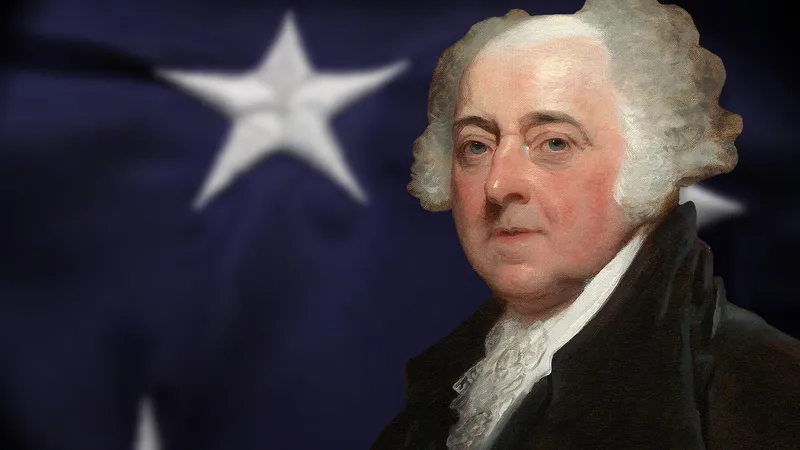
John Adams, born on October 30, 1735 (October 19, Old Style) in Braintree, Massachusetts, was the eldest son of Deacon John Adams and Susanna Boylston. Though raised in modest circumstances, his family descended from early Puritan settlers, instilling in him discipline, education, and civic duty.
Adams entered Harvard College, graduating in 1755. Initially preparing for the ministry, he shifted to law after teaching for three years. By 1758, he established a law practice near Boston, rising quickly in prominence.
In 1764, Adams married Abigail Smith, who became not only his partner in family life but also his closest political confidante. Their extensive correspondence remains one of the most intimate records of Revolutionary-era thought and personal resilience. Together, they raised four surviving children, including John Quincy Adams, who would later become the sixth president of the United States.
Revolutionary Leadership
Adams gained early recognition as a defender of colonial rights. His essay “A Dissertation on the Canon and Feudal Law” (1765) articulated resistance to the Stamp Act, framing it as a struggle against tyranny.
In 1770, he displayed principled independence by defending British soldiers charged in the Boston Massacre, insisting on fair trial rights despite public anger.
By the 1770s, Adams was a prominent member of the Continental Congress (1774–77). He nominated George Washington to command the Continental Army, helped select Thomas Jefferson to draft the Declaration of Independence, and pressed delegates toward a decisive break from Britain. His own Thoughts on Government (1776) became a guide for drafting state constitutions.
Known as the “Atlas of Independence,” Adams shaped policy and diplomacy, securing crucial support from France and later helping negotiate the Treaty of Paris (1783), which ended the Revolutionary War.
Diplomatic Service and Political Philosophy
Adams spent much of the 1780s in Europe, serving as the first U.S. ambassador to Britain (1785–88). His confrontational style clashed with European court politics, but his writings—including A Defence of the Constitutions of Government of the United States of America (1787)—influenced American constitutional thought, emphasizing checks and balances and the inevitability of social elites.
A political realist, Adams warned against utopian revolutions and predicted that unchecked radicalism, as seen in the French Revolution, would lead to dictatorship. His skepticism toward ideology and insistence on pragmatic governance foreshadowed debates central to U.S. political development.
First Vice President of the United States
In 1789, Adams became the nation’s first vice president under George Washington, after placing second in the Electoral College. Though he described the office as “the most insignificant ever contrived,” he cast 31–38 tie-breaking Senate votes, shaping early legislative outcomes.
He supported Washington’s administration, backing Alexander Hamilton’s financial plan, the Neutrality Proclamation (1793), and suppression of the Whiskey Rebellion (1794). His loyalty to constitutional order set the stage for his own presidency.
Presidency (1797–1801)
Adams was elected second president of the United States in 1796, narrowly defeating Thomas Jefferson. His term was dominated by international and domestic crises:
- Quasi-War with France (1798–1800): Adams avoided full-scale war by sending envoys to Paris, defying hawkish Federalists. His diplomacy preserved peace but cost him political capital.
- Alien and Sedition Acts (1798): Laws expanding deportation powers and curbing dissent tarnished his presidency, fueling charges of authoritarianism and eroding support.
- Midnight Appointments (1801): In his final days, Adams filled judicial posts with Federalists, including John Marshall as Chief Justice, shaping U.S. constitutional law for decades.
The Election of 1800, often called the “Revolution of 1800,” ended in defeat to Jefferson. Adams became the first president to reside in the White House and the first to leave office peacefully after losing reelection, establishing a precedent for democratic transition.
Retirement and Correspondence with Jefferson
Retiring to Peacefield in Quincy, Adams expected a quiet life but remained intellectually engaged. His vast correspondence included a famous exchange with Thomas Jefferson, rekindled in 1812. Their 158 letters, covering philosophy, politics, and the Revolution, stand as one of history’s greatest intellectual dialogues.
Adams lived to see his son, John Quincy Adams, elected president in 1824. On July 4, 1826, exactly 50 years after the Declaration of Independence, Adams died at age 90, hours after Jefferson, symbolizing the intertwined destinies of two Founding Fathers.
Legacy
John Adams’s legacy rests on his role as a founder, diplomat, and statesman. Though criticized in his time for stubbornness and unpopularity, later generations recognized his honesty, foresight, and commitment to principle. His defense of the rule of law, advocacy of independence, and peaceful transfer of power in 1801 remain cornerstones of American democracy.
Honored posthumously with induction into the Hall of Fame for Great Americans (1900), Adams is remembered as the architect of independence, the guardian of republican government, and a patriarch of one of America’s most prominent families.