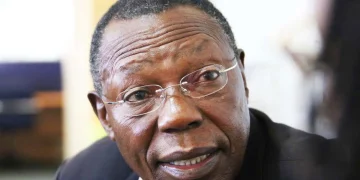
Jean-Marie Seroney emerged as one of Kenya’s most outspoken political figures during the post-independence period, combining legal expertise, trade union activism, and parliamentary leadership to advocate for human rights and government accountability. Born in 1927 in Kapsabet, present-day Nandi County, Seroney’s career reflected both the promise and tensions of Kenya’s early years as an independent state.
His legacy is closely associated with his resistance to state authority, which ultimately led to his detention without trial and his recognition as one of Kenya’s longest-serving prisoners of conscience.
Jean-Marie Seroney Early Life and Education
Seroney was born as Eric Seroney to Reuben and Leah Seroney, a family rooted in the Inland Church. His father, a preacher and teacher, played a role in translating the Bible into the Kalenjin language, reflecting a strong educational and religious background.
He began his education in 1935 before joining Kapsabet Government School in 1938. During this period, he studied alongside Daniel arap Moi and was taught by Argwings Kodhek, both of whom would later become significant figures in Kenya’s political landscape.
Seroney later joined Alliance High School from 1941 to 1945, where he received formal secondary education that prepared him for higher studies.
Jean-Marie Seroney Global Exposure and Academic Development
In 1945, Seroney proceeded to Makerere College, where he interacted with emerging African leaders such as Julius Nyerere and Edward Mutesa II. His time at Makerere marked the beginning of his engagement with political thought and activism.
He became active in student life, serving as president of the drama club and founding a political society. During this period, he also converted to Catholicism, changing his name from Eric to Jean-Marie Seroney.
Seeking further education, Seroney secured admission to the University of Allahabad in India, where he studied during a period marked by the country’s independence and partition.
While in India, he was influenced by leaders such as Jawaharlal Nehru, whose emphasis on democracy and equality shaped Seroney’s political philosophy.
He graduated in 1949, becoming the first Nandi to earn a university degree. He later pursued law, further strengthening his capacity for advocacy.
Jean-Marie Seroney and Early Political Activism
Seroney’s activism began during his time abroad. In 1950, he published an article titled “Threat of South African Fascism to East Africa,” in which he warned against the spread of apartheid-style policies.
Upon returning to Kenya, he joined Jomo Kenyatta in campaigning for independence across the Rift Valley in 1951.
He later traveled to the United Kingdom to further his legal studies and addressed international forums on colonialism, including a Moral Re-Armament conference in Switzerland.
These experiences exposed him to global political ideologies and strengthened his commitment to human rights.
Jean-Marie Seroney Trade Union and Legal Career
In 1956, Seroney joined the Law Society of Kenya and became active in trade unionism. He was elected secretary of the Kenyan African Civil Servants Association, a role that placed him within a broader network of nationalist leaders.
Trade unions at the time served as platforms for political engagement during the State of Emergency, and Seroney used this space to advocate for workers’ rights and social justice.
His legal background allowed him to challenge discriminatory policies and highlight inequalities in social services.
Jean-Marie Seroney Political Career and Parliamentary Role
Seroney entered formal politics in 1961 when he was elected to the Legislative Council under the Kenya African Democratic Union (KADU).
He participated in the Lancaster House Conference in 1962, contributing to discussions that shaped Kenya’s independence framework.
Later, he joined the Kenya African National Union (KANU), despite opposition from Daniel arap Moi, and retained his parliamentary seat.
During his time in parliament, Seroney became known for his outspoken views. He challenged government policies on land allocation in the Rift Valley, arguing that they were unfair to local communities.
His advocacy was reflected in the “Nandi Declaration,” which addressed land rights and historical injustices.
Jean-Marie Seroney and Opposition to State Policies
Seroney’s criticism extended to broader political issues. He opposed the banning of opposition parties, warning against the emergence of a one-party system.
He also called for the release of political prisoners and emphasized the importance of freedom of expression.
His positions placed him at odds with the government, particularly during the administration of Jomo Kenyatta.
In 1975, Seroney was elected Deputy Speaker of Parliament, a position that further increased his visibility.
Jean-Marie Seroney Detention and Imprisonment
Seroney’s confrontation with state authority reached a turning point in October 1975, when he was detained without trial after supporting statements critical of the ruling party.
He became one of Kenya’s longest-serving prisoners of conscience, held in detention until after the death of Kenyatta.
His detention had significant personal and political consequences. It affected his career and economic stability, limiting his ability to participate fully in public life after his release.
Jean-Marie Seroney Later Life and Death
After his release, Seroney struggled to regain his previous influence. His political career declined, and he faced personal challenges.
He died in 1982 at MP Shah Hospital in Nairobi at the age of 55.
Jean-Marie Seroney Legacy
Seroney is remembered as a principled leader who consistently advocated for human rights and accountability. His willingness to challenge authority, even at personal cost, remains a defining aspect of his legacy.
Outlook on Kenya’s Democratic Development
The life of Jean-Marie Seroney highlights the tensions between governance and dissent in post-independence Kenya. His experiences underscore the importance of protecting civil liberties and maintaining institutional accountability.
His legacy continues to inform discussions on democracy, human rights, and political leadership in Kenya.