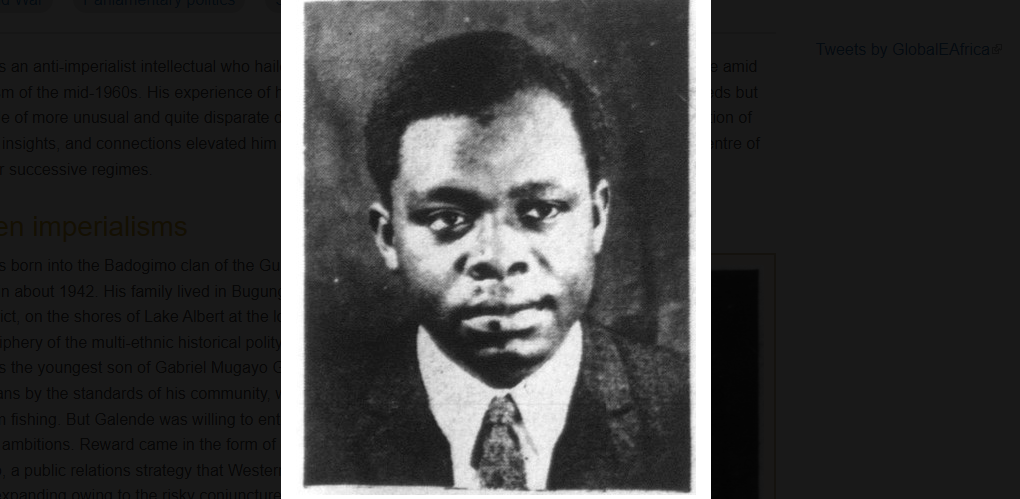
Joseph Robert Bikobbo Mugayo emerged as a prominent Ugandan intellectual and political advisor during the turbulent post-independence period, navigating ideological shifts and power transitions under successive regimes. Born around 1942 in Bugungu near Lake Albert, in present-day Buliisa District, Bikobbo’s career reflected the intersection of education, anti-imperialist thought, and state influence during the Cold War era.
His rise from a rural background to the inner circles of government illustrates how education and global exposure shaped a generation of African leaders operating within complex international and domestic political environments.
Bikobbo Mugayo Early Life and Education
Bikobbo was born into the Badogimo clan of the Gungu ethnic community. His family lived in a fishing region along Lake Albert, where economic opportunities were tied to natural resources.
Despite modest means, his father, Gabriel Mugayo Galende, supported his educational ambitions. Bikobbo’s schooling was partly facilitated by corporate sponsorship from Shell Company, reflecting broader Cold War-era strategies where multinational firms invested in African education.
He attended secondary school in Masindi in the early 1960s, during Uganda’s transition to independence.
This period was marked by political tensions within the Uganda People’s Congress (UPC), as ideological divisions emerged between radical and moderate factions.
Bikobbo Mugayo Radicalisation and University of Leeds
Bikobbo’s intellectual development deepened during his studies at the University of Leeds in the mid-1960s. The university environment exposed him to global debates on imperialism, war, and political ideology.
At the time, student movements in Britain were increasingly critical of Western foreign policy, particularly the United States’ involvement in the Vietnam War.
Bikobbo became part of this intellectual climate, developing anti-imperialist views that would later define his political outlook.
In 1968, he graduated with a first-class honours degree. Around the same time, he wrote to the editor of Newsweek, criticizing U.S. foreign policy as hypocritical, reflecting his growing engagement in global political discourse.
Bikobbo Mugayo Yugoslavia and Non-Aligned Influence
Later in 1968, Bikobbo enrolled at the University of Zagreb in Yugoslavia, where he studied Political Science and Administration.
Yugoslavia, under Josip Broz Tito, was a leading force in the Non-Aligned Movement, promoting independence from both Western and Soviet blocs.
This environment reinforced Bikobbo’s anti-imperialist stance while exposing him to alternative political and economic models, including market socialism.
However, his time in Zagreb was not without challenges. African students faced language barriers and instances of discrimination, while the region itself experienced rising nationalist tensions.
Despite these difficulties, Bikobbo’s experience in Yugoslavia broadened his understanding of global politics.
Bikobbo Mugayo Entry into Government Service
Bikobbo returned to Uganda in 1969 and joined the Ministry of Information, Broadcasting and Tourism. His role was short-lived, as he was soon sent to Sweden for further training under programs organized by the United Nations Economic Commission for Africa.
His academic credentials and international exposure brought him to the attention of senior government officials.
By 1970, he had joined the Research Secretariat in the Office of the President under Milton Obote.
The Secretariat functioned as an internal policy unit, providing analysis and strategic advice to the government.
Bikobbo Mugayo Role in the Research Secretariat
The Research Secretariat served as a think tank within the presidency, tasked with shaping policy and promoting ideological frameworks.
Bikobbo contributed to the dissemination of the “Common Man’s Charter,” a policy document that outlined Uganda’s move toward socialist-oriented governance.
He delivered lectures at schools and institutions, explaining the principles of the Charter and advocating for its implementation.
However, the Secretariat’s proximity to the General Service Department (GSD), Uganda’s intelligence agency, created risks for its members.
When a military coup led by Idi Amin overthrew Obote in 1971, individuals associated with the previous regime became vulnerable.
Bikobbo Mugayo Academic Pursuits in the United States
Around the time of the coup, Bikobbo secured a scholarship to study for a master’s degree in political science at Vanderbilt University in the United States.
During his studies, he focused on issues such as tribalism, leadership, and political development in Africa.
His academic work reflected a continued interest in governance and ideology, even as Uganda experienced political upheaval.
Bikobbo Mugayo Return Under Amin Regime
In 1972, Bikobbo returned to Uganda and took up a position in the Office of the President under the Amin regime.
His role during this period remains debated. In correspondence with academic contacts, he suggested that he attempted to influence policy and moderate shifts in foreign alliances.
However, other accounts indicate that his position placed him within the inner workings of the regime.
His foreign connections made him vulnerable during a period marked by suspicion and political violence.
He reportedly fled to Nairobi in 1973 after facing threats and personal loss, including the death of his son.
Bikobbo Mugayo Re-entry into Government and Final Years
Despite earlier challenges, Bikobbo returned to Uganda and resumed his role within the presidential administration, eventually serving as Principal Assistant Secretary.
His ability to navigate changing political environments reflected both his skills and the complexities of governance during the period.
In 1976, his career came to an abrupt end.
On 13 January 1976, Bikobbo died in a military helicopter crash in Mbale during a state visit by Mobutu Sese Seko.
He was 33 years old at the time of his death.
Bikobbo Mugayo Legacy
Bikobbo’s life represents the trajectory of a generation shaped by decolonisation, Cold War politics, and intellectual activism.
He is remembered as an anti-imperialist thinker who engaged with global and local political debates.
Outlook on Uganda’s Political History
The story of Bikobbo Mugayo highlights the risks faced by intellectuals operating close to political power in post-independence Africa.
His career reflects the broader challenges of navigating ideological commitments and state authority during periods of instability.
His legacy continues to inform discussions on governance, intellectual engagement, and political responsibility in Uganda.