


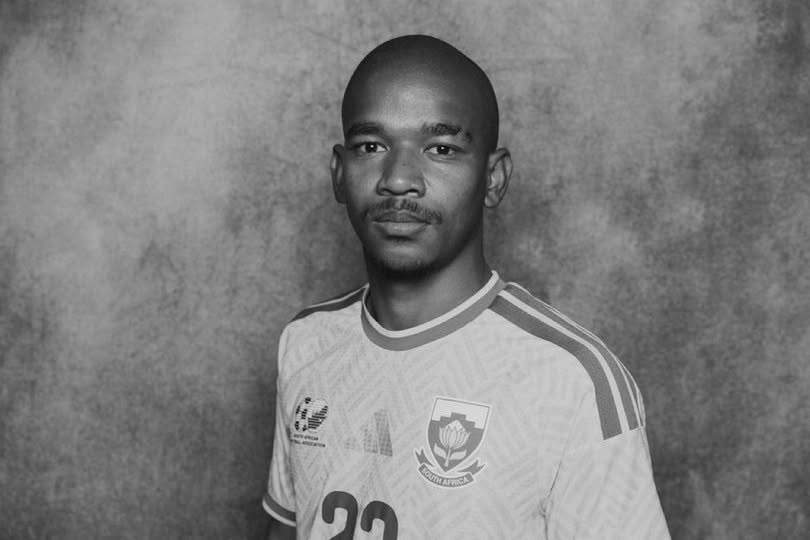
Jayden Adams, the Mamelodi Sundowns and South Africa midfielder who represented Bafana Bafana at the 2026 FIFA World Cup, has died at the age of 25.
The South African Football Players Union confirmed Adams’ death on Saturday, July 11, 2026, describing his passing as an immense loss to his family, clubs and the country. His death came only weeks after he appeared for South Africa during a historic World Cup campaign in North America.
No official cause of death had been publicly confirmed at the time of publication. Out of respect for Adams and his family, unverified claims circulating online should not be treated as fact.
Adams had featured in all three of South Africa’s group matches at the World Cup. He started against co-hosts Mexico and the Czech Republic before appearing as a substitute during the decisive match against South Korea. Reuters photographs documented him in action during the South Korea encounter on June 24.
The tournament carried a heavy personal burden for the midfielder. The South African Football Association confirmed that his grandmother, Marianna Adams, died shortly before South Africa’s match against the Czech Republic. Adams nevertheless remained with the squad and played in the fixture while mourning the family loss.
South Africa later advanced from the group stage during a campaign that restored national pride and returned Bafana Bafana to the World Cup knockout rounds. Adams’ participation meant that some of his final public appearances came while wearing the national colours on football’s largest stage.
His death has brought a sudden and painful end to the career of a midfielder who had progressed from Stellenbosch’s academy to South African champions Mamelodi Sundowns and the national team.
Jayden Adams’ Death Confirmed After World Cup Campaign
The South African Football Players Union announced Adams’ passing on July 11, prompting tributes across the domestic and international football community.
The union recognised the midfielder’s contribution to South African football and extended its sympathies to his family, teammates and former clubs. Reports said the family also requested privacy as relatives processed the loss.
Adams had turned 25 on May 5, little more than two months before his death.
The timing intensified the shock surrounding the announcement. Only weeks earlier, supporters had watched him compete against some of the world’s leading players at the World Cup.
He had also entered what should have been an important period in his club career with Sundowns.
Following the tournament, he was reportedly granted extended leave and was expected to return to club preparations ahead of the new season. Those plans were overtaken by the announcement of his death.
At the time of publication, neither the players’ union nor his family had publicly stated what caused his passing.
Responsible coverage must preserve that distinction. Confirmation that a person has died is not confirmation of how the death occurred.
Who Was Jayden Adams?
Jayden Oswin Adams was born in Cape Town on May 5, 2001.
He developed through the Stellenbosch FC youth system before becoming one of the club’s most prominent academy graduates.
Stellenbosch promoted him to the senior team in 2020, and he made his professional debut that year. He gradually became an important midfielder for the Western Cape club, contributing through his movement, passing and ability to operate in more than one midfield role.
His development coincided with Stellenbosch’s rise as a competitive force in South African football.
The club built a reputation for identifying and developing young talent rather than relying exclusively on established stars. Adams became one of the strongest examples of that model.
He helped Stellenbosch win the Carling Knockout in 2023, a landmark trophy for the club and an important moment in his early career.
His performances eventually attracted interest from Mamelodi Sundowns, the dominant force in South African domestic football.
From Stellenbosch Academy to the Professional Game
Adams’ journey began within Stellenbosch’s development structure.
Breaking into professional football from an academy is never guaranteed. Young players compete against teammates of similar ability while also attempting to earn the confidence of senior coaches.
Adams progressed successfully through that process.
He became the first Stellenbosch academy graduate to sign a professional contract with the club, according to published career records. His promotion represented both a personal achievement and evidence that Stellenbosch’s youth programme could produce players ready for top-flight competition.
His early appearances allowed him to adjust to the physical and tactical demands of South Africa’s premier division.
Rather than being treated only as a promising youngster, he gradually earned regular playing time.
He developed into a midfielder capable of carrying the ball, supporting attacks and contributing defensively. His versatility also allowed him to operate in wider areas when required.
That range became increasingly valuable as Stellenbosch competed in domestic cup competitions and sought higher league finishes.
Adams Helped Stellenbosch Win a Major Trophy
One of the defining achievements of Adams’ Stellenbosch career came in the 2023 Carling Knockout.
The title gave the club its first major top-flight trophy and strengthened its reputation as one of South African football’s most ambitious emerging teams.
For Adams, the success demonstrated that he could contribute within a side capable of managing high-pressure knockout matches.
Winning a cup also increased attention around Stellenbosch’s leading players.
Larger clubs routinely monitor successful teams for footballers who can strengthen title-challenging squads.
Adams’ performances and continued development eventually positioned him for a move to Sundowns.
Mamelodi Sundowns Signed Adams in 2025
Adams joined Mamelodi Sundowns from Stellenbosch in January 2025.
The transfer represented a major step in his career.
Sundowns compete under intense domestic expectations and regularly pursue continental honours. New signings must adapt to competition for places within a deep squad containing many established South African internationals.
Adams moved from being a central figure at Stellenbosch to entering a club where every position carried significant competition.
His selection showed that Sundowns regarded him as a player capable of contributing at a higher level.
The move also gave him access to CAF competition, title races and a demanding schedule involving domestic and international fixtures.
He wore the No. 8 shirt and was increasingly viewed as part of the club’s midfield future.
A Rising Career at South Africa’s Leading Club
Joining Sundowns can transform a South African player’s career.
The club offers opportunities to compete for league titles, national cups and the CAF Champions League. It also carries pressure because anything short of winning can be treated as disappointment.
Adams had to demonstrate tactical discipline while adapting to a squad built around possession, technical quality and positional flexibility.
His ability to function in different midfield roles made him useful across competitions.
He scored domestic goals and continued developing his national-team prospects after the transfer.
The move appeared to place him on a path toward becoming an established figure for both Sundowns and South Africa.
His death ended that progression before its full potential could be measured.
Jayden Adams’ South Africa Career
Adams made his senior international debut for South Africa in 2022.
He later formed part of the Bafana Bafana squad that finished third at the 2023 Africa Cup of Nations, held in early 2024.
That tournament helped restore belief in the national team after years of inconsistent results.
South Africa defeated DR Congo in the third-place match and returned home with a bronze medal, giving a new generation of players valuable experience in international knockout football.
Adams’ international career was not entirely uninterrupted.
He was omitted from the national setup for a period before working his way back into coach Hugo Broos’ plans.
His return showed that international careers can recover after setbacks when players respond through club performances and improved discipline.
He later scored important goals during the qualifying period and earned selection in South Africa’s final 2026 World Cup squad. Reuters included him among the midfielders in Bafana Bafana’s 26-player tournament group.
A Difficult Route Back Into Bafana Bafana
Adams’ route to the 2026 World Cup was not completely straightforward.
He had previously fallen out of national-team consideration following concerns raised by the coaching staff.
Instead of allowing that setback to define his international future, he produced performances strong enough to regain selection.
That recovery added significance to his World Cup appearance.
He was not a player whose place had remained secure throughout the qualifying cycle. He had to rebuild trust and demonstrate that he could contribute to the squad.
His inclusion also reflected the strength of his club form and his ability to offer midfield depth.
For a 25-year-old player, the tournament should have marked the beginning of a longer period in the national team.
Jayden Adams at the 2026 FIFA World Cup
Adams appeared in each of South Africa’s three group-stage fixtures during the 2026 World Cup.
Bafana Bafana were drawn alongside Mexico, the Czech Republic and South Korea in Group A.
The group presented contrasting challenges.
Mexico carried home support as one of the tournament’s co-hosts.
The Czech Republic offered a disciplined European test.
South Korea brought speed, experience and a team led by internationally established players.
Adams started South Africa’s opening match against Mexico and retained his place for the encounter with the Czech Republic.
He then came off the bench against South Korea in Monterrey, where Reuters documented him in action.
Those appearances took his career onto a global stage far beyond domestic and continental football.
Starting Against Co-Hosts Mexico
South Africa opened its campaign against Mexico in Mexico City on June 11.
The fixture carried historical significance because the countries had also contested the opening match of the 2010 World Cup in Johannesburg.
For Adams, starting the 2026 opener represented one of the biggest assignments of his career.
A World Cup opening match requires players to manage nerves, tactical instructions and the intensity created by a large home crowd.
Mexico won the match, but Adams’ selection demonstrated the confidence the coaching staff had in his ability to handle the occasion.
He was part of a midfield asked to compete against a technically strong side operating with the momentum of host-nation support.
Playing Against the Czech Republic While Mourning
Adams started South Africa’s second group match against the Czech Republic under extremely difficult personal circumstances.
His grandmother, Marianna Adams, had died shortly before the fixture.
SAFA publicly confirmed the family loss and expressed condolences to Adams and his relatives. Reports said he learned of her death a day before playing against the Czech side.
He nevertheless remained with the team and took part in the match.
The decision should not be used to suggest that athletes must always suppress grief for professional duty.
Every person responds to bereavement differently.
Some may seek privacy and time away. Others may choose to continue working or playing as a way of honouring a relative or remaining connected to teammates.
Adams’ choice reflected his personal circumstances and should be remembered with empathy rather than turned into an expectation for others.
South Africa’s Crucial Match Against South Korea
South Africa entered its final group game against South Korea needing a strong result to preserve its hopes of advancing.
Adams began the match among the substitutes but was introduced during the contest.
The appearance meant he had contributed in all three group fixtures.
South Africa secured the result required to progress, completing a group-stage recovery after the opening loss to Mexico.
For Bafana Bafana, qualification represented an important national achievement.
The expanded 48-team format introduced a Round of 32, creating an additional knockout stage before the traditional last 16. South Africa’s advancement placed the team among those continuing beyond the initial phase.
Adams therefore became part of a squad that delivered one of the country’s most significant World Cup campaigns.
South Africa’s Historic Knockout Qualification
South Africa’s progression carried special meaning because the national team had not advanced beyond the World Cup group stage in its previous appearances.
Bafana Bafana participated in 1998, 2002 and 2010 but did not reach the knockouts.
The 2026 team changed that record.
Advancement provided a new reference point for South African football and demonstrated the progress made under Broos and the players who had also performed strongly at the Africa Cup of Nations.
Adams’ three group appearances formed part of that achievement.
Even though he did not start the knockout match, his earlier contribution had helped place South Africa in a position to qualify.
The World Cup Run Ended Against Canada
South Africa faced co-hosts Canada in the Round of 32.
Canada won the tightly contested match 1-0, ending Bafana Bafana’s campaign.
Adams was named among the substitutes but did not enter the field.
The defeat brought disappointment, but it did not erase what the team had achieved by progressing from the group.
For Adams, the Canada fixture became the final match of his first and only World Cup.
His last appearance in the tournament had come against South Korea during the group stage.
Only a short time later, news of his death reached the football community.
Grief Followed Adams Through His Final Weeks
The final period of Adams’ life was marked by both professional achievement and personal grief.
He represented his country at a World Cup, helped South Africa reach the knockout phase and experienced the pride associated with competing at the highest level.
At the same time, he mourned his grandmother.
Football often presents athletes as performers whose private lives disappear once they enter a stadium.
Adams’ experience was a reminder that players carry family concerns, loss and emotional pressure onto the field.
His willingness to remain with the squad was recognised by teammates and supporters, but the scale of what he was processing privately may never be fully known.
His death shortly after the tournament adds a further layer of sadness to those final appearances.
Why Adams’ Death Has Shocked South African Football
The news was especially difficult because Adams was young, active and apparently preparing for another season.
Supporters had recently watched him compete internationally.
He had joined one of Africa’s leading clubs and appeared to have several important career years ahead.
The shock is therefore connected not only to what he had achieved but to what remained possible.
He could have developed into a regular Bafana Bafana midfielder.
He could have accumulated more domestic and continental honours.
He could have played in future Africa Cup of Nations and World Cup qualifying campaigns.
Those possibilities ended suddenly.
Tributes From the Football Community
Tributes began appearing after the players’ union confirmed the death.
Supporters remembered Adams’ performances for Stellenbosch, Sundowns and South Africa.
Former teammates and members of the wider football community recognised his journey from academy football to the World Cup.
The South African Football Players Union described the loss as extending beyond his current club to the entire national game.
Official tributes from clubs and governing bodies are likely to provide further detail about his influence on teammates and staff.
Until those statements are fully published, reports should avoid inventing quotations or attributing emotions to individuals who have not spoken publicly.
Stellenbosch Lost One of Its Leading Graduates
Adams’ death will be felt strongly at Stellenbosch.
He represented the success of its youth pathway and became one of the players younger academy members could use as an example.
He progressed from development football to a professional contract, regular top-flight appearances, a cup title, a transfer to Sundowns and World Cup selection.
That pathway demonstrated what was possible for players training within the club’s structures.
Although he had moved on, his career remained part of Stellenbosch’s institutional story.
The club did not merely sign him as an established player. It participated in his development from a young age.
Mamelodi Sundowns Lost a Player Entering His Prime
At Sundowns, Adams was still building his place within a highly competitive squad.
Midfielders often reach their strongest years in their mid-to-late 20s, after combining physical ability with greater tactical experience.
At 25, Adams was entering that stage.
He had gained experience in domestic cup finals, continental competition, the Africa Cup of Nations environment and the World Cup.
Those experiences could have helped him take on a more influential role during future seasons.
Sundowns must now mourn a teammate rather than prepare with him for another campaign.
What Adams Represented for Young South African Players
Adams’ career offered a powerful example for academy players outside the country’s most famous clubs.
He did not begin his senior career at Sundowns, Orlando Pirates or Kaizer Chiefs.
He emerged through Stellenbosch, established himself through consistent performances and earned a move to the national champions.
His route demonstrated that development and visibility are possible at clubs committed to youth.
It also showed that international selection can follow sustained domestic performance.
A young player does not always need to join the biggest club immediately.
Regular playing time, coaching and gradual responsibility may provide a stronger foundation.
His Quiet Rise Reflected Consistent Development
Adams was not always the loudest or most heavily marketed figure in South African football.
His career grew through steady progression.
He earned minutes at Stellenbosch.
He became a regular starter.
He won a trophy.
He entered the national setup.
He recovered from an international setback.
He joined Sundowns.
He reached a World Cup.
That sequence demonstrated resilience and professional growth.
The tragedy is that the career ended soon after reaching its most visible stage.
The Importance of Respecting the Family’s Privacy
Sudden deaths involving public figures often produce rumours before verified information becomes available.
That pattern is especially common on social media, where claims can spread without evidence.
At the time this article was prepared, the official confirmation established that Adams had died. It did not establish the cause.
The correct approach is therefore to avoid publishing supposed medical, personal or circumstantial explanations unless they are confirmed by the family or an authorised body.
Privacy is not evidence of a hidden story.
Families are entitled to process grief before deciding whether to release additional information.
What Comes Next
Further official statements are expected from Adams’ family, Mamelodi Sundowns, Stellenbosch FC, SAFA and football organisations connected with his career.
Details of memorial arrangements may also be announced when the family is ready.
Sundowns and Bafana Bafana could choose to honour him through moments of silence, black armbands or other commemorations.
Those decisions should be reported only after confirmation.
The football community’s immediate responsibility is to support his relatives, friends and teammates while avoiding speculation.
Expert Analysis
Jayden Adams’ death has struck South African football at a moment when his career appeared to be expanding rapidly.
His path represented several positive developments within the domestic game.
Stellenbosch’s academy demonstrated that it could develop international-level players.
Sundowns showed confidence in signing a midfielder entering his prime rather than relying entirely on foreign recruitment or established veterans.
Bafana Bafana gave Adams an opportunity to recover from an earlier setback and return to the national team.
He responded by earning a place at the World Cup.
His tournament appearances also carried an emotional weight that was not visible through statistics alone.
Playing shortly after the death of his grandmother demonstrated the personal difficulty athletes can carry while representing their country.
It should be remembered as an individual act of commitment, not used to glorify the suppression of grief.
The most painful part of Adams’ story is the abrupt interruption of potential.
He was not a veteran completing the final chapter of a long career.
He was 25, had recently entered a leading club and had just experienced his first World Cup.
His career arc suggested more international appearances, trophies and leadership could follow.
South African football has therefore lost both an accomplished player and a future that was still developing.
Frequently Asked Questions
Who was Jayden Adams?
Jayden Adams was a South African international midfielder who played for Stellenbosch FC and Mamelodi Sundowns. He represented Bafana Bafana at the 2026 FIFA World Cup.
How old was Jayden Adams?
He was 25. Adams was born in Cape Town on May 5, 2001.
When did Jayden Adams die?
His death was confirmed on Saturday, July 11, 2026, by the South African Football Players Union.
What was Jayden Adams’ cause of death?
No official cause of death had been publicly confirmed at the time of publication. Claims not supported by his family or an authorised organisation should be treated as unverified.
Did Jayden Adams play at the 2026 World Cup?
Yes. He appeared in all three of South Africa’s group matches, starting against Mexico and the Czech Republic before coming on against South Korea.
Which clubs did Jayden Adams play for?
He developed at Stellenbosch FC and played for its senior team before joining Mamelodi Sundowns in January 2025.
What happened to Adams’ grandmother during the World Cup?
SAFA confirmed that his grandmother, Marianna Adams, died shortly before the Czech Republic match. Adams remained with the squad and played in the fixture while mourning.
Conclusion
Jayden Adams’ death at 25 has deprived South African football of a midfielder whose career was only beginning to reach its highest level.
He rose through the Stellenbosch academy, became a senior professional, helped the club win a major trophy and secured a move to Mamelodi Sundowns.
He also recovered from a difficult period in his international career to earn a place in South Africa’s 2026 World Cup squad.
At the tournament, he featured in all three group matches and helped form part of the first Bafana Bafana team to progress into the expanded competition’s knockout stage.
His final weeks also revealed extraordinary personal strain.
Adams played against the Czech Republic shortly after learning of his grandmother’s death, carrying grief while fulfilling his role for the national team.
Only weeks later, South African football was mourning Adams himself.
His legacy cannot be measured only through goals, appearances or trophies.
It also lies in the pathway he created from academy football to the World Cup and the example he offered to young players developing outside the country’s traditional giants.
The cause of his death remained unconfirmed when this article was published, and his family’s request for privacy should be respected.
What is already clear is the scale of the loss.
South Africa has lost a World Cup midfielder, Stellenbosch has lost one of its finest academy graduates, Sundowns has lost a player entering his prime, and a family has lost a loved one whose life extended far beyond football.
Read Also: Jeff Garcia: Jimmy Neutron Actor Dies at 50, Son Leads World in Mourning


