The Marilyn Monroe ring associated with Joe DiMaggio is one of Hollywood’s most recognisable wedding jewels, even though surprisingly little is known about how it was selected, when it was presented or whether Monroe wore it during the couple’s ceremony.
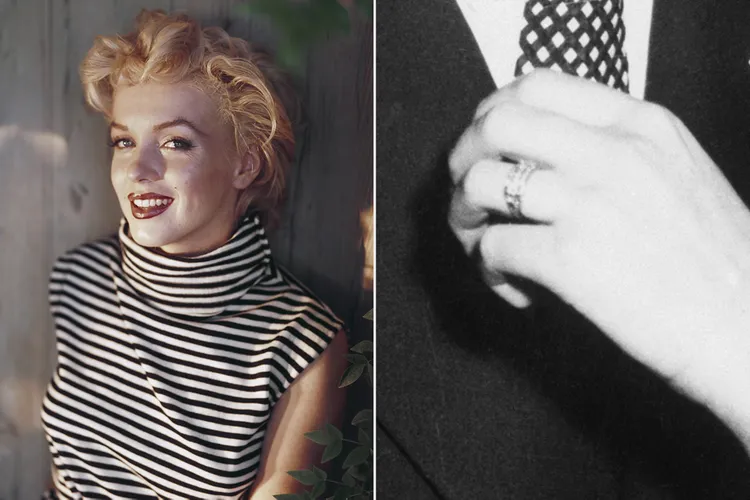
The platinum eternity band was originally set with 36 baguette-cut diamonds arranged continuously around the finger. Unlike the large centre-stone engagement rings traditionally associated with Hollywood marriages, Monroe’s jewel had no dominant diamond. Its visual impact came from an uninterrupted line of geometrically cut stones.
DiMaggio reportedly proposed without a ring shortly before the couple married at San Francisco City Hall on January 14, 1954. Their decision to wed was relatively sudden, and the ceremony took place only days after they publicly discussed marriage. Monroe appeared outside the courthouse wearing a sparkling band, but jewellery researchers have questioned whether that ring was the platinum eternity band later identified as DiMaggio’s gift.
The uncertainty has created two possible histories. The famous eternity band may have served as both Monroe’s engagement and wedding ring from the beginning. Alternatively, the ring visible immediately after the ceremony may have been a temporary or borrowed piece that was later replaced by the diamond band.
What is certain is that the platinum ring became part of Monroe’s personal property and was sold by Christie’s in 1999. By then, one diamond was missing, leaving 35 stones in place. Despite a relatively modest estimate, the ring achieved $772,500, demonstrating how strongly buyers valued its connection to Monroe. Christie’s official catalogue describes it as a platinum band set with 35 baguette diamonds, with one stone missing, and states that DiMaggio gave it to Monroe after their wedding.
The jewel’s value lies not only in its diamonds. It carries the history of a brief and difficult marriage, the mythology surrounding two American celebrities and the enduring market power of Monroe’s name.
The Marilyn Monroe Ring Featured 36 Baguette Diamonds
The ring attributed to Joe DiMaggio was designed as a full platinum eternity band.
It originally contained 36 baguette-cut diamonds arranged around the entire circumference. By the time Christie’s offered it in 1999, one diamond had been lost, and the auction house catalogued the jewel with 35 remaining stones.
Baguette diamonds differ from round brilliant stones.
They are normally rectangular and cut with long, parallel facets. Rather than producing the intense sparkle associated with round diamonds, baguettes create flashes of light and a cleaner architectural appearance.
This made Monroe’s band visually modern for the early 1950s.
The diamonds formed a continuous line without a raised central setting. That design allowed the ring to function simultaneously as a wedding band and the principal engagement jewel associated with the marriage.
An eternity band traditionally symbolises an unbroken relationship because the stones form a complete circle. In Monroe and DiMaggio’s case, the symbolism became tragically ironic. Their marriage lasted only about nine months before Monroe filed for divorce.
The ring nevertheless remained one of the most important surviving objects linked to their relationship.
Was It an Engagement Ring or a Wedding Band?
The jewel is frequently called Marilyn Monroe’s engagement ring, but Christie’s described it as an eternity band given to her after the 1954 wedding.
This difference matters.
Available accounts suggest DiMaggio did not stage a formal proposal involving a ring weeks or months before the ceremony. The couple instead discussed marriage and reached a relatively quick decision to wed.
The platinum eternity band may therefore have served several functions at once:
It was a wedding band.
It became the main ring representing their engagement and marriage.
It later became the most recognisable piece of jewellery connected with the relationship.
Calling it an engagement ring is understandable because it occupies the place that an engagement jewel normally holds in a celebrity love story. Technically, however, the evidence more strongly supports describing it as a wedding or eternity band that also became associated with the engagement.
That distinction is part of what makes the jewel elusive.
Its cultural identity is clearer than its original presentation.
Joe DiMaggio Reportedly Proposed Without a Ring
Monroe and DiMaggio met on a blind date in 1952 and dated for roughly two years before marrying.
Their relationship brought together two very different forms of American fame.
DiMaggio was already a retired baseball legend whose career with the New York Yankees had made him a national sporting figure.
Monroe was becoming one of Hollywood’s most visible stars, associated with films, magazine covers and a carefully constructed screen image.
In January 1954, the couple decided to marry without a long public engagement. Monroe told reporters after the ceremony that they had begun discussing marriage only a few days earlier.
There is no reliable evidence of DiMaggio presenting the famous eternity band during a conventional private proposal.
Some accounts therefore state that he proposed without a ring and supplied the diamond band at or shortly after the wedding.
This explanation fits Christie’s description, which says the ring was given to Monroe after the marriage.
However, photographs show Monroe wearing a sparkling ring as she emerged from City Hall. That visual evidence created the unresolved question of whether Christie’s wording was approximate or whether another jewel was used during the ceremony.
The Couple Married at San Francisco City Hall
Monroe and DiMaggio married on January 14, 1954, at San Francisco City Hall.
The civil ceremony was held in the chambers of Municipal Judge Charles S. Perry.
Although the couple attempted to keep their plans relatively private, reporters, photographers and fans gathered around the building. Their combined fame made a discreet ceremony almost impossible.
Monroe wore a dark suit with a white fur-trimmed collar and carried white flowers rather than choosing a traditional bridal gown.
DiMaggio wore a dark suit and tie.
Images of them leaving the courthouse became among the most famous photographs of the marriage. Monroe can be seen holding up her left hand in some pictures, drawing attention to the ring.
The ceremony represented the convergence of Hollywood and professional sport at a time when celebrity media was becoming increasingly influential.
Monroe and DiMaggio did not merely marry as private individuals. They entered a relationship followed by newspapers and photographers across the United States.
That public pressure would continue throughout their short marriage.
Was Monroe Wearing the Famous Ring at City Hall?
Researchers studying photographs of Monroe’s wedding have raised doubts about whether the courthouse ring and the auctioned eternity band were the same object.
Scott Fortner, a Monroe collector and historian, has argued that the ring visible immediately after the wedding appears different from the later platinum band.
The City Hall jewel may look wider, more irregular or differently set depending on the photograph and angle.
Later images associated with Monroe and the eternity band appear to show the more uniform baguette design ultimately sold at auction.
This has led to several theories.
The Same Ring May Look Different in Photographs
Archival pictures vary in resolution, lighting and angle.
A platinum band covered with diamonds can look wider or narrower depending on how Monroe held her hand.
Early press photographs may also have been retouched or reproduced repeatedly, reducing fine detail.
The apparent differences may therefore be photographic rather than physical.
DiMaggio May Have Presented a Temporary Ring
Because the marriage was arranged quickly, the final eternity band may not have been ready.
A temporary ring could have been used at City Hall and during the early honeymoon period.
The permanent diamond band may have arrived later.
The Wedding-Day Ring Could Have Been a Family Heirloom
Another theory suggests that DiMaggio borrowed a family ring for the ceremony and returned it afterwards.
No documentary evidence has confirmed which family member might have owned it.
Monroe May Have Owned Another Similar Band
Monroe possessed jewellery before the wedding, and it is possible that she wore a ring already available to her.
Again, no surviving record establishes this explanation.
The evidence remains inconclusive. The most accurate conclusion is that the eternity band is unquestionably associated with the DiMaggio marriage, but its presence at the precise moment of the City Hall ceremony is disputed.
Why the Wedding-Day Question Matters
At first glance, identifying which ring Monroe wore during a brief civil ceremony may seem like a minor detail.
In the collector market, however, provenance determines value.
A ring physically used during the marriage ceremony carries a different historical claim from one presented days or weeks later.
Both would remain valuable because of their association with Monroe and DiMaggio. Yet the exact wedding ring would have a uniquely documented role in one of twentieth-century America’s most publicised marriages.
The uncertainty also illustrates the difficulty of reconstructing celebrity history.
Modern engagements are documented through high-resolution photographs, social-media announcements, jeweller statements and detailed press releases.
Monroe married in an era when celebrities revealed less commercial information about jewellery. There was no official designer announcement, gemological certificate or public explanation of how DiMaggio acquired the ring.
Historians must therefore rely on photographs, auction records, recollections and later research.
Those sources do not align perfectly.
Who Designed Marilyn Monroe’s Ring?
The maker of the platinum eternity band has not been reliably identified.
Christie’s did not attribute the ring to Cartier, Tiffany & Co., Van Cleef & Arpels or another major house in its official lot description. It simply catalogued the piece as an eternity band.
This absence is important.
Famous jewels are often misattributed online when later writers assume a celebrity must have used a recognised luxury brand.
Without a maker’s mark, purchase receipt or authoritative auction attribution, it would be inaccurate to claim that a particular jeweller designed Monroe’s ring.
DiMaggio may have purchased it from a local or national jewellery retailer.
It may have been custom ordered.
It may also have been acquired quickly from existing inventory because of the spontaneous nature of the wedding.
The lack of confirmed authorship adds another layer to the mystery.
Why Baguette Diamonds Made the Ring Distinctive
The baguette-cut stones gave Monroe’s ring a restrained form of luxury.
A large solitaire would have created a clear focal point and projected the traditional image of an engagement ring.
The eternity band instead emphasised repetition and symmetry.
Each diamond contributed to the whole design rather than dominating it individually.
The choice also suited mid-century fashion.
The clean geometry of baguette diamonds reflected the continuing influence of Art Deco jewellery, even though the ring was produced years after the movement’s peak.
Platinum strengthened the modern appearance.
Its white colour allowed the metal to blend with the diamonds, making the stones appear to form an uninterrupted circle.
The low profile would also have made the ring easier to wear than a large raised diamond.
Monroe Rarely Appeared Wearing the Eternity Band
Despite the importance later attached to the ring, relatively few clear photographs show Monroe wearing it during the marriage.
This may reflect the short length of the relationship.
She and DiMaggio married in January and separated publicly later in 1954.
The ring also lacked the instantly visible centre stone that helps photographers identify other celebrity engagement jewels.
From a distance, an eternity band can resemble an ordinary diamond wedding ring.
Monroe’s professional photographs were usually styled around costumes, studio jewellery or fashion concepts rather than documentary records of her private possessions.
The limited visual evidence contributes to the disagreement about when and where she wore the band.
Background: Marilyn Monroe’s Three Marriages
Monroe married three times.
Each marriage occurred during a different phase of her life and career.
Her first husband was James Dougherty.
Her second was Joe DiMaggio.
Her third was playwright Arthur Miller.
The diamond eternity band is the only widely documented jewel routinely described as Monroe’s engagement ring across those relationships.
There is little reliable information about a formal engagement ring from Dougherty.
Miller reportedly did not present Monroe with a conventional engagement ring before their marriage either.
The absence of documented rings does not prove that no jewellery was exchanged privately. It means no other piece has emerged with comparable photographs, records and auction provenance.
Monroe Married James Dougherty at 16
Norma Jeane Baker, who later became Marilyn Monroe, married James Dougherty in June 1942 when she was 16.
Dougherty was 21.
The marriage occurred before her modelling and film career.
Monroe’s difficult childhood had involved foster homes and unstable guardianship arrangements. The marriage helped prevent her from being returned to an institutional living arrangement when her guardians planned to move.
This was not the glamorous Hollywood marriage later associated with her public image.
There is no well-documented engagement ring from the relationship.
The couple separated as Monroe’s modelling career developed and divorced in 1946.
Because the marriage predated her fame, few objects connected with it received the detailed documentation later applied to her possessions.
Her Marriage to DiMaggio Became a Global Story
By the time Monroe married DiMaggio, she was no longer an unknown young woman seeking stability.
She had become one of Hollywood’s most photographed performers.
Films such as Gentlemen Prefer Blondes and How to Marry a Millionaire had strengthened her screen image.
DiMaggio’s sporting fame added another level of interest.
The marriage was presented publicly as a union between America’s leading baseball hero and its most glamorous film star.
Yet their expectations differed considerably.
DiMaggio reportedly preferred a more private and conventional marriage, while Monroe’s career depended on public appearances, suggestive publicity and continued professional ambition.
The differences contributed to conflict.
The eternity band’s circle suggested permanence, but the relationship deteriorated quickly.
The Marriage Lasted About Nine Months
Monroe filed for divorce in October 1954, less than a year after the City Hall ceremony.
She cited mental cruelty in the proceedings.
Their relationship has often been romanticised because DiMaggio remained connected to Monroe later in her life and arranged her funeral after her death in 1962.
A responsible historical account should not allow that later loyalty to erase evidence that the marriage itself was troubled.
Biographers have described DiMaggio as jealous, possessive and uncomfortable with Monroe’s public image.
The famous filming of the skirt scene for The Seven Year Itch in New York reportedly intensified tensions between them.
Their separation demonstrates why jewellery symbolism should not be mistaken for evidence of a healthy relationship.
An eternity ring can represent an aspiration. It cannot guarantee the reality of the marriage.
DiMaggio Remained Part of Monroe’s Life
Although the marriage ended, Monroe and DiMaggio later re-established contact.
He supported her during difficult periods and reportedly considered remarrying her.
After Monroe died in August 1962, DiMaggio took responsibility for funeral arrangements and restricted attendance to people he considered genuinely close to her.
His continuing devotion contributed to the mythology surrounding their relationship.
The eternity band therefore came to represent more than the nine-month marriage.
It also became connected to the idea of a bond that survived divorce, even though the full history was far more complicated than a simple unfinished romance.
Monroe Married Arthur Miller in 1956
Monroe married Arthur Miller in 1956, not 1965 as incorrectly stated in some captions and secondary retellings.
They completed a civil ceremony in White Plains, New York, on June 29, 1956, followed by a Jewish ceremony in early July at the home of Miller’s literary agent.
The marriage joined one of Hollywood’s greatest stars with one of America’s leading playwrights.
Monroe converted to Judaism around the time of the wedding, seeking to connect with Miller and his family.
No conventional engagement ring from Miller is firmly documented.
Instead, another hastily arranged wedding produced another jewellery mystery.
Arthur Miller Gave Monroe a Family Wedding Band
Miller reportedly intended to present Monroe with a Cartier wedding ring, but the ordered piece did not arrive in time.
His mother, Augusta Miller, supplied a 22-carat gold band that had belonged to the family.
Monroe used that ring for the wedding.
The family-heirloom account is supported by later auction descriptions and historical jewellery reporting.
This episode has an interesting parallel with the disputed DiMaggio wedding-day ring.
Both marriages were arranged quickly enough to create questions about whether the permanent jewellery was ready.
In the Miller marriage, the temporary family band is better documented.
That precedent makes the theory of a borrowed DiMaggio ring plausible, although it does not prove it.
Why Monroe Had Only One Known Engagement Ring
Modern audiences may assume that a major celebrity who married three times would have accumulated several spectacular engagement rings.
That expectation reflects current celebrity culture more than Monroe’s era or personal circumstances.
Her first marriage occurred before fame and under practical pressure.
Her second marriage was arranged quickly without a lengthy engagement.
Her third also moved rapidly toward marriage, with even the intended wedding band reportedly arriving late.
The platinum eternity band is therefore the only jewel that survived with a clear connection to a proposal or marriage and later achieved major public recognition.
It became known as her engagement ring because no comparable alternative exists.
The Ring Entered Monroe’s Estate
After Monroe died in 1962, much of her personal property passed under her will to acting teacher Lee Strasberg.
Following Strasberg’s death, the collection came under the control of his widow, Anna Strasberg.
The property included clothing, documents, furniture, personal effects and jewellery.
In 1999, Christie’s offered hundreds of items in The Personal Property of Marilyn Monroe, one of the most important celebrity auctions of its era.
The eternity band appeared as Lot 10.
Its official description was concise: a platinum band set with 35 baguette-cut diamonds, with one stone missing, given to Monroe by DiMaggio after their 1954 wedding.
That brief catalogue entry became one of the ring’s most authoritative surviving records.
The Missing Diamond Became Part of Its Story
One of the original 36 diamonds was absent by 1999.
The available record does not establish when the stone was lost.
It may have disappeared while Monroe owned the ring.
It may have been lost during estate storage or handling.
No reliable account explains whether an attempt was made to replace it before the auction.
Ordinarily, a missing diamond would reduce the value of a ring because it disrupts the eternity design and requires repair.
In this case, buyers may have regarded the imperfection as part of the object’s authentic history.
Replacing the diamond could have restored visual completeness but altered the ring from the condition in which it emerged from Monroe’s estate.
Collectors of historical objects often accept damage when it establishes continuity and has been documented transparently.
Christie’s Expected Far Less Than the Final Price
The ring carried a presale estimate generally reported at approximately $30,000 to $50,000.
When bidding ended, it had achieved $772,500.
The result was more than 15 times the upper estimate.
Christie’s records and later fashion histories consistently identify $772,500 as the 1999 sale price.
The difference illustrates the difficulty of valuing cultural provenance.
An appraiser can estimate the diamonds, platinum and comparable vintage jewellery.
It is much harder to predict how strongly bidders will compete for an object connected with one of the most recognisable figures in entertainment history.
The ring was not simply jewellery.
It was a portable piece of Monroe’s biography.
Why the Ring Sold for $772,500
Several factors supported the result.
Marilyn Monroe’s Global Fame
Monroe remained a cultural icon decades after her death.
Her photographs, films and personal story continued attracting collectors internationally.
The DiMaggio Connection
The ring linked two major American figures rather than one.
Baseball collectors, Hollywood collectors and jewellery buyers could all find it significant.
Documented Estate Provenance
The ring came directly through the authorised sale of Monroe’s personal property.
That chain of ownership reduced authenticity concerns.
Emotional Recognition
The band represented a famous but short-lived marriage that continued generating public fascination.
Rarity
Many Monroe-related objects exist, including photographs, documents and costumes.
Only one identified diamond eternity band came from her marriage to DiMaggio.
Auction Competition
Two determined bidders can push a unique object far above its estimate.
The final figure reflects the strongest competition present on that specific day, not a fixed scientific value.
The Ring Was Offered Again in 2011
The eternity band later returned to auction through Profiles in History as part of an Icons of Hollywood sale.
Contemporary collector records identify the piece as the same platinum band, retaining 35 baguette diamonds with one missing.
It was offered with a substantially higher estimate than in 1999 because the Christie’s result had established its market importance.
Reports state that the ring sold for approximately $516,000 in 2011. The figure comes primarily from auction and Monroe-collector reporting rather than a currently accessible detailed institutional result, so it should be treated with some caution.
If accurate, the lower resale price does not necessarily mean the ring permanently lost value.
Auction results depend on economic conditions, promotion, bidder participation and the strength of the wider sale.
Unique objects can produce very different results each time they appear.
Who Owns Marilyn Monroe’s Ring Today?
The current owner has not been publicly identified.
Private collectors frequently purchase high-value celebrity memorabilia anonymously.
Privacy can reduce security risks and prevent unwanted approaches from dealers, media organisations or fans.
The ring has not been widely displayed through a major public museum since the later auction.
Without confirmation from an auction house, owner or recognised institution, claims about its present location should be considered speculative.
It may remain in a private collection.
It could also have changed hands through a confidential private transaction.
The uncertainty adds to its reputation as an elusive jewel.
What Would the Ring Be Worth Today?
No reliable current value can be calculated without a new appraisal and competitive sale.
Its price would depend on several variables:
The condition of the platinum and remaining diamonds.
Whether the missing stone has been replaced.
The completeness of ownership documents after 2011.
The level of global interest in Monroe memorabilia.
The quality of the auction marketing.
The number of wealthy bidders participating.
Inflation alone would make $772,500 in 1999 equivalent to a significantly larger nominal amount today.
However, historical objects do not automatically track inflation.
Some appreciate dramatically as their subjects become more culturally important.
Others fall when collecting tastes change or when they return to market too quickly.
The ring’s rarity and provenance would probably ensure substantial interest, but any specific multimillion-dollar estimate would remain speculative without an actual sale.
Why Monroe Memorabilia Commands High Prices
Monroe occupies an unusual position in the celebrity memorabilia market.
Her screen career was relatively short, yet her image became one of the most reproduced in modern culture.
Collectors value objects linked with several aspects of her identity:
Hollywood history.
Fashion.
Photography.
Celebrity.
Gender and beauty culture.
Personal tragedy.
Twentieth-century American life.
Her costumes have achieved particularly high prices.
The dress associated with her performance of “Happy Birthday” for President John F. Kennedy sold for $1.267 million in the 1999 Christie’s auction and later resold for a far larger amount.
Compared with such costumes, the ring is small and visually restrained.
Its importance comes from intimacy. It was not a studio prop or performance garment. It was a personal marital object worn on her hand.
The Ring’s Design Influenced Later Celebrity Jewellery Interest
Monroe did not invent the eternity band, but her ring helped turn the style into part of Hollywood jewellery history.
The design remains popular for wedding anniversaries, wedding bands and stackable diamond jewellery.
A full eternity ring offers visual continuity from every angle.
Its disadvantages include difficult resizing and increased exposure to wear because stones extend beneath the finger.
Modern versions may therefore use half- or three-quarter settings.
Monroe’s band demonstrates the traditional full-circle form.
Its baguette stones also distinguish it from eternity rings made with round or princess-cut diamonds.
Contemporary jewellers continue producing Monroe-inspired designs, although reproductions have no direct connection with the original ring.
The Jewel Contrasted With Monroe’s Screen Image
Monroe’s public image was associated with dramatic glamour.
She wore elaborate costumes, diamonds and sparkling accessories in films and publicity photographs.
Her performance of “Diamonds Are a Girl’s Best Friend” in Gentlemen Prefer Blondes became one of cinema’s most famous jewellery-related sequences.
Against that background, her real marital ring was surprisingly restrained.
It did not feature an enormous centre stone.
It did not rise dramatically above her hand.
Its luxury was visible through craftsmanship, repetition and the quality of the diamonds rather than obvious scale.
This contrast reminds readers that a star’s screen wardrobe and private possessions are not always the same.
The Ring Cannot Explain the Marriage
Celebrity jewellery articles often use rings as shorthand for relationships.
A larger diamond is treated as evidence of greater devotion.
An eternity band is interpreted as a promise of permanence.
Such readings are emotionally appealing but historically weak.
The Monroe-DiMaggio marriage contained significant conflict despite the ring’s symbolism.
Jewellery records a gesture or intention at one moment.
It cannot reveal the complete quality of a relationship.
The band’s lasting circle did not prevent divorce.
Its high auction value does not transform the marriage into a successful romance.
A balanced account can appreciate the design and provenance without using the ring to romanticise harmful behaviour or erase Monroe’s reasons for leaving.
What the Wedding-Day Mystery Reveals About Celebrity History
The unresolved ring question demonstrates how cultural myths develop.
A famous photograph shows Monroe with a sparkling band.
A later auction presents an eternity ring associated with the marriage.
Over time, the two objects become assumed to be identical.
Researchers then study the photographs and identify inconsistencies.
The result is not a completely solved history but a more careful one.
Responsible reporting should preserve that uncertainty rather than selecting the most dramatic explanation.
There may have been one ring photographed differently.
There may have been two rings.
The first may have been borrowed, inherited or hastily purchased.
Without stronger documentary evidence, each remains a theory.
Expert Analysis
Marilyn Monroe’s eternity band matters because it sits at the intersection of jewellery, celebrity mythology and incomplete historical evidence.
The basic facts are secure.
Joe DiMaggio gave Monroe a platinum band originally containing 36 baguette diamonds.
One stone was missing by 1999.
Christie’s sold it for $772,500 as part of Monroe’s personal property.
What remains unclear is how and when the band entered the relationship.
Christie’s wording indicates that DiMaggio gave it to Monroe after the wedding. Photographs show her wearing a glittering ring immediately after leaving City Hall.
Those statements can coexist only if the auction description used “after” loosely or if Monroe wore another band during the ceremony.
The second possibility is credible because the wedding was arranged quickly and because Monroe later used a family ring when marrying Arthur Miller after another intended band failed to arrive in time.
Yet credibility is not proof.
The visual evidence is too limited to identify the City Hall ring conclusively.
The auction market does not appear to have punished that ambiguity. Buyers accepted the documented association with DiMaggio and Monroe as sufficient.
The $772,500 result shows that provenance does not always need to answer every question. Mystery can itself increase interest when the core ownership history remains credible.
The ring’s later history also demonstrates the volatility of celebrity collectibles. A reported resale near $516,000 would represent a lower nominal result, but one auction does not establish a permanent value.
Its next appearance could produce an entirely different outcome.
Ultimately, the most important feature of the jewel is not the number of diamonds or even its auction price.
It is the tension between the promise represented by an eternity band and the reality of the marriage it commemorated.
That tension makes the ring culturally powerful but should not be used to turn a troubled relationship into a simple tale of lost love.
Frequently Asked Questions
What did Marilyn Monroe’s engagement ring look like?
The ring associated with Joe DiMaggio was a platinum eternity band originally set with 36 rectangular baguette-cut diamonds.
Was Marilyn Monroe’s ring an engagement ring or wedding ring?
It is commonly described as both. Christie’s catalogued it as an eternity band given to Monroe by DiMaggio after their 1954 wedding.
Did Marilyn Monroe wear the eternity band at her wedding?
Possibly, but this has not been conclusively established. Some researchers believe photographs from San Francisco City Hall show a different ring that may have been used temporarily.
How much did Marilyn Monroe’s ring sell for?
It sold for $772,500 at Christie’s 1999 auction of Monroe’s personal property, far above its reported estimate.
Why did the ring have only 35 diamonds at auction?
It originally had 36 baguette diamonds, but one stone was missing when Christie’s catalogued the ring in 1999.
Did Marilyn Monroe receive an engagement ring from Arthur Miller?
No firmly documented conventional engagement ring is known. Miller reportedly used a 22-carat gold band belonging to his mother because another ring ordered from Cartier was not ready for the wedding.
Who owns Marilyn Monroe’s ring now?
Its confirmed current owner has not been publicly disclosed. It is believed to remain in private hands, but its precise location is unknown.
Conclusion
Marilyn Monroe’s diamond eternity band is one of Hollywood’s most historically valuable wedding jewels, but it remains surrounded by unanswered questions.
Its design is well established.
The platinum ring originally contained 36 baguette-cut diamonds arranged in a continuous circle. One diamond was missing when Christie’s offered the piece in 1999.
Its connection with Joe DiMaggio is also secure.
The auction house identified it as the band he gave Monroe following their January 1954 wedding, and its association with the marriage helped drive the price to $772,500.
The uncertainty concerns timing.
Monroe emerged from San Francisco City Hall already wearing a sparkling ring, yet some specialists believe the courthouse jewel does not match the eternity band sold decades later.
It may have been the same ring distorted by archival photography.
It may have been a temporary or borrowed band.
No surviving receipt, jeweller’s record or definitive close-up photograph has resolved the question.
That mystery does not diminish the ring’s significance.
Instead, it captures the fragmented way Monroe’s private life became public history.
She was married three times, but only one ring emerged with a firmly documented connection to her personal estate and the international auction market.
The jewel’s symbolism is equally complicated.
An eternity band represents continuity, yet Monroe and DiMaggio’s marriage ended within nine months. Their later relationship and his involvement after her death encouraged generations to romanticise their bond, but the ring should not be used to erase the conflict that contributed to their divorce.
Today, its whereabouts are not publicly known.
Its next owner, sale price and even its current physical condition remain private.
What survives publicly is its remarkable history: a restrained platinum circle that began as a marital gift, passed through Monroe’s estate and became a six-figure artefact of Hollywood’s golden age.