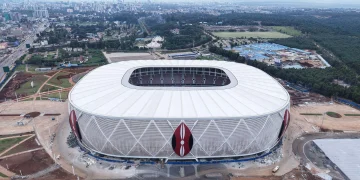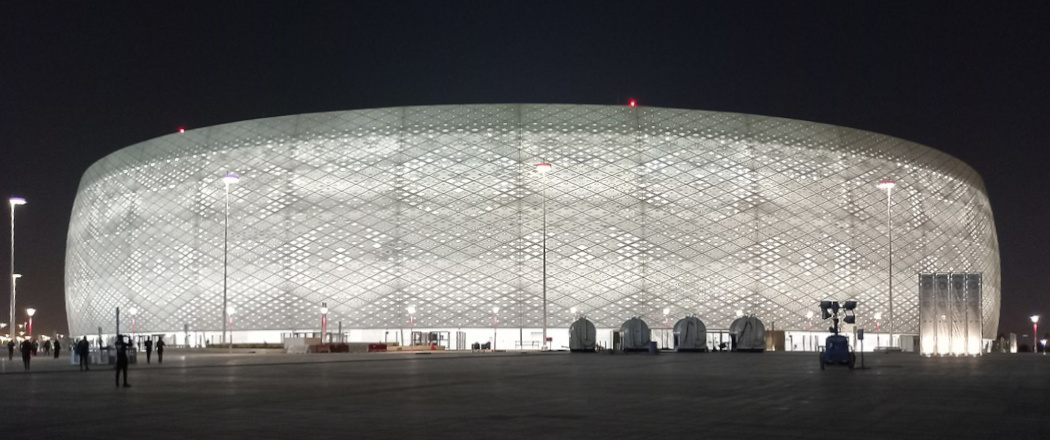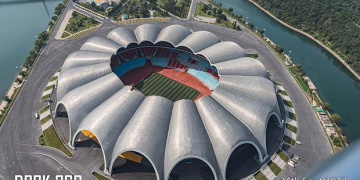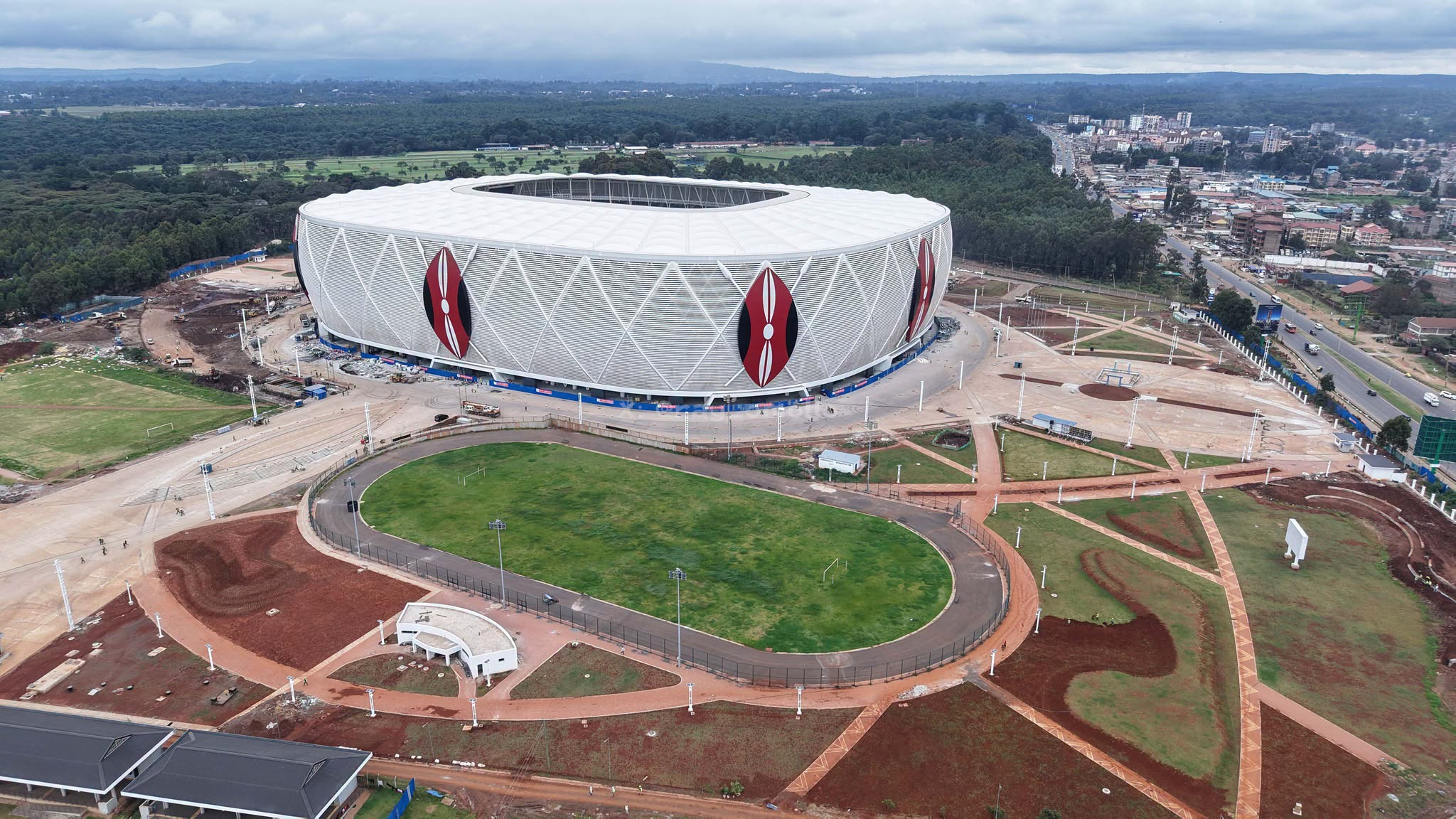
Raila Odinga Stadium is emerging as one of the most ambitious sports infrastructure developments undertaken in East Africa, combining a 60,000-seat capacity with a football-first seating bowl, covered stands and technology intended to support major continental competitions.
The arena, previously developed under the Talanta Sports Stadium name, anchors the wider Talanta Sports City project in Nairobi. President William Ruto’s administration now refers to it as the 60,000-seat Raila Odinga International Stadium, although the broader complex continues to carry the Talanta Sports City identity. The government has positioned it as a central part of Kenya’s preparations for the 2027 Africa Cup of Nations, which the country will co-host with Uganda and Tanzania.
Its arrival has generated claims that it could become the best stadium in Africa. That description is ultimately subjective. Africa already has larger venues, including Johannesburg’s FNB Stadium and Egypt’s Misr Stadium, while Morocco has recently delivered advanced football grounds designed partly for the 2030 FIFA World Cup.
What makes the Nairobi project significant is not simply its capacity. It is being designed without an athletics track, allowing spectators to sit closer to football and rugby action. Plans also include a fully covered three-tier seating bowl, large digital screens, modern media facilities and systems intended to support Video Assistant Referee operations and goal-line technology.
The stadium’s roof has attracted particular interest. Published project accounts describe a hydraulic lifting process used to position sections of the tension-cable roof structure. However, the frequently repeated assertion that it is Africa’s only computerised hydraulic roof system has not been independently confirmed through comprehensive engineering comparisons with every major stadium on the continent.
The fairest conclusion is that Raila Odinga Stadium is set to become one of Africa’s most modern new arenas. Whether it deserves the title of the continent’s best will depend on completion quality, certification, match operations, maintenance and the spectator experience after opening.
Raila Odinga Stadium Brings a Football-First Design to Kenya
The stadium is being constructed in Nairobi’s Jamhuri area off Ngong Road, around 10 kilometres from the central business district.
It forms the centrepiece of Talanta Sports City, a wider development expected to contain training fields, athletics facilities, commercial areas, hospitality infrastructure and supporting public spaces.
Kenya’s presidency has described the complex as being anchored by the 60,000-seat Raila Odinga International Stadium and supported by training, hospitality, commercial, media-production and mobility facilities.
The main arena is intended primarily for football and rugby.
This is an important departure from the design of many major stadiums in Africa, where football pitches are separated from spectators by athletics tracks.
Tracks improve versatility because they allow venues to host athletics championships. However, they can weaken the football atmosphere by pushing the first seating rows farther from the field.
Raila Odinga Stadium places the stands around a rectangular playing surface without an athletics oval.
That arrangement should improve sightlines, intensify crowd noise and make spectators feel more directly connected to matches.
The design places athletics functions elsewhere within the wider complex rather than forcing the main stadium to serve every sporting discipline.
Why the Lack of an Athletics Track Matters
Purpose-built football stadiums are increasingly preferred for major football events because the crowd is physically and acoustically closer to play.
At an athletics stadium, the distance between the touchline and front row may become substantial, especially behind the goals where the track curves.
A rectangular seating bowl can reduce that gap.
This has several practical effects:
Supporters can see tactical details more clearly.
Players experience a stronger atmosphere.
Television coverage can capture a more visually intense crowd backdrop.
Premium hospitality areas can be positioned with closer views of the field.
Acoustic energy is more likely to remain inside the bowl.
For Kenyan football, this could create a home environment unlike the one traditionally experienced at multi-purpose venues such as Moi International Sports Centre, Kasarani.
It may also make the stadium more attractive for continental club finals, international rugby and major entertainment events.
The main limitation is reduced athletics flexibility. Kenya will still require separate facilities capable of hosting top-level track and field competitions, particularly given the country’s global status in athletics.
The wider Talanta Sports City plan attempts to address that issue by separating the main rectangular stadium from supporting athletics infrastructure.
A Three-Tier Bowl Designed for 60,000 Spectators
Published design information describes an auditorium divided into three main levels and covered by the roof structure.
A three-tier configuration enables planners to manage different categories of spectator demand.
Lower tiers provide proximity to the field.
Middle levels can contain hospitality boxes, media areas and premium seating.
Upper sections create the scale required to reach the 60,000-seat target.
The design also makes it easier to separate supporter groups, control circulation and meet security requirements for major international fixtures.
Seats are expected to reflect colours associated with Kenya’s flag, while exterior architectural elements are intended to draw from the shield and spear symbols found in the national emblem.
This visual identity is important.
Many modern stadiums use broadly similar structural systems, concrete bowls and metal façades. Locally inspired patterns can help a venue develop an identity connected with its country rather than appearing as a generic imported arena.
The ultimate architectural success will depend on execution. Decorative symbolism must work alongside safe crowd movement, accessibility, ventilation and ease of maintenance.
The Roof Is One of the Stadium’s Defining Features
The roof structure has become one of the project’s most discussed engineering elements.
Reports describe a tension-cable roofing system installed with the assistance of computer-controlled hydraulic lifting equipment. The lifting method allows large structural components to be raised and tensioned with a high degree of coordination.
Hydraulic synchronisation is valuable because roof elements must move evenly. Uneven lifting can place excessive stress on cables, supports or temporary structures.
The completed roof is expected to cover the spectator seating while leaving the playing field open to natural light and ventilation.
This is different from a fully retractable roof that opens and closes over the field after the stadium begins operating.
Some online descriptions have incorrectly presented the stadium as having a conventional retractable roof. Available project reporting more accurately describes a cable-supported canopy whose construction involved an advanced hydraulic lifting process.
The distinction matters because a roof-lifting construction method and an operational retractable roof are not the same technology.
Is It Really Africa’s Only Computerised Hydraulic Roof System?
The claim that the Nairobi arena contains Africa’s only computerised hydraulic roof-lifting system has been repeated widely in social-media posts and local reporting.
It may refer to the particular construction method, scale or configuration used on the Talanta project.
However, publicly available evidence does not establish a complete engineering comparison covering every stadium in Africa.
Several major African arenas have complex cable roofs, membrane structures, movable components and advanced construction systems.
Without documentation from the stadium’s engineer or an independent continental database, the exclusivity claim should be presented carefully.
A defensible description is that the project uses a rare and advanced hydraulic lifting process for its tension-cable roof.
That is already a significant engineering achievement without needing an unverified continental “only” label.
The distinction protects the stadium’s credibility. Strong infrastructure journalism should celebrate genuine innovation while avoiding claims that may later be challenged.
VAR and Goal-Line Technology Are Planned
The stadium is intended to support modern football officiating and broadcasting.
Published project information lists VAR facilities and goal-line technology among its planned features.
VAR requires more than placing monitors beside the pitch.
A functioning system needs:
Multiple calibrated camera angles.
Reliable high-speed communication.
A secure video-operation room.
Direct communication between video officials and the referee.
Broadcast-grade replay infrastructure.
Stable power and backup systems.
Goal-line technology is even more specialised.
It normally uses a network of high-speed cameras or sensor-based systems to determine whether the entire ball has crossed the line.
The system must then transmit an immediate decision to the referee.
Installation alone does not complete the process. The equipment must be tested, certified and operated by trained officials.
The presence of suitable infrastructure would place Kenya in a stronger position to host high-profile CAF and FIFA fixtures.
However, the stadium’s final technological status should be judged after commissioning and formal competition certification.
Broadcasting Infrastructure Could Improve Kenya’s Event Economy
Modern stadiums are also television-production facilities.
International competitions require dedicated camera positions, commentary booths, interview zones, mixed areas, press-conference rooms and connectivity capable of moving high-definition video reliably.
Large screens inside the stadium improve the spectator experience by showing replays, match information and safety announcements.
Media infrastructure can also create economic value beyond football.
A stadium capable of supporting international broadcasts can host:
Continental finals.
Rugby competitions.
Religious gatherings.
Concerts.
Government ceremonies.
Esports and entertainment productions.
International sponsors are more likely to support events when organisers can guarantee high-quality visibility and broadcast delivery.
For Kenya, this could strengthen sports tourism and reduce dependence on hiring temporary production facilities for every major event.
Raila Odinga Stadium Is Part of AFCON 2027 Preparations
Kenya, Uganda and Tanzania won the right to stage the 2027 Africa Cup of Nations through the joint East Africa Pamoja bid.
The tournament will be the first senior men’s AFCON jointly hosted by the three East African countries.
Raila Odinga Stadium is intended to serve as one of Kenya’s principal venues, alongside upgrades to Kasarani and Nyayo Stadium and work on other supporting facilities.
The new arena is especially important because CAF tournaments require more than a large seating capacity.
Host venues must meet standards covering:
Pitch quality.
Floodlighting.
Player facilities.
Medical services.
Media operations.
Security.
Ticketing.
Transport.
Training grounds.
Hospitality.
Emergency access.
Broadcasting.
The stadium’s final readiness will therefore depend on the entire operating ecosystem, not only completion of concrete, roofing and seats.
Road access, public transport, parking and crowd management must all work during full-capacity events.
Renaming Talanta Stadium After Raila Odinga
The project began under the name Talanta Sports City Stadium or Talanta Sports Stadium.
President Ruto approved the proposal to name the completed arena after former Prime Minister Raila Odinga in December 2025.
The president subsequently referred to the wider complex as Talanta Sports City, anchored by the Raila Odinga International Stadium.
This creates a useful naming distinction:
Talanta Sports City refers to the complete sports and commercial complex.
Raila Odinga International Stadium refers to the principal 60,000-seat arena within it.
Naming major infrastructure after national leaders often generates political debate.
Supporters view it as recognition of public service and national contribution.
Critics may question whether facilities should carry the names of political figures or retain neutral identities.
Regardless of those debates, consistency will be important for branding, ticketing, navigation, tourism promotion and international tournament communication.
Can It Be Called Kenya’s First World-Class Stadium?
Supporters have described it as Kenya’s first truly world-class football stadium since independence.
That statement reflects understandable pride but needs context.
Kenya already has historic venues that have staged major international sport, including Kasarani and Nyayo.
Kasarani was considered a major modern facility when built for the 1987 All-Africa Games.
Nyayo has hosted international football, athletics and national events for decades.
The new stadium differs because it is designed around contemporary football, broadcasting, hospitality and digital officiating requirements.
It may therefore become Kenya’s most advanced purpose-built football venue.
Calling it the country’s first stadium of any international quality would unfairly dismiss the role played by earlier facilities.
A more accurate description is that it represents Kenya’s first new national-scale football-first arena of the modern CAF and FIFA era.
How It Compares With Africa’s Largest Stadiums
Capacity is the simplest way to rank stadiums, but it is not the same as measuring quality.
A larger venue may be older, less comfortable or designed primarily for athletics.
A smaller stadium may offer superior sightlines, technology, hospitality and transport.
Raila Odinga Stadium’s planned 60,000 seats place it below Africa’s biggest arenas by capacity but still within a high continental category.
Its strongest competitive advantages are expected to be age, design, roof coverage and closeness to the pitch.
1. FNB Stadium, South Africa
FNB Stadium in Johannesburg remains Africa’s largest widely recognised operational stadium, with a capacity of about 94,736.
It is famous for its calabash-inspired exterior and its role in the 2010 FIFA World Cup, including the opening match and final.
The stadium’s historical importance is difficult for a new arena to match.
It hosted Nelson Mandela’s final major public appearance and has staged some of African football’s biggest matches.
FNB’s advantages include scale, global recognition and proven experience with full international tournaments.
Raila Odinga Stadium will be smaller by more than 34,000 seats.
However, the Nairobi venue could offer a more intimate football atmosphere because FNB’s field remains surrounded by a broader multi-purpose layout.
FNB leads in capacity and history. Nairobi may compete through newer technology and a more football-focused configuration.
2. Misr Stadium, Egypt
Misr Stadium in Egypt’s New Administrative Capital has a reported capacity of approximately 93,940, making it one of Africa’s largest modern sporting arenas.
It forms part of a major Olympic city development and reflects Egypt’s wider investment in large-scale national infrastructure.
Its strength lies in combining huge capacity with recent construction.
Compared with Misr Stadium, Raila Odinga Stadium is significantly smaller.
However, capacity alone does not determine match atmosphere or operating efficiency.
A 60,000-seat arena that fills regularly may create more value than a 94,000-seat venue that remains partly empty for most events.
Misr Stadium is the stronger candidate in a size-based ranking.
Raila Odinga Stadium may still compete on football sightlines, regional importance and the quality of the fan experience.
3. Borg El-Arab Stadium, Egypt
Borg El-Arab Stadium near Alexandria holds about 86,000 spectators.
The venue was developed partly in connection with Egypt’s international tournament ambitions and has hosted national-team and major club fixtures.
Its enormous bowl makes it one of the continent’s most imposing stadiums.
It also contains an athletics track, creating greater distance between supporters and football action.
This gives the Nairobi project a potential experiential advantage despite its smaller capacity.
Borg El-Arab is the greater colossus.
Raila Odinga Stadium is likely to feel more compact and football-specific.
4. Stade des Martyrs, DR Congo
Stade des Martyrs in Kinshasa is commonly listed with a capacity of around 80,000.
It is one of Central Africa’s most important sports and national-event venues.
Its scale and location in one of Africa’s largest cities give it enormous symbolic importance.
However, like many older multi-purpose stadiums, its quality depends heavily on maintenance, renovation and operational investment.
Raila Odinga Stadium will enter service with newer systems and a purpose-built rectangular seating environment.
Stade des Martyrs leads in size and established history.
Nairobi is positioned to compete through modern comfort and technology.
5. Cairo International Stadium, Egypt
Cairo International Stadium has long been one of African football’s most recognisable arenas.
Its listed capacity varies according to configuration and renovation, but it is generally placed around 75,000.
The venue has hosted Africa Cup of Nations finals, major Egyptian club matches and international athletics.
Its greatest strength is history.
Some of Africa’s most intense football atmospheres have been created there by supporters of Egypt, Al Ahly and Zamalek.
Raila Odinga Stadium cannot reproduce that history immediately.
It must build its own identity through memorable finals, national-team victories and consistent use.
In infrastructure terms, Nairobi may be newer. In football culture, Cairo has decades of advantage.
6. Grand Stade de Tanger, Morocco
The Grand Stade de Tanger, also known as Ibn Batouta Stadium, was expanded and renovated for Morocco’s international hosting programme.
Its capacity is commonly reported at around 75,000 after redevelopment.
Morocco has invested heavily in stadium, rail and airport infrastructure as it prepares to co-host the 2030 FIFA World Cup.
The Tangier venue has already been tested through major continental events.
This gives it an operational advantage over the Nairobi stadium, which must still prove itself after completion.
Both venues illustrate different continental strategies.
Morocco is preparing for the World Cup.
Kenya is using AFCON 2027 to accelerate East African sports infrastructure.
7. Prince Moulay Abdellah Stadium, Morocco
The rebuilt Prince Moulay Abdellah Stadium in Rabat opened in September 2025.
Populous lists its capacity at 68,700, while CAF documentation uses a figure slightly above 68,000 depending on configuration.
It is one of the strongest direct comparisons for Raila Odinga Stadium.
Both are recently developed football venues with advanced architecture and major-event ambitions.
The Rabat stadium has already hosted top-level matches and was central to Morocco’s AFCON programme.
Its palm-inspired façade, LED elements and modern hospitality facilities have gained international recognition.
Raila Odinga Stadium is smaller but may compete through its distinctive Kenyan design, roof engineering and football-rugby configuration.
At present, Rabat has the advantage of completed and tested operations.
8. Raila Odinga International Stadium, Kenya
Kenya’s new stadium enters this continental group not because it is one of the very largest, but because of its complete design proposition.
Its expected advantages include:
60,000 seats.
No athletics track.
A three-tier football bowl.
A roof covering spectator areas.
Modern officiating facilities.
Goal-line and VAR readiness.
Large digital screens.
Contemporary media facilities.
Nationally inspired architecture.
Integration into a broader sports city.
These features could make it one of the continent’s best spectator-oriented arenas.
The main question is no longer the concept. It is execution.
9. Alassane Ouattara Stadium, Ivory Coast
Alassane Ouattara Stadium in Ebimpé has a capacity of approximately 60,000, making it a close capacity comparison with Nairobi.
The venue was a central part of Ivory Coast’s 2023 Africa Cup of Nations, staged in early 2024.
It hosted the final in which the host country defeated Nigeria.
That match gave the stadium an immediate place in African football history.
The arena is modern and visually impressive, but tournament experiences also highlighted the importance of transport, pitch management and operational preparation.
Nairobi can learn from Ebimpé’s experience.
A new stadium’s success depends on much more than architecture. Access, drainage, field quality and event management must perform under pressure.
10. Abdoulaye Wade Stadium, Senegal
Abdoulaye Wade Stadium near Dakar opened in 2022 with approximately 50,000 seats.
Its modern exterior and football-first arrangement quickly made it one of West Africa’s most recognisable new venues.
The stadium demonstrated that capacity below 60,000 does not prevent a venue from being treated as world class.
Its atmosphere, aesthetics and modern facilities have given Senegal a strong national football home.
Raila Odinga Stadium is larger and appears to contain a more elaborate roof structure.
The Senegalese venue already has the advantage of operation and established national-team use.
Capacity Does Not Decide Africa’s Best Stadium
A ranking based only on seat numbers would place the Nairobi stadium below several older African venues.
A ranking based on modernity would favour newer facilities in Kenya, Morocco, Senegal, Ivory Coast and Egypt.
A ranking based on football history would favour Cairo International, FNB Stadium and other established arenas.
A ranking based on atmosphere might depend on the supporters filling the seats rather than the engineering.
The title of “best stadium in Africa” therefore depends on the criteria selected.
Reasonable categories include:
Capacity.
Architecture.
Football sightlines.
Roof coverage.
Pitch quality.
Technology.
Hospitality.
Accessibility.
Sustainability.
Safety.
Maintenance.
Atmosphere.
Historical importance.
Commercial performance.
Raila Odinga Stadium could rank strongly in several technical and spectator categories without being Africa’s largest or most historically important.
East Africa’s Stadium Infrastructure Gap
For decades, North, Southern and parts of West Africa have dominated the continent’s stadium infrastructure.
South Africa’s 2010 World Cup produced a generation of major venues.
Egypt has long maintained large national stadiums.
Morocco has accelerated investment for AFCON and the 2030 World Cup.
Ivory Coast and Senegal have also opened important new facilities.
East Africa has had fewer modern national-scale football-first stadiums.
Kenya’s new arena could therefore have regional importance beyond its own borders.
It may help East Africa compete for:
CAF club finals.
Africa Cup of Nations matches.
FIFA youth competitions.
Major rugby tournaments.
International concerts.
Continental sports conferences.
A successful AFCON 2027 would strengthen the region’s case for hosting additional international events.
The Economic Opportunity Around the Stadium
A stadium creates the greatest value when it is used regularly.
Construction spending alone does not guarantee long-term economic benefit.
Talanta Sports City’s wider commercial, hospitality and media elements may help improve year-round use.
Potential revenue sources include:
Match tickets.
Hospitality boxes.
Naming and sponsorship rights.
Retail.
Restaurants.
Museum and stadium tours.
Concerts.
Conferences.
Parking.
Advertising.
Broadcast production.
Training facilities.
Community sport.
Surrounding property and commercial activity may also benefit from increased foot traffic.
However, the stadium will require disciplined management.
Many African venues deteriorate because maintenance budgets are inadequate after opening.
The financial model should reserve sufficient income for the pitch, roof, seating, digital systems, sanitation, lifts, security and public areas.
Transport Will Be a Major Test
A 60,000-seat stadium can place heavy pressure on surrounding roads.
Even if only a portion of spectators arrive in private vehicles, thousands of cars may converge within a short period.
The project’s published plan includes parking, but parking alone cannot solve full-capacity transport demand.
Effective operations will require:
Dedicated bus services.
Pedestrian routes.
Traffic separation.
Ride-hailing zones.
Emergency corridors.
Safe entry and exit points.
Possibly park-and-ride systems.
Coordination with city authorities.
Ngong Road is already one of Nairobi’s important and frequently congested transport corridors.
Match-day planning must prevent the stadium from paralysing the surrounding area.
Smart mobility systems referenced by the presidency will need to become practical services rather than promotional language.
The Pitch Will Determine Football Quality
Supporters may first notice the roof, façade and seats, but players and competition officials will judge the pitch.
A high-quality playing surface requires:
Effective drainage.
Correct grass selection.
Reliable irrigation.
Adequate sunlight.
Ventilation.
Regular mowing.
Professional groundskeeping.
Controlled non-football use.
The roof design must allow sufficient light and airflow to maintain healthy grass.
Concerts and other large events can generate revenue but may damage the field if protection and recovery systems are inadequate.
The stadium’s management will therefore need to balance commercial use with football requirements.
Maintenance Will Decide Its Long-Term Ranking
Africa has many impressive stadiums whose condition declined after major tournaments.
Deferred maintenance can affect toilets, seats, lighting, lifts, roofing, pitch quality and technology.
Raila Odinga Stadium’s strongest features will also be among the most expensive to maintain.
Hydraulic and cable systems require specialist inspection.
Digital screens and officiating systems require updates.
Security technology must remain functional.
Premium seating must be kept at an international standard.
The pitch needs continuous investment.
A maintenance programme should begin before opening, not after deterioration becomes visible.
If the stadium remains clean, safe and technologically reliable ten years after launch, it will have a stronger claim to continental leadership than it does through construction photographs alone.
Fan Claims Reflect National Pride
Kenyan supporters have described the project as history in the making and a long-awaited FIFA-standard home for the national team.
That enthusiasm is understandable.
Modern stadiums become symbols of national ambition, particularly when they arrive after long periods of limited infrastructure investment.
The absence of an athletics track has received especially strong approval because it brings spectators closer to football.
Fan reaction can contribute to the stadium’s identity before its first major match.
However, official evaluations must remain separate from social-media excitement.
CAF and FIFA certification, safety testing and successful event delivery will provide the most reliable evidence of quality.
Is Raila Odinga Stadium the Best in Africa?
It is too early to give a definitive answer.
The stadium is one of Africa’s most significant new arena projects and appears capable of competing with leading venues on design, technology and spectator proximity.
It is not Africa’s largest.
It has not yet accumulated the history of FNB Stadium, Cairo International or Stade des Martyrs.
It has not yet been tested through a complete international tournament in the way newer grounds in Morocco and Ivory Coast have.
Its strongest potential advantages are:
A football-first bowl.
Covered stands.
Modern roof engineering.
Integrated digital officiating.
Contemporary media infrastructure.
A distinctive Kenyan architectural identity.
A wider sports-city environment.
Its eventual standing will depend on whether those features work as promised.
What Comes Next
The key milestones include final construction, safety inspections, pitch preparation and formal certification.
Tournament organisers will also need to conduct test events before AFCON 2027.
Test matches can reveal problems that architectural inspections may not identify, including:
Long entrance queues.
Ticket-scanning failures.
Poor signage.
Mobile-network congestion.
Insufficient sanitation.
Transport bottlenecks.
Restricted emergency movement.
Weak food and retail operations.
Audio-system problems.
Crowd-separation difficulties.
The stadium should host progressively larger events before operating at full capacity.
A well-managed testing programme will improve its readiness for continental football.
Expert Analysis
Raila Odinga International Stadium represents a major shift in Kenyan sports infrastructure.
Its importance comes from three elements.
First, it introduces a new national-scale stadium rather than relying entirely on renovations of venues built decades ago.
Second, it prioritises football and rugby sightlines by removing the athletics track from the main bowl.
Third, it forms part of a broader sports-city model rather than functioning as an isolated arena.
The claims around advanced technology are plausible but require careful language.
VAR and goal-line infrastructure are expected features, but their final value depends on certification and operation.
The roof uses an advanced hydraulic installation process, but the claim that it is the only system of its kind in Africa needs more independent engineering evidence.
Those qualifications do not diminish the project.
A 60,000-seat covered football stadium with modern broadcasting and officiating systems is already a major achievement for Kenya.
The greatest risk is allowing the discussion to end with architectural comparison.
A stadium should be judged by what happens after construction.
Can spectators reach it safely?
Can they enter without long delays?
Does the pitch remain excellent?
Do toilets and seats remain functional?
Can management generate revenue without damaging the field?
Can Kenya maintain the technology?
Does the stadium serve local football between major tournaments?
These questions will determine whether it becomes a sustainable national asset or a prestigious but underused project.
If the stadium delivers strong operations during AFCON 2027 and remains well maintained afterwards, it could credibly be placed among Africa’s leading football venues.
Frequently Asked Questions
What is Raila Odinga International Stadium?
It is a planned 60,000-seat football and rugby stadium being completed within Talanta Sports City in Nairobi. The project is intended to become one of Kenya’s main venues for the 2027 Africa Cup of Nations.
Was Raila Odinga Stadium previously called Talanta Stadium?
Yes. The project was developed as Talanta Sports Stadium. The main arena is now referred to by the government as Raila Odinga International Stadium, while the wider complex remains Talanta Sports City.
How many people will the stadium hold?
The planned capacity is 60,000 spectators.
Does the stadium have an athletics track?
No. The main stadium is being designed for football and rugby without an athletics track, bringing spectators closer to the field. Supporting athletics facilities are planned within the wider sports complex.
Will it have VAR and goal-line technology?
Project reports say the venue is planned with VAR facilities and goal-line technology. The systems will still require installation, testing and competition certification.
Does the stadium have a retractable roof?
Available information describes a tension-cable roof installed using hydraulic lifting technology. This should not automatically be interpreted as a fully retractable roof that opens and closes during normal stadium operations.
Is Raila Odinga Stadium the biggest in Africa?
No. FNB Stadium, Misr Stadium, Borg El-Arab and several other African venues have larger listed capacities.
Is it the best stadium in Africa?
That remains subjective and cannot be established before the venue is completed and tested. It has the potential to rank among Africa’s best modern football stadiums based on its design, roof, spectator proximity and planned technology.
Conclusion
Raila Odinga International Stadium is set to transform Kenya’s position within African sports infrastructure.
Its 60,000 seats will not make it the continent’s largest venue, but capacity is only one measure of stadium quality.
The football-first seating bowl, lack of an athletics track, covered stands, modern media spaces and planned VAR and goal-line systems give it the potential to offer one of Africa’s strongest new spectator experiences.
Its architecture also carries a clear national identity through design elements associated with Kenya’s flag, shield and colours.
The arena will enter a competitive continental group.
South Africa’s FNB Stadium remains unmatched in capacity and World Cup history.
Egypt’s giant venues dominate the size rankings.
Morocco’s new stadiums have already demonstrated advanced architecture and tournament capability.
Ivory Coast and Senegal have opened modern national arenas with proven football atmospheres.
Kenya’s advantage is the opportunity to learn from all of them.
The new stadium can combine modern design with operational planning suited to Nairobi and East African football.
Its final reputation will not be secured by construction claims or social-media praise.
It will be built through safe events, full stands, reliable technology, excellent pitch conditions and sustained maintenance.
Should Kenya deliver those elements during AFCON 2027 and preserve them afterwards, Raila Odinga Stadium will have a strong claim to being one of Africa’s finest football venues.
The greater achievement would be ensuring that it remains one long after the opening ceremony.
Raila Odinga Stadium is emerging as one of the most ambitious sports infrastructure developments undertaken in East Africa, combining a 60,000-seat capacity with a football-first seating bowl, covered stands and technology intended to support major continental competitions.
The arena, previously developed under the Talanta Sports Stadium name, anchors the wider Talanta Sports City project in Nairobi. President William Ruto’s administration now refers to it as the 60,000-seat Raila Odinga International Stadium, although the broader complex continues to carry the Talanta Sports City identity. The government has positioned it as a central part of Kenya’s preparations for the 2027 Africa Cup of Nations, which the country will co-host with Uganda and Tanzania.
Its arrival has generated claims that it could become the best stadium in Africa. That description is ultimately subjective. Africa already has larger venues, including Johannesburg’s FNB Stadium and Egypt’s Misr Stadium, while Morocco has recently delivered advanced football grounds designed partly for the 2030 FIFA World Cup.
What makes the Nairobi project significant is not simply its capacity. It is being designed without an athletics track, allowing spectators to sit closer to football and rugby action. Plans also include a fully covered three-tier seating bowl, large digital screens, modern media facilities and systems intended to support Video Assistant Referee operations and goal-line technology.
The stadium’s roof has attracted particular interest. Published project accounts describe a hydraulic lifting process used to position sections of the tension-cable roof structure. However, the frequently repeated assertion that it is Africa’s only computerised hydraulic roof system has not been independently confirmed through comprehensive engineering comparisons with every major stadium on the continent.
The fairest conclusion is that Raila Odinga Stadium is set to become one of Africa’s most modern new arenas. Whether it deserves the title of the continent’s best will depend on completion quality, certification, match operations, maintenance and the spectator experience after opening.
Raila Odinga Stadium Brings a Football-First Design to Kenya
The stadium is being constructed in Nairobi’s Jamhuri area off Ngong Road, around 10 kilometres from the central business district.
It forms the centrepiece of Talanta Sports City, a wider development expected to contain training fields, athletics facilities, commercial areas, hospitality infrastructure and supporting public spaces.
Kenya’s presidency has described the complex as being anchored by the 60,000-seat Raila Odinga International Stadium and supported by training, hospitality, commercial, media-production and mobility facilities.
The main arena is intended primarily for football and rugby.
This is an important departure from the design of many major stadiums in Africa, where football pitches are separated from spectators by athletics tracks.
Tracks improve versatility because they allow venues to host athletics championships. However, they can weaken the football atmosphere by pushing the first seating rows farther from the field.
Raila Odinga Stadium places the stands around a rectangular playing surface without an athletics oval.
That arrangement should improve sightlines, intensify crowd noise and make spectators feel more directly connected to matches.
The design places athletics functions elsewhere within the wider complex rather than forcing the main stadium to serve every sporting discipline.
Why the Lack of an Athletics Track Matters
Purpose-built football stadiums are increasingly preferred for major football events because the crowd is physically and acoustically closer to play.
At an athletics stadium, the distance between the touchline and front row may become substantial, especially behind the goals where the track curves.
A rectangular seating bowl can reduce that gap.
This has several practical effects:
Supporters can see tactical details more clearly.
Players experience a stronger atmosphere.
Television coverage can capture a more visually intense crowd backdrop.
Premium hospitality areas can be positioned with closer views of the field.
Acoustic energy is more likely to remain inside the bowl.
For Kenyan football, this could create a home environment unlike the one traditionally experienced at multi-purpose venues such as Moi International Sports Centre, Kasarani.
It may also make the stadium more attractive for continental club finals, international rugby and major entertainment events.
The main limitation is reduced athletics flexibility. Kenya will still require separate facilities capable of hosting top-level track and field competitions, particularly given the country’s global status in athletics.
The wider Talanta Sports City plan attempts to address that issue by separating the main rectangular stadium from supporting athletics infrastructure.
A Three-Tier Bowl Designed for 60,000 Spectators
Published design information describes an auditorium divided into three main levels and covered by the roof structure.
A three-tier configuration enables planners to manage different categories of spectator demand.
Lower tiers provide proximity to the field.
Middle levels can contain hospitality boxes, media areas and premium seating.
Upper sections create the scale required to reach the 60,000-seat target.
The design also makes it easier to separate supporter groups, control circulation and meet security requirements for major international fixtures.
Seats are expected to reflect colours associated with Kenya’s flag, while exterior architectural elements are intended to draw from the shield and spear symbols found in the national emblem.
This visual identity is important.
Many modern stadiums use broadly similar structural systems, concrete bowls and metal façades. Locally inspired patterns can help a venue develop an identity connected with its country rather than appearing as a generic imported arena.
The ultimate architectural success will depend on execution. Decorative symbolism must work alongside safe crowd movement, accessibility, ventilation and ease of maintenance.
The Roof Is One of the Stadium’s Defining Features
The roof structure has become one of the project’s most discussed engineering elements.
Reports describe a tension-cable roofing system installed with the assistance of computer-controlled hydraulic lifting equipment. The lifting method allows large structural components to be raised and tensioned with a high degree of coordination.
Hydraulic synchronisation is valuable because roof elements must move evenly. Uneven lifting can place excessive stress on cables, supports or temporary structures.
The completed roof is expected to cover the spectator seating while leaving the playing field open to natural light and ventilation.
This is different from a fully retractable roof that opens and closes over the field after the stadium begins operating.
Some online descriptions have incorrectly presented the stadium as having a conventional retractable roof. Available project reporting more accurately describes a cable-supported canopy whose construction involved an advanced hydraulic lifting process.
The distinction matters because a roof-lifting construction method and an operational retractable roof are not the same technology.
Is It Really Africa’s Only Computerised Hydraulic Roof System?
The claim that the Nairobi arena contains Africa’s only computerised hydraulic roof-lifting system has been repeated widely in social-media posts and local reporting.
It may refer to the particular construction method, scale or configuration used on the Talanta project.
However, publicly available evidence does not establish a complete engineering comparison covering every stadium in Africa.
Several major African arenas have complex cable roofs, membrane structures, movable components and advanced construction systems.
Without documentation from the stadium’s engineer or an independent continental database, the exclusivity claim should be presented carefully.
A defensible description is that the project uses a rare and advanced hydraulic lifting process for its tension-cable roof.
That is already a significant engineering achievement without needing an unverified continental “only” label.
The distinction protects the stadium’s credibility. Strong infrastructure journalism should celebrate genuine innovation while avoiding claims that may later be challenged.
VAR and Goal-Line Technology Are Planned
The stadium is intended to support modern football officiating and broadcasting.
Published project information lists VAR facilities and goal-line technology among its planned features.
VAR requires more than placing monitors beside the pitch.
A functioning system needs:
Multiple calibrated camera angles.
Reliable high-speed communication.
A secure video-operation room.
Direct communication between video officials and the referee.
Broadcast-grade replay infrastructure.
Stable power and backup systems.
Goal-line technology is even more specialised.
It normally uses a network of high-speed cameras or sensor-based systems to determine whether the entire ball has crossed the line.
The system must then transmit an immediate decision to the referee.
Installation alone does not complete the process. The equipment must be tested, certified and operated by trained officials.
The presence of suitable infrastructure would place Kenya in a stronger position to host high-profile CAF and FIFA fixtures.
However, the stadium’s final technological status should be judged after commissioning and formal competition certification.
Broadcasting Infrastructure Could Improve Kenya’s Event Economy
Modern stadiums are also television-production facilities.
International competitions require dedicated camera positions, commentary booths, interview zones, mixed areas, press-conference rooms and connectivity capable of moving high-definition video reliably.
Large screens inside the stadium improve the spectator experience by showing replays, match information and safety announcements.
Media infrastructure can also create economic value beyond football.
A stadium capable of supporting international broadcasts can host:
Continental finals.
Rugby competitions.
Religious gatherings.
Concerts.
Government ceremonies.
Esports and entertainment productions.
International sponsors are more likely to support events when organisers can guarantee high-quality visibility and broadcast delivery.
For Kenya, this could strengthen sports tourism and reduce dependence on hiring temporary production facilities for every major event.
Raila Odinga Stadium Is Part of AFCON 2027 Preparations
Kenya, Uganda and Tanzania won the right to stage the 2027 Africa Cup of Nations through the joint East Africa Pamoja bid.
The tournament will be the first senior men’s AFCON jointly hosted by the three East African countries.
Raila Odinga Stadium is intended to serve as one of Kenya’s principal venues, alongside upgrades to Kasarani and Nyayo Stadium and work on other supporting facilities.
The new arena is especially important because CAF tournaments require more than a large seating capacity.
Host venues must meet standards covering:
Pitch quality.
Floodlighting.
Player facilities.
Medical services.
Media operations.
Security.
Ticketing.
Transport.
Training grounds.
Hospitality.
Emergency access.
Broadcasting.
The stadium’s final readiness will therefore depend on the entire operating ecosystem, not only completion of concrete, roofing and seats.
Road access, public transport, parking and crowd management must all work during full-capacity events.
Renaming Talanta Stadium After Raila Odinga
The project began under the name Talanta Sports City Stadium or Talanta Sports Stadium.
President Ruto approved the proposal to name the completed arena after former Prime Minister Raila Odinga in December 2025.
The president subsequently referred to the wider complex as Talanta Sports City, anchored by the Raila Odinga International Stadium.
This creates a useful naming distinction:
Talanta Sports City refers to the complete sports and commercial complex.
Raila Odinga International Stadium refers to the principal 60,000-seat arena within it.
Naming major infrastructure after national leaders often generates political debate.
Supporters view it as recognition of public service and national contribution.
Critics may question whether facilities should carry the names of political figures or retain neutral identities.
Regardless of those debates, consistency will be important for branding, ticketing, navigation, tourism promotion and international tournament communication.
Can It Be Called Kenya’s First World-Class Stadium?
Supporters have described it as Kenya’s first truly world-class football stadium since independence.
That statement reflects understandable pride but needs context.
Kenya already has historic venues that have staged major international sport, including Kasarani and Nyayo.
Kasarani was considered a major modern facility when built for the 1987 All-Africa Games.
Nyayo has hosted international football, athletics and national events for decades.
The new stadium differs because it is designed around contemporary football, broadcasting, hospitality and digital officiating requirements.
It may therefore become Kenya’s most advanced purpose-built football venue.
Calling it the country’s first stadium of any international quality would unfairly dismiss the role played by earlier facilities.
A more accurate description is that it represents Kenya’s first new national-scale football-first arena of the modern CAF and FIFA era.
How It Compares With Africa’s Largest Stadiums
Capacity is the simplest way to rank stadiums, but it is not the same as measuring quality.
A larger venue may be older, less comfortable or designed primarily for athletics.
A smaller stadium may offer superior sightlines, technology, hospitality and transport.
Raila Odinga Stadium’s planned 60,000 seats place it below Africa’s biggest arenas by capacity but still within a high continental category.
Its strongest competitive advantages are expected to be age, design, roof coverage and closeness to the pitch.
1. FNB Stadium, South Africa
FNB Stadium in Johannesburg remains Africa’s largest widely recognised operational stadium, with a capacity of about 94,736.
It is famous for its calabash-inspired exterior and its role in the 2010 FIFA World Cup, including the opening match and final.
The stadium’s historical importance is difficult for a new arena to match.
It hosted Nelson Mandela’s final major public appearance and has staged some of African football’s biggest matches.
FNB’s advantages include scale, global recognition and proven experience with full international tournaments.
Raila Odinga Stadium will be smaller by more than 34,000 seats.
However, the Nairobi venue could offer a more intimate football atmosphere because FNB’s field remains surrounded by a broader multi-purpose layout.
FNB leads in capacity and history. Nairobi may compete through newer technology and a more football-focused configuration.
2. Misr Stadium, Egypt
Misr Stadium in Egypt’s New Administrative Capital has a reported capacity of approximately 93,940, making it one of Africa’s largest modern sporting arenas.
It forms part of a major Olympic city development and reflects Egypt’s wider investment in large-scale national infrastructure.
Its strength lies in combining huge capacity with recent construction.
Compared with Misr Stadium, Raila Odinga Stadium is significantly smaller.
However, capacity alone does not determine match atmosphere or operating efficiency.
A 60,000-seat arena that fills regularly may create more value than a 94,000-seat venue that remains partly empty for most events.
Misr Stadium is the stronger candidate in a size-based ranking.
Raila Odinga Stadium may still compete on football sightlines, regional importance and the quality of the fan experience.
3. Borg El-Arab Stadium, Egypt
Borg El-Arab Stadium near Alexandria holds about 86,000 spectators.
The venue was developed partly in connection with Egypt’s international tournament ambitions and has hosted national-team and major club fixtures.
Its enormous bowl makes it one of the continent’s most imposing stadiums.
It also contains an athletics track, creating greater distance between supporters and football action.
This gives the Nairobi project a potential experiential advantage despite its smaller capacity.
Borg El-Arab is the greater colossus.
Raila Odinga Stadium is likely to feel more compact and football-specific.
4. Stade des Martyrs, DR Congo
Stade des Martyrs in Kinshasa is commonly listed with a capacity of around 80,000.
It is one of Central Africa’s most important sports and national-event venues.
Its scale and location in one of Africa’s largest cities give it enormous symbolic importance.
However, like many older multi-purpose stadiums, its quality depends heavily on maintenance, renovation and operational investment.
Raila Odinga Stadium will enter service with newer systems and a purpose-built rectangular seating environment.
Stade des Martyrs leads in size and established history.
Nairobi is positioned to compete through modern comfort and technology.
5. Cairo International Stadium, Egypt
Cairo International Stadium has long been one of African football’s most recognisable arenas.
Its listed capacity varies according to configuration and renovation, but it is generally placed around 75,000.
The venue has hosted Africa Cup of Nations finals, major Egyptian club matches and international athletics.
Its greatest strength is history.
Some of Africa’s most intense football atmospheres have been created there by supporters of Egypt, Al Ahly and Zamalek.
Raila Odinga Stadium cannot reproduce that history immediately.
It must build its own identity through memorable finals, national-team victories and consistent use.
In infrastructure terms, Nairobi may be newer. In football culture, Cairo has decades of advantage.
6. Grand Stade de Tanger, Morocco
The Grand Stade de Tanger, also known as Ibn Batouta Stadium, was expanded and renovated for Morocco’s international hosting programme.
Its capacity is commonly reported at around 75,000 after redevelopment.
Morocco has invested heavily in stadium, rail and airport infrastructure as it prepares to co-host the 2030 FIFA World Cup.
The Tangier venue has already been tested through major continental events.
This gives it an operational advantage over the Nairobi stadium, which must still prove itself after completion.
Both venues illustrate different continental strategies.
Morocco is preparing for the World Cup.
Kenya is using AFCON 2027 to accelerate East African sports infrastructure.
7. Prince Moulay Abdellah Stadium, Morocco
The rebuilt Prince Moulay Abdellah Stadium in Rabat opened in September 2025.
Populous lists its capacity at 68,700, while CAF documentation uses a figure slightly above 68,000 depending on configuration.
It is one of the strongest direct comparisons for Raila Odinga Stadium.
Both are recently developed football venues with advanced architecture and major-event ambitions.
The Rabat stadium has already hosted top-level matches and was central to Morocco’s AFCON programme.
Its palm-inspired façade, LED elements and modern hospitality facilities have gained international recognition.
Raila Odinga Stadium is smaller but may compete through its distinctive Kenyan design, roof engineering and football-rugby configuration.
At present, Rabat has the advantage of completed and tested operations.
8. Raila Odinga International Stadium, Kenya
Kenya’s new stadium enters this continental group not because it is one of the very largest, but because of its complete design proposition.
Its expected advantages include:
60,000 seats.
No athletics track.
A three-tier football bowl.
A roof covering spectator areas.
Modern officiating facilities.
Goal-line and VAR readiness.
Large digital screens.
Contemporary media facilities.
Nationally inspired architecture.
Integration into a broader sports city.
These features could make it one of the continent’s best spectator-oriented arenas.
The main question is no longer the concept. It is execution.
9. Alassane Ouattara Stadium, Ivory Coast
Alassane Ouattara Stadium in Ebimpé has a capacity of approximately 60,000, making it a close capacity comparison with Nairobi.
The venue was a central part of Ivory Coast’s 2023 Africa Cup of Nations, staged in early 2024.
It hosted the final in which the host country defeated Nigeria.
That match gave the stadium an immediate place in African football history.
The arena is modern and visually impressive, but tournament experiences also highlighted the importance of transport, pitch management and operational preparation.
Nairobi can learn from Ebimpé’s experience.
A new stadium’s success depends on much more than architecture. Access, drainage, field quality and event management must perform under pressure.
10. Abdoulaye Wade Stadium, Senegal
Abdoulaye Wade Stadium near Dakar opened in 2022 with approximately 50,000 seats.
Its modern exterior and football-first arrangement quickly made it one of West Africa’s most recognisable new venues.
The stadium demonstrated that capacity below 60,000 does not prevent a venue from being treated as world class.
Its atmosphere, aesthetics and modern facilities have given Senegal a strong national football home.
Raila Odinga Stadium is larger and appears to contain a more elaborate roof structure.
The Senegalese venue already has the advantage of operation and established national-team use.
Capacity Does Not Decide Africa’s Best Stadium
A ranking based only on seat numbers would place the Nairobi stadium below several older African venues.
A ranking based on modernity would favour newer facilities in Kenya, Morocco, Senegal, Ivory Coast and Egypt.
A ranking based on football history would favour Cairo International, FNB Stadium and other established arenas.
A ranking based on atmosphere might depend on the supporters filling the seats rather than the engineering.
The title of “best stadium in Africa” therefore depends on the criteria selected.
Reasonable categories include:
Capacity.
Architecture.
Football sightlines.
Roof coverage.
Pitch quality.
Technology.
Hospitality.
Accessibility.
Sustainability.
Safety.
Maintenance.
Atmosphere.
Historical importance.
Commercial performance.
Raila Odinga Stadium could rank strongly in several technical and spectator categories without being Africa’s largest or most historically important.
East Africa’s Stadium Infrastructure Gap
For decades, North, Southern and parts of West Africa have dominated the continent’s stadium infrastructure.
South Africa’s 2010 World Cup produced a generation of major venues.
Egypt has long maintained large national stadiums.
Morocco has accelerated investment for AFCON and the 2030 World Cup.
Ivory Coast and Senegal have also opened important new facilities.
East Africa has had fewer modern national-scale football-first stadiums.
Kenya’s new arena could therefore have regional importance beyond its own borders.
It may help East Africa compete for:
CAF club finals.
Africa Cup of Nations matches.
FIFA youth competitions.
Major rugby tournaments.
International concerts.
Continental sports conferences.
A successful AFCON 2027 would strengthen the region’s case for hosting additional international events.
The Economic Opportunity Around the Stadium
A stadium creates the greatest value when it is used regularly.
Construction spending alone does not guarantee long-term economic benefit.
Talanta Sports City’s wider commercial, hospitality and media elements may help improve year-round use.
Potential revenue sources include:
Match tickets.
Hospitality boxes.
Naming and sponsorship rights.
Retail.
Restaurants.
Museum and stadium tours.
Concerts.
Conferences.
Parking.
Advertising.
Broadcast production.
Training facilities.
Community sport.
Surrounding property and commercial activity may also benefit from increased foot traffic.
However, the stadium will require disciplined management.
Many African venues deteriorate because maintenance budgets are inadequate after opening.
The financial model should reserve sufficient income for the pitch, roof, seating, digital systems, sanitation, lifts, security and public areas.
Transport Will Be a Major Test
A 60,000-seat stadium can place heavy pressure on surrounding roads.
Even if only a portion of spectators arrive in private vehicles, thousands of cars may converge within a short period.
The project’s published plan includes parking, but parking alone cannot solve full-capacity transport demand.
Effective operations will require:
Dedicated bus services.
Pedestrian routes.
Traffic separation.
Ride-hailing zones.
Emergency corridors.
Safe entry and exit points.
Possibly park-and-ride systems.
Coordination with city authorities.
Ngong Road is already one of Nairobi’s important and frequently congested transport corridors.
Match-day planning must prevent the stadium from paralysing the surrounding area.
Smart mobility systems referenced by the presidency will need to become practical services rather than promotional language.
The Pitch Will Determine Football Quality
Supporters may first notice the roof, façade and seats, but players and competition officials will judge the pitch.
A high-quality playing surface requires:
Effective drainage.
Correct grass selection.
Reliable irrigation.
Adequate sunlight.
Ventilation.
Regular mowing.
Professional groundskeeping.
Controlled non-football use.
The roof design must allow sufficient light and airflow to maintain healthy grass.
Concerts and other large events can generate revenue but may damage the field if protection and recovery systems are inadequate.
The stadium’s management will therefore need to balance commercial use with football requirements.
Maintenance Will Decide Its Long-Term Ranking
Africa has many impressive stadiums whose condition declined after major tournaments.
Deferred maintenance can affect toilets, seats, lighting, lifts, roofing, pitch quality and technology.
Raila Odinga Stadium’s strongest features will also be among the most expensive to maintain.
Hydraulic and cable systems require specialist inspection.
Digital screens and officiating systems require updates.
Security technology must remain functional.
Premium seating must be kept at an international standard.
The pitch needs continuous investment.
A maintenance programme should begin before opening, not after deterioration becomes visible.
If the stadium remains clean, safe and technologically reliable ten years after launch, it will have a stronger claim to continental leadership than it does through construction photographs alone.
Fan Claims Reflect National Pride
Kenyan supporters have described the project as history in the making and a long-awaited FIFA-standard home for the national team.
That enthusiasm is understandable.
Modern stadiums become symbols of national ambition, particularly when they arrive after long periods of limited infrastructure investment.
The absence of an athletics track has received especially strong approval because it brings spectators closer to football.
Fan reaction can contribute to the stadium’s identity before its first major match.
However, official evaluations must remain separate from social-media excitement.
CAF and FIFA certification, safety testing and successful event delivery will provide the most reliable evidence of quality.
Is Raila Odinga Stadium the Best in Africa?
It is too early to give a definitive answer.
The stadium is one of Africa’s most significant new arena projects and appears capable of competing with leading venues on design, technology and spectator proximity.
It is not Africa’s largest.
It has not yet accumulated the history of FNB Stadium, Cairo International or Stade des Martyrs.
It has not yet been tested through a complete international tournament in the way newer grounds in Morocco and Ivory Coast have.
Its strongest potential advantages are:
A football-first bowl.
Covered stands.
Modern roof engineering.
Integrated digital officiating.
Contemporary media infrastructure.
A distinctive Kenyan architectural identity.
A wider sports-city environment.
Its eventual standing will depend on whether those features work as promised.
What Comes Next
The key milestones include final construction, safety inspections, pitch preparation and formal certification.
Tournament organisers will also need to conduct test events before AFCON 2027.
Test matches can reveal problems that architectural inspections may not identify, including:
Long entrance queues.
Ticket-scanning failures.
Poor signage.
Mobile-network congestion.
Insufficient sanitation.
Transport bottlenecks.
Restricted emergency movement.
Weak food and retail operations.
Audio-system problems.
Crowd-separation difficulties.
The stadium should host progressively larger events before operating at full capacity.
A well-managed testing programme will improve its readiness for continental football.
Expert Analysis
Raila Odinga International Stadium represents a major shift in Kenyan sports infrastructure.
Its importance comes from three elements.
First, it introduces a new national-scale stadium rather than relying entirely on renovations of venues built decades ago.
Second, it prioritises football and rugby sightlines by removing the athletics track from the main bowl.
Third, it forms part of a broader sports-city model rather than functioning as an isolated arena.
The claims around advanced technology are plausible but require careful language.
VAR and goal-line infrastructure are expected features, but their final value depends on certification and operation.
The roof uses an advanced hydraulic installation process, but the claim that it is the only system of its kind in Africa needs more independent engineering evidence.
Those qualifications do not diminish the project.
A 60,000-seat covered football stadium with modern broadcasting and officiating systems is already a major achievement for Kenya.
The greatest risk is allowing the discussion to end with architectural comparison.
A stadium should be judged by what happens after construction.
Can spectators reach it safely?
Can they enter without long delays?
Does the pitch remain excellent?
Do toilets and seats remain functional?
Can management generate revenue without damaging the field?
Can Kenya maintain the technology?
Does the stadium serve local football between major tournaments?
These questions will determine whether it becomes a sustainable national asset or a prestigious but underused project.
If the stadium delivers strong operations during AFCON 2027 and remains well maintained afterwards, it could credibly be placed among Africa’s leading football venues.
Frequently Asked Questions
What is Raila Odinga International Stadium?
It is a planned 60,000-seat football and rugby stadium being completed within Talanta Sports City in Nairobi. The project is intended to become one of Kenya’s main venues for the 2027 Africa Cup of Nations.
Was Raila Odinga Stadium previously called Talanta Stadium?
Yes. The project was developed as Talanta Sports Stadium. The main arena is now referred to by the government as Raila Odinga International Stadium, while the wider complex remains Talanta Sports City.
How many people will the stadium hold?
The planned capacity is 60,000 spectators.
Does the stadium have an athletics track?
No. The main stadium is being designed for football and rugby without an athletics track, bringing spectators closer to the field. Supporting athletics facilities are planned within the wider sports complex.
Will it have VAR and goal-line technology?
Project reports say the venue is planned with VAR facilities and goal-line technology. The systems will still require installation, testing and competition certification.
Does the stadium have a retractable roof?
Available information describes a tension-cable roof installed using hydraulic lifting technology. This should not automatically be interpreted as a fully retractable roof that opens and closes during normal stadium operations.
Is Raila Odinga Stadium the biggest in Africa?
No. FNB Stadium, Misr Stadium, Borg El-Arab and several other African venues have larger listed capacities.
Is it the best stadium in Africa?
That remains subjective and cannot be established before the venue is completed and tested. It has the potential to rank among Africa’s best modern football stadiums based on its design, roof, spectator proximity and planned technology.
Conclusion
Raila Odinga International Stadium is set to transform Kenya’s position within African sports infrastructure.
Its 60,000 seats will not make it the continent’s largest venue, but capacity is only one measure of stadium quality.
The football-first seating bowl, lack of an athletics track, covered stands, modern media spaces and planned VAR and goal-line systems give it the potential to offer one of Africa’s strongest new spectator experiences.
Its architecture also carries a clear national identity through design elements associated with Kenya’s flag, shield and colours.
The arena will enter a competitive continental group.
South Africa’s FNB Stadium remains unmatched in capacity and World Cup history.
Egypt’s giant venues dominate the size rankings.
Morocco’s new stadiums have already demonstrated advanced architecture and tournament capability.
Ivory Coast and Senegal have opened modern national arenas with proven football atmospheres.
Kenya’s advantage is the opportunity to learn from all of them.
The new stadium can combine modern design with operational planning suited to Nairobi and East African football.
Its final reputation will not be secured by construction claims or social-media praise.
It will be built through safe events, full stands, reliable technology, excellent pitch conditions and sustained maintenance.
Should Kenya deliver those elements during AFCON 2027 and preserve them afterwards, Raila Odinga Stadium will have a strong claim to being one of Africa’s finest football venues.
The greater achievement would be ensuring that it remains one long after the opening ceremony.