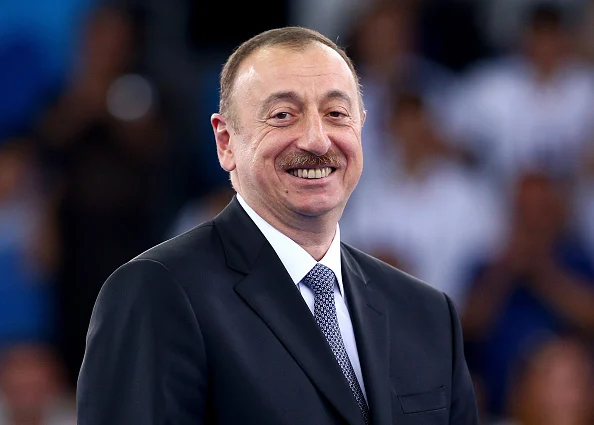
Ilham Aliyev (born December 24, 1961, Baku, Azerbaijan, U.S.S.R. [now Azerbaijan]) is the president of Azerbaijan (2003– ), known for consolidating power, expanding military capacity, and reclaiming control of Nagorno-Karabakh. The son of longtime leader Heydar Aliyev, he has leveraged Azerbaijan’s vast oil and gas wealth to entrench his family’s rule while facing criticism for corruption and authoritarianism.
Early Life and Education
Aliyev was born in Soviet Baku, the second child of Heydar Aliyev and Zarifa Aliyeva, an ophthalmologist. He studied at the Moscow State Institute of International Relations (MGIMO) from 1977, completing both undergraduate and doctoral degrees before becoming a lecturer. His academic career ended in 1990 after Soviet forces killed more than 130 Azerbaijanis in Baku during the “Black January” crackdown, when his father publicly condemned Moscow’s actions.
Struggling in Moscow, Aliyev moved to Istanbul before returning to Azerbaijan in 1993, when his father assumed the presidency amid the first Nagorno-Karabakh conflict.
Rise in Politics and Oil Industry
In 1994, Aliyev was appointed vice president of the State Oil Company of the Azerbaijan Republic (SOCAR). His work focused on partnerships with Western oil companies, culminating in agreements for the Baku–Tbilisi–Ceyhan pipeline (opened 2005), a project that integrated Azerbaijan into global energy markets.
Simultaneously, Aliyev entered parliamentary politics, winning seats in 1995 and 2000. From 2001 to 2003, he represented Azerbaijan in the Parliamentary Assembly of the Council of Europe. In August 2003, with his father gravely ill, he became prime minister and was positioned as the presidential successor.
Presidency: From Dynast to Autocrat
Aliyev was elected president on October 15, 2003, winning more than 75% of the vote in an election widely criticized as fraudulent. He was inaugurated on October 31, following his father’s death.
Under his rule:
- Oil wealth modernized Baku but deepened corruption.
- Repression increased, with media restrictions and imprisonment of opponents.
- A 2009 referendum abolished term limits, allowing Aliyev to remain in office indefinitely.
- A 2016 constitutional reform extended presidential terms to seven years and created the post of vice president, filled in 2017 by his wife, Mehriban Aliyeva.
- He cultivated “caviar diplomacy,” using Azerbaijan’s wealth to influence foreign politicians and institutions.
Despite international criticism, Aliyev sought to project Azerbaijan’s global image by hosting events such as the Eurovision Song Contest (2012), the European Games (2015), and the Formula One Azerbaijan Grand Prix (since 2016)—efforts often described as sportswashing.
Nagorno-Karabakh Conflict and Military Victories
Aliyev’s most significant achievement came in the long-running conflict over Nagorno-Karabakh:
- In 2020, Azerbaijani forces, backed by Turkish drones and Israeli technology, decisively defeated Armenian forces, retaking Shusha and forcing a cease-fire that returned large territories to Azerbaijan.
- In 2022, Azerbaijani forces blockaded the Lachin Corridor, tightening control over the enclave.
- In September 2023, a renewed offensive led to the mass exodus of over 100,000 Armenians from Nagorno-Karabakh, cementing Azerbaijan’s authority.
- In February 2024, Aliyev called early elections and secured another term, capitalizing on his popularity after the victory.
On August 9, 2025, Aliyev signed a historic peace deal with Armenia at the White House, formally ending decades of conflict.
Personal Life
Aliyev married Mehriban Pashayeva in 1983. As first vice president since 2017, she has become one of Azerbaijan’s most influential policymakers. The couple has two daughters, Leyla and Arzu, and a son, Heydar, all of whom have drawn scrutiny for offshore financial dealings.
Key Facts at a Glance
| Year | Event | Outcome |
|---|---|---|
| 1961 | Born in Baku | Son of Heydar Aliyev |
| 1994 | VP of SOCAR | Key role in oil contracts |
| 2003 | Elected president | Succeeded his father |
| 2009 | Abolished term limits | Unlimited presidency |
| 2016 | Extended term to 7 years | Wife named VP in 2017 |
| 2020 | Won war in Karabakh | Major territorial gains |
| 2023 | Renewed offensive | 100,000 Armenians fled |
| 2024 | Early election win | Consolidated power |
| 2025 | Signed peace deal | Armenia–Azerbaijan accord |
Conclusion
Ilham Aliyev has dominated Azerbaijan’s politics for over two decades, fusing dynastic rule with oil wealth. His presidency is marked by authoritarianism at home, sportswashing abroad, and military triumph in Nagorno-Karabakh, culminating in the 2025 peace deal with Armenia. His leadership secures him as one of the most consequential—and controversial—figures in the Caucasus.