Did you know your hair grows like a plant—and can be transplanted? Thanks to advancements in hair transplants in Kenya, it’s now possible to restore bald spots, reshape hairlines, thicken eyebrows, and even grow a full Viking-style beard.
DJ Michael Macharia’s Hairline Transformation
Growing up in Githurai 45, Michael Macharia had a naturally high hairline that made him self-conscious. While it didn’t lead to bullying, it often became a subject of teasing among friends.
As an up-and-coming DJ, image mattered. Despite his talent and confidence behind the decks, the one thing that bugged him was his hairline.
“I just felt uncomfortable,” Michael says. “My friends used to joke about it, but it stuck with me.”
He initially tried hairline tattoos, but they didn’t provide the natural look he wanted. So, he researched alternatives and discovered a hair transplant clinic in Kenya.
Undergoing the Procedure: From Fear to Follicles
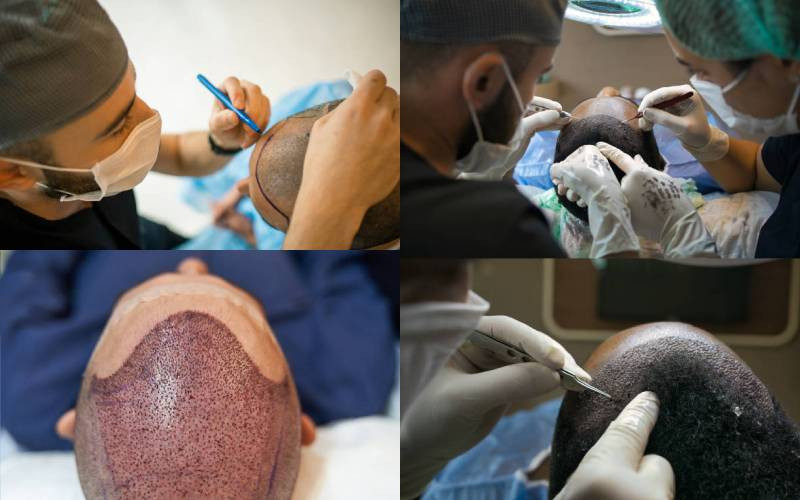
Michael booked an appointment and went through the hair transplant process, which lasted six hours.
- Step 1: Dreadlocks were shaved.
- Step 2: Injections were administered to numb his scalp.
- Step 3: Hair follicles were removed from the back of his head.
- Step 4: Doctors made tiny holes at the front of his scalp and transplanted each follicle one by one.
The pain was minimal, mostly limited to the initial injection. “After that, I felt nothing,” he explains.
The Healing Phase and Regrowth
The first seven days after the transplant required strict care:
- No bending the head.
- No sleeping on the side.
- Stay indoors.
- Use medicated soap and lotion.
- Avoid scratching or touching the scalp.
Two days later, Michael returned for a check-up. At first, the transplanted hair withered—but this was expected. Like a plant, the roots remained. Within a month, new hair started to grow. Now, six months in, he has a full head of natural-looking hair—even his barber can’t tell it’s a transplant.
Hair Clinics and Techniques Used in Kenya
Leader Hair Clinic Kenya is one of the facilities offering advanced hair transplants in Kenya. According to specialist Berkay Kargi, they treat both men (65%) and women (35%) using:
- Sapphire FUE (for bald areas)
- DHI (Direct Hair Implantation) (for thinning hair)
- Hybrid Methods (a combination of both)
He explains that Afro hair requires specialized skill to extract and implant due to its natural curl pattern.
Eyebrow transplants are also offered, but not all Afro hair types are suitable. If successful, the new brow hair grows just like it did on the scalp and must be regularly trimmed.
Why Women Are Opting for Hair Transplants
Women in Kenya are increasingly embracing hair transplant procedures. In salons and forums, the stigma around female hair loss is slowly disappearing. Aging, hormonal changes, and styling damage have led many to seek professional restoration.
Up to 50% of women experience hair loss at some point, and 40% show visible thinning by age 40. Unlike men, female hair loss is more diffuse and subtle, requiring a different transplant approach focused on density enhancement rather than hairline reconstruction.
Celebrity Examples of Hair Transplants
Globally, several female celebrities have undergone hair restoration procedures:
- Fergie Duhamel: Treated for traction alopecia.
- Naomi Campbell: Suffered bald patches from extensions and styling.
- Oprah Winfrey: Restored her hair after years of heavy styling.
- Tyra Banks: Recovered from alopecia areata using hair transplant methods.
These stories have helped normalize the conversation around female hair transplants.
The Cost and Confidence Factor
Michael spent around KES 150,000 for his transplant, a price he says is well worth the boost in confidence.
“I feel great. My confidence is at 100%. I don’t wear hats anymore. My DJ career has improved because now, I walk into a room and feel like I belong,” he shares.
According to Berkay Kargi, patients come in wearing hats and leave beaming. The procedure doesn’t just restore hair—it restores identity, pride, and emotional well-being.