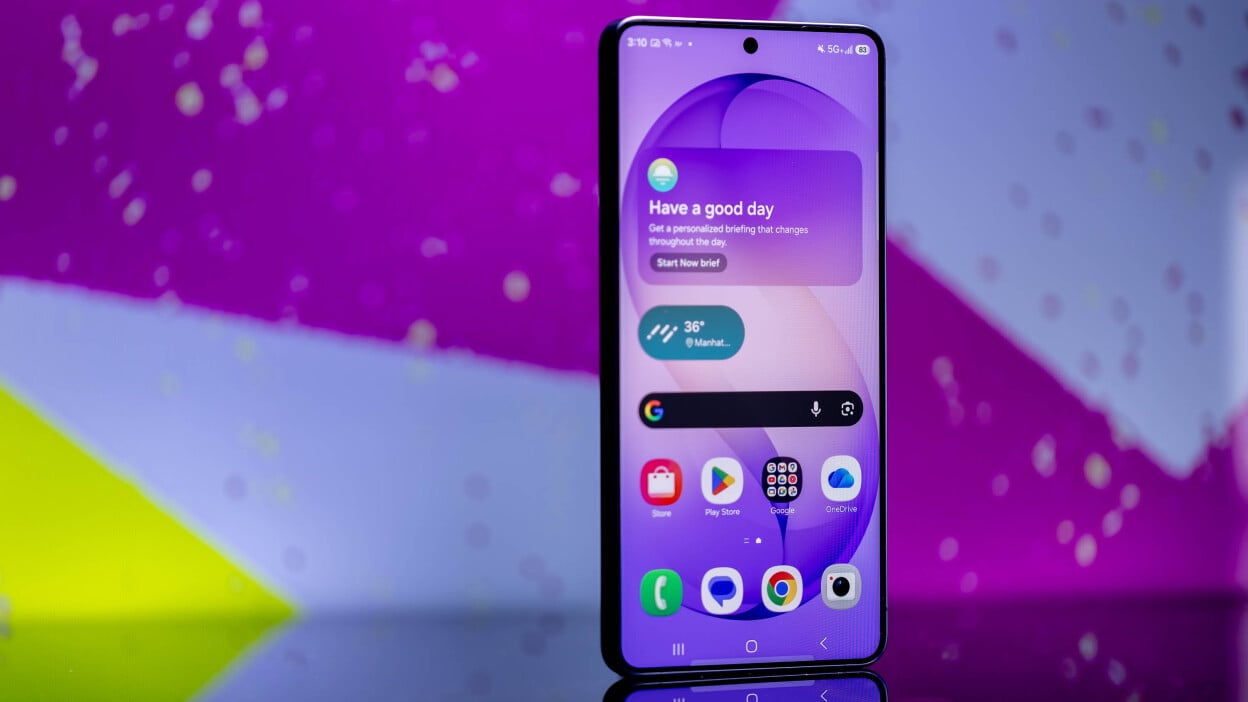
The Galaxy S26 arrives at a time when compact flagships have become a niche within a niche. Most brands now push buyers toward larger screens, larger batteries, and more expensive Pro-tier hardware. Samsung still keeps the smaller flagship alive, and that alone gives the Galaxy S26 a clear role in the market.
Even so, the challenge is obvious. A compact flagship can get away with some compromise, but not too much at this price. The Galaxy S26 improves battery life, keeps Samsung’s polished software experience, and adds a few useful video tools. However, the overall package still feels too close to last year’s model, while several rivals now offer more ambitious hardware.
Specifications Table
| Spec | Details |
|---|---|
| Display | 6.3-inch Dynamic LTPO AMOLED 2X, 1080 x 2340, 1-120Hz, HDR10+, up to 2600 nits peak |
| Chipset | Exynos 2600 (ROW) / Snapdragon 8 Elite Gen 5 (US/CN), Xclipse 960 or Adreno 840 |
| RAM & Storage | 12GB RAM, 256GB/512GB, UFS 4.x, no microSD |
| Rear Camera | 50MP main with OIS + 10MP 3x telephoto with OIS + 12MP ultrawide |
| Front Camera | 12MP with dual pixel PDAF |
| Battery | 4300mAh |
| Charging | 25W wired, 15W wireless, 4.5W reverse wireless |
| OS | Android 16, One UI 8.5, up to 7 major Android upgrades |
| Build | Gorilla Glass Victus 2 front/back, Armor Aluminum 2 frame, IP68 |
| Connectivity | 5G, Wi-Fi 7, Bluetooth 5.4, NFC, USB-C, dual SIM + eSIM, DeX |
Design and Build Quality
The Galaxy S26 does not try to change Samsung’s flagship design language in any major way. It still uses flat glass on the front and back, flat sides, and a neat, minimal frame. In isolation, it looks refined. It also feels expensive in hand. The combination of Victus 2 glass, Armor Aluminum 2, and a 167g weight makes it one of the easier premium phones to carry every day.
The size remains one of its strongest features. Samsung has increased the display to 6.3 inches, but the phone still feels compact by current standards. It is narrow enough for one-handed use, the buttons are easy to reach, and the weight distribution is well judged. If you value comfort more than showmanship, the Galaxy S26 still gets that part right.
Compared with the Galaxy S25, the biggest visible change is the new camera island. Samsung has grouped the rear cameras into a more obvious bump, and it protrudes more than before. That is a step back in day-to-day use. The phone wobbles more on a desk, and the design change does not bring a clear practical benefit.
Build quality is otherwise excellent. The frame feels dense, the seams are tight, and the ultrasonic fingerprint scanner remains one of the best in the class. It is fast, reliable, and less fussy than optical readers. The only real criticism is that Samsung’s compact flagship still settles for IP68 while some rivals have moved beyond that.
Display Performance
The Galaxy S26 uses a 6.3-inch LTPO AMOLED panel with a 1080p resolution and adaptive refresh rate up to 120Hz. This is a very familiar formula, but it still works. The panel is sharp enough at this size, contrast is excellent, and colors look punchy without appearing too unnatural in the default modes.
Brightness remains strong. Manual brightness is decent, auto mode is much better, and peak output is high enough for outdoor use and HDR playback. In practice, the screen is easy to read under sunlight, while the very low minimum brightness also helps at night. That balance matters more than the headline numbers.
Refresh rate behavior is handled well. The display can scale down to 1Hz when idle, and Adaptive mode does a better job matching video frame rates than Standard mode. That helps with smoothness and efficiency. Samsung still has one of the cleaner high-refresh implementations on Android.
There are still a few missing pieces, though. There is no Dolby Vision, no high-frequency PWM dimming, and no 10-bit panel depth. None of those omissions ruin the screen, but together they make the Galaxy S26 feel less complete than some rivals in the same price bracket. Samsung’s added image processing features such as ProScaler and mDNIe help with presentation, yet they do not replace actual hardware gains.
Galaxy S26 Performance and Benchmarks
The Galaxy S26 is one of those phones whose performance story depends on where you buy it. The US and China get Snapdragon 8 Elite Gen 5, while many other markets get the Exynos 2600. The review data here is based on the Exynos model, and that matters.
On paper, the Exynos 2600 is a serious chip. It uses a 2nm process, a new CPU layout, a much stronger NPU, and the new Xclipse 960 GPU. In practice, the results are more mixed. Multi-core performance is strong, and graphics performance is better than last year’s Galaxy S25. However, single-core improvement is modest, and the chip does not consistently pull ahead in all benchmark suites.
Galaxy S26 real-world performance
In daily use, the Galaxy S26 feels fast. Apps launch without delay, multitasking is stable, and One UI 8.5 runs smoothly. That should not be surprising. This is still a high-end chipset paired with 12GB of RAM and fast UFS 4.x storage.
Gaming performance is also solid. The GPU has enough headroom for demanding titles, and the phone does not feel weak in any obvious way. However, the experience is not quite as convincing as the best compact rivals. Frame rates are strong, but not always as class-leading as Samsung’s marketing would suggest. In other words, performance is flagship-grade, just not flagship-leading.
That is the problem with the Galaxy S26. It is not slow. It simply feels less special when you compare it with the best hardware in this segment.
Galaxy S26 thermal performance
Sustained performance is respectable but not exceptional. Under CPU stress, performance drops by around 40%, and GPU stress shows losses above 50%. That means the phone can hold up under normal heavy use, but it does not sustain peak performance especially well over longer sessions.
In practical use, that will matter most to gamers and power users. The phone remains responsive, but it clearly prioritizes manageable heat and compact thermals over long-duration performance. For a small flagship, that trade-off is understandable. Still, some rivals do a better job here.
Camera Performance
The Galaxy S26 carries over the same familiar rear camera arrangement: a 50MP main camera, 10MP 3x telephoto, and 12MP ultrawide. On paper, it looks increasingly conservative for a phone in this price band. In use, it behaves like a mature but aging camera system.
The camera setup is not bad. In fact, it is reliable in good light and strong for video. The issue is that still photo performance no longer leads this class, especially after dark. Samsung gets the basics right, but there is a growing gap between competence and excellence.
Galaxy S26 main camera analysis
The main camera uses a 1/1.56-inch sensor with 1.0µm pixels, dual pixel PDAF, and OIS. In daylight, it captures very good images. Detail is strong, textures look natural enough, white balance is dependable, and dynamic range is wide. Samsung’s processing still tends to favor attractive output, but it avoids the worst excesses of oversharpening.
Human subjects also come out well. Skin tones look pleasing, and Photo mode gives a subtle natural separation before Portrait mode adds more computational blur. Portrait rendering is generally believable, though the default blur can still feel a touch heavy at times.
The main camera’s 2x crop mode is also usable in daylight. It does not look class-leading, but it is better than many digital crops from phones without dedicated intermediate zoom hardware. However, this is one area where the Galaxy S26+ appears slightly sharper, which is a little awkward given how close the phones are on paper.
Galaxy S26 low-light performance
Low-light photography is where the Galaxy S26 loses ground. The hardware can still produce decent results, but Samsung’s current Night mode implementation gets in the way. In full auto, the main camera often produces noisy, somewhat rough images with softer detail than expected from a phone at this price.
More aggressive Night mode processing helps. The problem is that Samsung has made access to it less intuitive than it should be. Sometimes the crescent icon appears, sometimes it does not, and the behavior is inconsistent enough to frustrate even experienced users. A separate Camera Assistant app can restore a more traditional Night mode, but buyers should not need extra setup to get reliable low-light output in 2026.
The telephoto and ultrawide follow a similar pattern. Auto mode results are often soft and noisy, while more deliberate Night mode usage improves things. That means the hardware is not entirely at fault, but the out-of-box experience still falls short. For point-and-shoot stills after dark, the Galaxy S26 does not feel like one of the best compact flagships anymore.
Galaxy S26 video performance
Video is one of the Galaxy S26’s stronger areas. Samsung gives the phone a wide video feature set, including 8K on the main camera, 4K60 on all cameras, 10-bit HDR10+, Log recording, LUT presets, and a strong Pro video mode. There is no 4K120 or APV codec as on the Ultra, but the standard S26 still offers more serious video tools than many direct rivals.
Daylight video quality is very good from the main camera and good from the ultrawide. Colors are slightly warm, dynamic range is wide, and detail holds up well. The 2x crop is respectable, while the 3x telephoto remains only decent rather than impressive.
Low-light video is better than the still photo results suggest. The main camera holds up well, exposure is controlled, and footage stays usable. The ultrawide is acceptable, though softer in shadows. The telephoto struggles more noticeably.
Stabilization is excellent. Samsung has clearly tuned this well, and the Galaxy S26 produces steady handheld clips across its cameras. Horizon Lock is also useful if you actually shoot dynamic clips and want more control. For users who care about mobile video more than still photography, the Galaxy S26 makes a stronger case for itself.
Battery and Charging
Battery life is one of the clearest upgrades this year. Samsung has increased capacity to 4300mAh, and the endurance gains are better than the raw numbers suggest. The phone posts a strong active use result of around 15 hours 20 minutes, which is a meaningful step up from the Galaxy S25.
That makes the Galaxy S26 easier to trust as an all-day phone. For moderate users, it should comfortably last through a day and into the next morning. Heavy users will still need nightly charging, but the anxiety that often follows compact flagships is less obvious here.
Charging is more complicated. The actual charging curve is slightly improved, and the phone reaches 62% in 30 minutes, which is better than last year. A full charge is also quicker than before. Even so, 25W wired charging still looks underwhelming in this class, especially when Samsung’s own midrange lineup has moved further.
Wireless charging remains at 15W, with Qi2 readiness but no built-in magnets. That means the experience feels half-modern. The Galaxy S26 supports the standard, but you still need a magnetic case to get the best from it. Heat management and battery protection features are good, but the headline charging numbers still lag behind many direct competitors.
Software and User Experience
Software remains one of Samsung’s strongest advantages. The Galaxy S26 runs Android 16 with One UI 8.5, and Samsung promises seven major Android updates plus seven years of security patches. That is still among the best support policies in the industry.
The interface is mature, polished, and feature-rich. One UI is no longer trying to imitate stock Android. It has its own logic, its own visual rhythm, and its own ecosystem hooks. That works well if you like Samsung’s approach. Menus are dense but organized, multitasking tools are strong, and DeX still adds genuine utility for some users.
Most of the visible changes this year sit inside Galaxy AI rather than in the core interface. Some users will find those additions useful. Others will see them as secondary to the usual fundamentals of speed, battery life, and camera quality. The good news is that One UI itself feels stable and refined regardless of how much AI you use.
The downside is familiar too. Samsung still preloads more services and ecosystem prompts than Google or Apple. It is not a bloated mess, but it is busier than the cleaner Android skins. Even so, for long-term usability and update confidence, the Galaxy S26 remains strong.
Connectivity and Extras
Connectivity is up to flagship expectations. The Galaxy S26 supports 5G, Wi-Fi 7, Bluetooth 5.4, NFC, eSIM, and USB-C, with Samsung DeX and Wireless DeX still offering a practical extra that few direct rivals can match.
The ultrasonic fingerprint scanner is excellent. It is faster and more tolerant than many optical solutions, and it adds to the sense of polish in daily use. Speaker tuning is also good, and stereo output remains competitive for a compact phone.
There are still some missing features to note. There is no microSD slot, no headphone jack, and no top-tier water resistance standard beyond IP68. Those omissions are not surprising, but they do matter when rivals start offering more on the margins.
Audio and Multimedia
The stereo speakers are good, though slightly quieter than last year by loudness figures. In return, the tuning is a bit warmer and more balanced, especially for vocals. That trade-off is reasonable. The phone sounds fuller and less sharp, which helps with music, video, and podcasts.
For multimedia, the Galaxy S26 does well overall. The AMOLED screen is bright and smooth, the speaker setup is competent, and HDR10+ support helps with compatible content. Gaming also benefits from the responsive display and stereo layout.
The only frustration is that this part of the experience is good without being cutting-edge. That becomes a recurring theme in the whole review. Samsung delivers few bad choices, but also fewer standout hardware wins than expected.
Competition and Market Position
The Galaxy S26 sits in a crowded part of the market. In the US, it lines up against the iPhone 17 Pro and Pixel 10 Pro. In Europe and Asia, it also faces the Xiaomi 17 and vivo X300, both of which make Samsung’s job harder.
Against the Pixel 10 Pro, the Galaxy S26 fights back with stronger video tools, a better ultrawide, and competitive battery life. Against the iPhone 17 Pro, it offers a familiar Android alternative with a more open ecosystem and stronger desktop-style features through DeX. Those are real advantages.
The problem appears when the comparison broadens. The Xiaomi 17 and vivo X300 push harder on battery capacity, charging speed, and still camera ambition. In pure value-for-money terms, Samsung’s compact flagship looks conservative. It is easier to justify if you already prefer One UI, Samsung’s ecosystem, or the compact Galaxy formula. It is harder to justify if you are shopping with a cold eye for hardware value alone.
That leaves the Galaxy S26 in a defensive position. It is a polished compact flagship with long-term support and a strong software identity. However, it is no longer the obvious all-round pick in its segment.
Verdict
The Galaxy S26 is easy to like and harder to recommend. It feels premium, lasts longer than its predecessor, and continues to offer one of the most mature software experiences in Android. It also remains one of the few genuinely compact flagship options left.
At the same time, the hardware story feels too restrained. Charging is slow for the segment, the still cameras are no longer especially competitive, and the year-over-year changes are modest. Samsung has polished the formula, but it has not meaningfully pushed it forward.
Why This Phone Matters in Africa
The Galaxy S26 matters in Africa because Samsung’s brand strength still carries real weight across the continent. Buyers often think beyond benchmark numbers. They look at service access, resale value, software longevity, and network reliability. In those areas, Samsung usually has an advantage over smaller or less established premium brands.
Battery reliability is also important. The gains this year make the Galaxy S26 more practical for users who spend long hours away from power. Its compact size is another plus for people who want a premium phone that is easier to carry and use one-handed.
Network compatibility should be good in most markets, though variant differences always matter and should be checked before purchase. Repairability and resale are also likely to be stronger than on many Chinese flagships, simply because Samsung has wider support channels and a healthier second-hand market in many African cities.
The main issue is price sensitivity. In Africa, value for money tends to matter more than minor refinements. That means the Galaxy S26 will appeal most to buyers who specifically want Samsung, compact size, and long support. Buyers focused strictly on hardware value may find better deals elsewhere.
Final Thoughts
The Galaxy S26 is best for buyers who want a compact premium phone, care about software support, like One UI, and shoot a fair amount of video. It is also a sensible option for Samsung users who want to stay in the brand without moving to a larger device.
It is less convincing for buyers who prioritize still photography in low light, charging speed, or raw value for money. Those users should look harder at the Pixel 10 Pro, iPhone 17 Pro, Xiaomi 17, or vivo X300 depending on priorities and regional pricing. The Galaxy S26 should age well on the software side, and its resale strength will likely remain solid, but the hardware itself feels more iterative than ambitious.
The Review
Galaxy S26
The Samsung Galaxy S26 is a premium compact flagship with strong software, improved battery life, and reliable long-term support. It stands out for users who value Samsung’s ecosystem, resale value, and service availability, especially in African markets.However, the phone feels too incremental. Charging is slow, cameras are no longer class-leading, and upgrades over the previous model are modest.In Africa, it remains appealing due to brand trust, durability, and resale strength, but its high price makes it less attractive for buyers focused on raw value.
PROS
- Compact and premium build
- Bright LTPO AMOLED display
- Clearly improved battery life over the S25
- Excellent ultrasonic fingerprint reader
- Strong selfie camera with autofocus
- Very good video features and stabilization
- Seven years of software support
- DeX remains genuinely useful
CONS
- Too small an upgrade over the Galaxy S25
- 25W charging is behind many rivals
- Exynos model does not feel equally competitive everywhere
- Rear camera hardware looks dated for the price
- Night mode behavior is confusing and inconsistent
- New camera bump adds wobble without clear benefit
- No Dolby Vision, no high-frequency PWM, no 10-bit panel
- Better value options exist in many markets
 Samsung