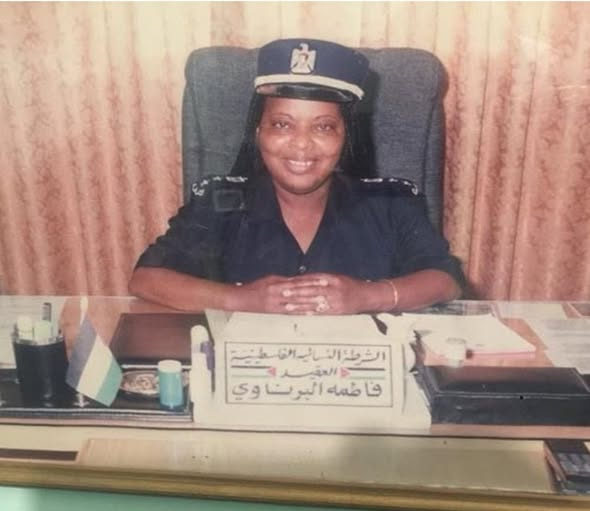
Fatima Barnawi, widely recognized as the founder of the Palestinian Women’s Police, played a central role in shaping women’s participation in Palestinian security institutions following decades of political activism and imprisonment. Her life spanned key historical phases in the Palestinian struggle, from the British Mandate period to the post-Oslo political era.
Barnawi was born in 1939 in the Old City of Jerusalem during the British Mandate. Her father, of Nigerian origin, was among Africans who had travelled to Jerusalem for pilgrimage and trade before settling permanently, while her mother was Palestinian-Jordanian. She grew up in a community that included families from sub-Saharan Africa living in Jerusalem.
Fatima Barnawi Early Life and Displacement
Following the establishment of the state of Israel in 1948, Barnawi and her family relocated to Jordan, where they lived for several years before returning to Jerusalem. This early displacement reflected broader population movements that affected many Palestinian families during that period.
Her upbringing in a diverse community and exposure to political developments in the region shaped her later involvement in activism.
Fatima Barnawi Arrest and Imprisonment
In October 1967, Barnawi became the first woman to be arrested by Israeli forces in connection with militant activities. She was detained and later tried by an Israeli military court.
The court found her guilty of terrorism and sentenced her to life imprisonment after she was accused of planting explosives outside a cinema in West Jerusalem. The device did not detonate after being discovered shortly before the scheduled explosion.
Barnawi spent nearly 11 years in prison. Her case drew attention as one of the earliest instances of a woman involved in militant activity being prosecuted under Israeli law.
Deportation and Role in Fatah
In 1977, Barnawi was deported to Lebanon, where she joined the Fatah movement. She worked as a nurse, a role that brought her into direct contact with Yasser Arafat, then head of Fatah and chairman of the Palestine Liberation Organisation (PLO).
Her involvement in Fatah during this period placed her within the broader framework of Palestinian political and organizational structures.
Fatima Barnawi and the Oslo Accords Era
After the signing of the Oslo Accords in 1993, Barnawi returned to the Gaza Strip as part of the changes that followed the agreement between Israel and the PLO.
She was tasked by Arafat with establishing a women’s police unit, marking a shift from activism to institutional development.
Fatima Barnawi and the Palestinian Women’s Police
Barnawi led the formation of the Palestinian Women’s Police, becoming a colonel and overseeing an initial group of 30 policewomen. The initiative represented a significant step in integrating women into formal security roles.
Over time, the force expanded. By July 2022, the all-female police unit had grown to include 532 officers, reflecting sustained institutional development.
Recognition and Later Life
In 2015, Mahmoud Abbas awarded Barnawi the Military Star of Honour in recognition of her contributions.
She died in 2022 at the age of 83, leaving behind a legacy tied to both political activism and institutional leadership.
Broader Implications
Barnawi’s life illustrates the intersection of political struggle and state-building efforts. Her transition from prisoner to security leader highlights the evolving roles of individuals within shifting political contexts.
Outlook on Legacy
Fatima Barnawi remains a notable figure in Palestinian history. Her contributions continue to be referenced in discussions about women’s roles in security, governance, and political movements.