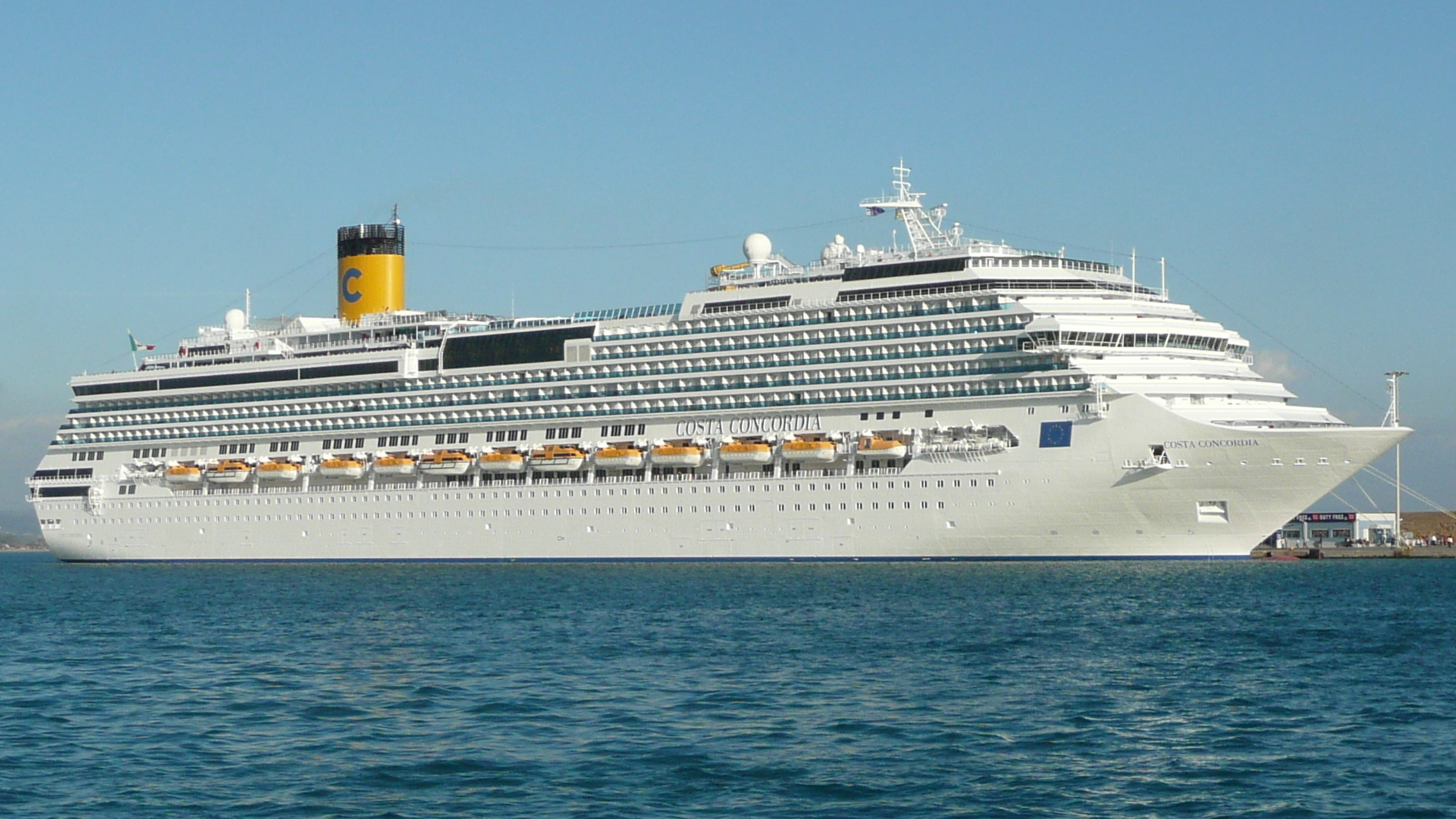
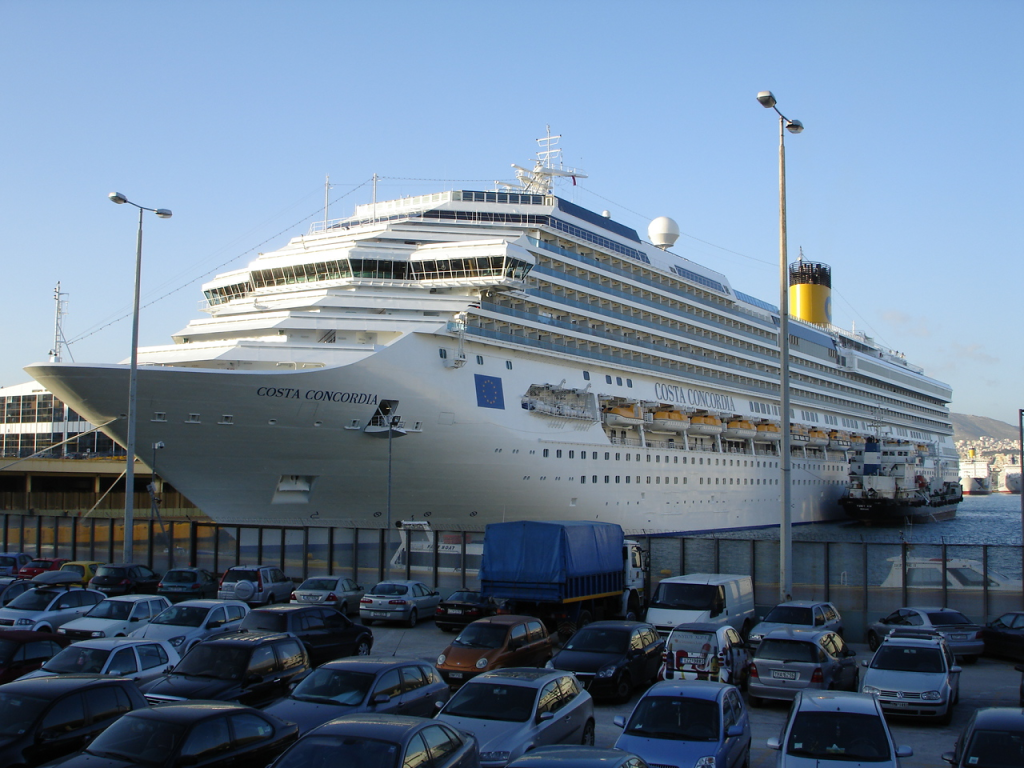
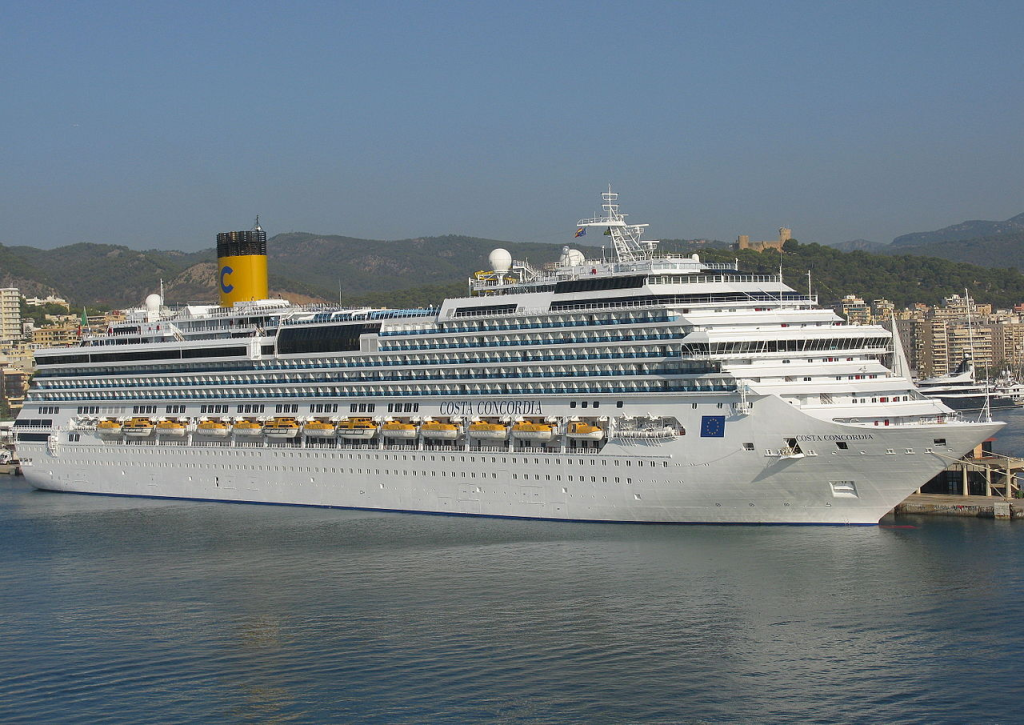
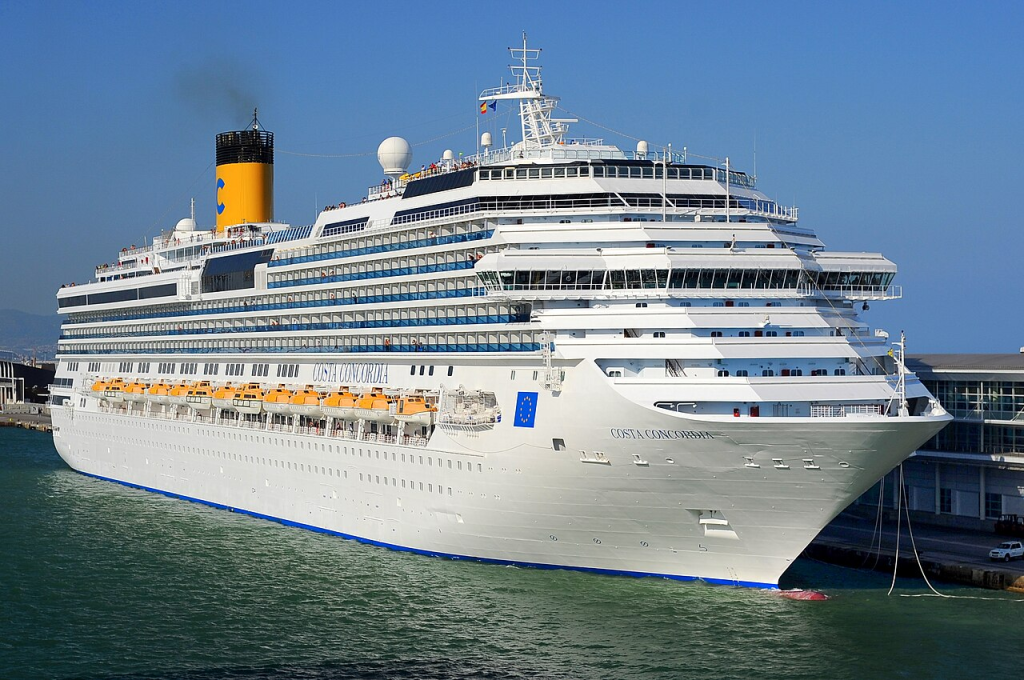
The Costa Concordia (Italian pronunciation: [ˈkɔsta konˈkɔrdja]) was a cruise ship operated by Costa Crociere. It was the lead ship of its class, followed by sister ships Costa Serena, Costa Pacifica, Costa Favolosa, and Costa Fascinosa, as well as Carnival Splendor, built for Carnival Cruise Line. When the 114,137-ton Costa Concordia and its sister ships were introduced, they were among the largest ships constructed in Italy until the 130,000 GT Dream-class cruise ships were built.
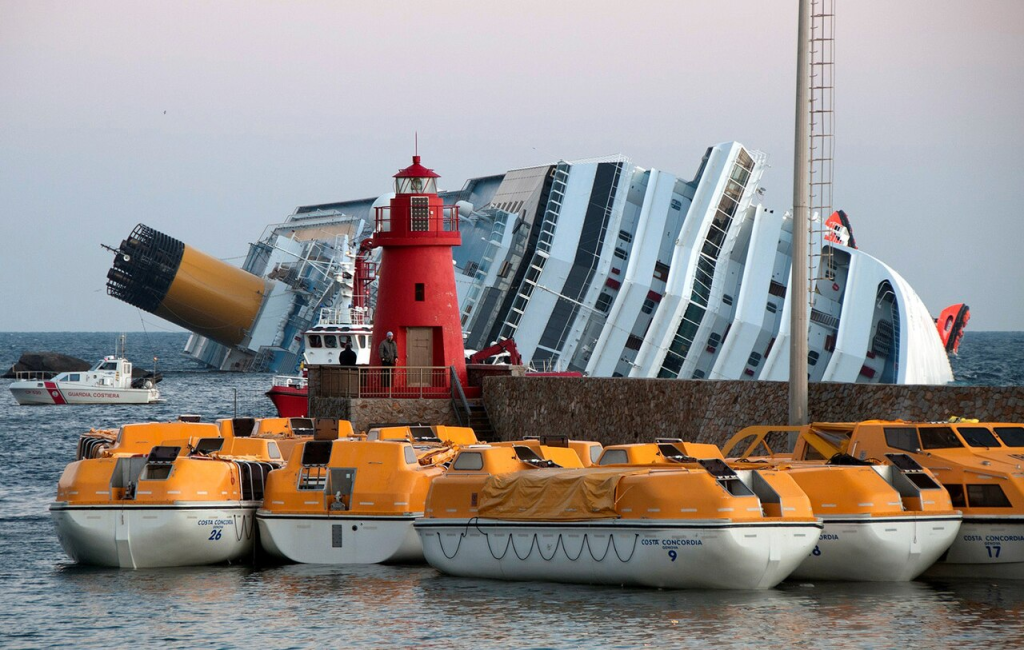
On January 13, 2012, at 21:45, the Costa Concordia struck a rock in the Tyrrhenian Sea near the eastern coast of Isola del Giglio. This collision tore a 50-meter (160-foot) gash in the port side of its hull, causing parts of the engine room to flood and cutting power to the engines and ship services. As the ship began to list and take on water, it drifted back toward the island and eventually grounded near shore, capsizing onto its starboard side on a rocky underwater ledge.
The evacuation of the Costa Concordia lasted over six hours. Of the 3,229 passengers and 1,023 crew members on board, 32 lost their lives. The ship’s captain, Francesco Schettino, was later convicted of manslaughter, causing a maritime accident, and abandoning the ship, receiving a 16-year prison sentence in 2015. The wreckage was salvaged three years after the incident and towed to Genoa for dismantling.
Concept and Construction
The Costa Concordia was ordered in 2004 by Carnival Corporation from Fincantieri and built at the Sestri Ponente shipyard in Genoa, with yard number 6122. At the ship’s launch on September 2, 2005, a champagne bottle swung by model Eva Herzigová failed to break against the hull on the first try, an event considered a bad omen among sailors. This incident has been partly blamed for the ship’s accidents in 2008 and its eventual sinking in 2012.
The Costa Concordia was delivered to Costa on June 30, 2006, at a cost of €450 million (£372 million, US$570 million). The name “Concordia” symbolized a desire for “continuing harmony, unity, and peace among European nations.”
Description
The Costa Concordia was 290.20 meters (952 ft 1 in) long, with a beam of 35.50 meters (116 ft 6 in) and a draft of 8.20 meters (26 ft 11 in). It was powered by a Diesel-electric power plant consisting of six 12-cylinder Wärtsilä 12V46C four-stroke medium-speed diesel generators, producing a total of 76.6 MW (102,780 hp). These generators provided power for all ship systems, including propulsion and hotel services. The ship was driven by two 21-megawatt electric motors connected to fixed-pitch propellers, achieving a design speed of 19.6 knots (36 km/h; 23 mph) and a maximum speed of 23 knots (43 km/h; 26 mph) during sea trials.
Layout
The Costa Concordia featured 13 public decks, each named after a European country:
- Deck 1: Olanda (Holland)
- Deck 2: Svezia (Sweden)
- Deck 3: Belgio (Belgium)
- Deck 4: Grecia (Greece)
- Deck 5: Italia (Italy)
- Deck 6: Gran Bretagna (Great Britain)
- Deck 7: Irlanda (Ireland)
- Deck 8: Portogallo (Portugal)
- Deck 9: Francia (France)
- Deck 10: Germania (Germany)
- Deck 11: Spagna (Spain)
- Deck 12: Austria (Austria)
- Deck 14: Polonia (Poland)
Amenities
The Costa Concordia had around 1,500 cabins, including 505 with private balconies and 55 with direct access to the Samsara Spa, designated as Spa staterooms. It also had 58 suites with private balconies and 12 with direct spa access. The ship featured one of the largest exercise areas at sea, the Samsara Spa, a two-level, 6,000 m² (64,600 sq ft) fitness center equipped with a gym, thalassotherapy pool, sauna, Turkish bath, and solarium. There were four swimming pools (two with retractable roofs), five Jacuzzis, five spas, and a poolside movie theater. Dining options included five on-board restaurants, with Club Concordia and Samsara offering reservations-only dining, and 13 bars, including a cigar and cognac bar and a coffee and chocolate bar. Entertainment facilities included a three-level theater, a casino, a futuristic disco, a children’s area with video games, a basketball court, a Grand Prix motor racing simulator, and an internet café.
Accidents and Incidents
2008 Bow Damage
On November 22, 2008, the Costa Concordia sustained damage to its bow when strong winds in Palermo, Sicily, pushed the ship against the dock. No injuries were reported, and repairs began soon after. Initial repairs were completed in December, though some dents remained visible until they were fully repaired during a 2011 refurbishment.
2012 Grounding and Partial Sinking
On January 13, 2012, under Captain Francesco Schettino’s command, the Costa Concordia departed Civitavecchia, the port serving Rome, for a seven-night cruise. At 21:45 local time, in calm seas and overcast conditions, the ship collided with a rock off Isola del Giglio, creating a 53-meter (174 ft) gash along the port-side hull, which damaged three compartments of the engine room and caused power outages. The ship listed to the starboard side and was later pushed back toward Giglio Island by strong winds, grounding 500 meters (550 yards) north of Giglio Porto. The ship rested on its starboard side in shallow water, with much of the starboard side submerged.
Although international maritime law requires evacuation within 30 minutes of an order to abandon ship, the evacuation of the Costa Concordia took over six hours. The ship was carrying 3,206 passengers and 1,023 crew members at the time. The incident resulted in 32 fatalities, with the body of the last missing person, Indian crew member Russel Rebello, being recovered on November 3, 2014. Rebello is believed to have died while helping others.
Salvage
An initial assessment by salvage experts Smit International estimated that removing the Costa Concordia and its 2,380 tonnes of fuel could take up to 10 months. Smit recommended writing off the ship as a constructive total loss due to severe damage. Smit was contracted to remove the fuel from the ship.
During the fuel removal process, Smit reported that the ship had shifted 60 cm (24 in) in the three weeks since the grounding, though there was no immediate risk of it breaking apart or sinking further. Fuel removal was completed in March 2012, clearing the way for the ship’s ultimate salvage and scrapping.
On September 17, 2013, the Costa Concordia was brought to a vertical position through a parbuckling procedure. The salvage operation’s cost increased to $799 million. The ship had suffered severe hull deformations in two areas, and the next phase of the operation was expected to be completed by early-to-mid 2014. After the “floating” operation, the ship was to be towed to a salvage yard on the Italian mainland for dismantling.
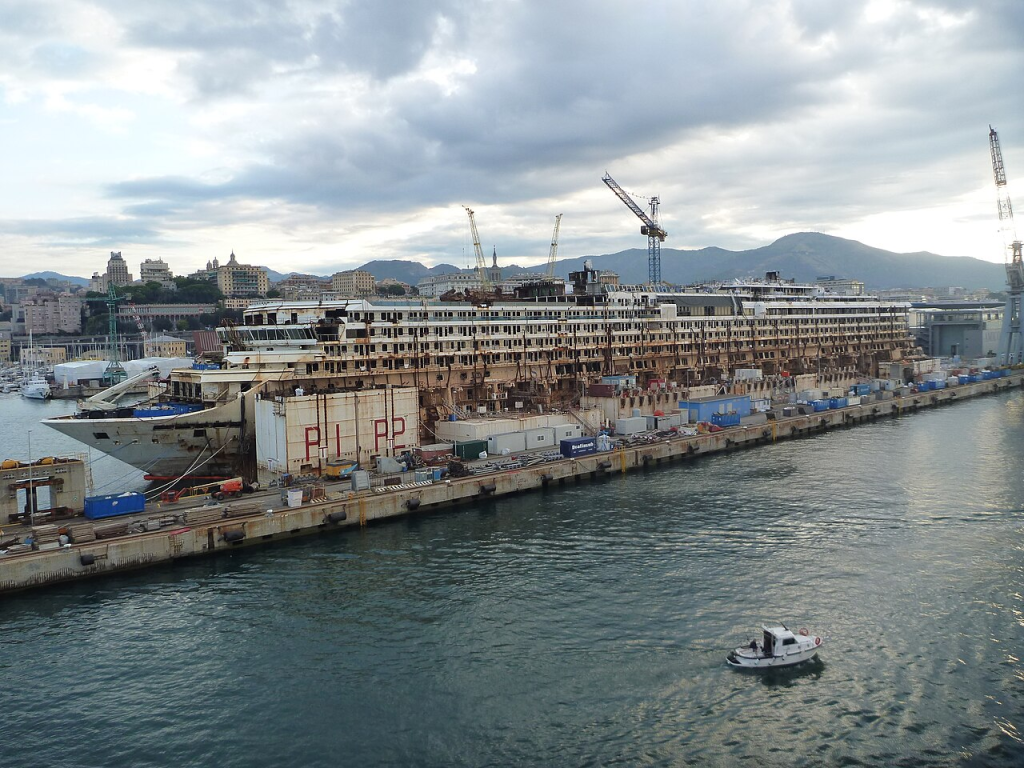
On July 14, 2014, work began to refloat the Costa Concordia in preparation for towing. By this time, costs had risen to €1 billion, with the final cost, including towing, breaking, and damage repair to Giglio Island, estimated at €1.5 billion ($2 billion). The ship commenced its final journey to Genoa for scrapping on July 23, traveling at 2 knots (4 km/h; 2 mph) with a 14-ship escort. It arrived at port on July 27 after a four-day journey, where it was moored to a seawall, awaiting dismantling.
On May 11, 2015, following initial dismantling, the hull was towed 10 miles (16 km) to the Superbacino dock in Genoa for upper deck removal. The last sponsons were removed in August 2016, and the hull was taken to a drydock on September 1 for final dismantling. Scrapping was completed on July 7, 2017.
In Popular Culture
In 2010, the Costa Concordia served as the setting for Jean-Luc Godard’s film Socialisme.
American poet and singer Patti Smith composed parts of her 2012 album Banga aboard the ship. Smith and Lenny Kaye were invited by Godard to accompany him during the filming of Socialisme. The Banga CD booklet includes photos of Smith and her band during their cruise.
On April 11, 2012, the United Kingdom aired a documentary titled Terror at Sea: The Sinking of the Costa Concordia, followed by The Sinking of the Concordia: Caught on Camera, which featured footage recorded by passengers and crew.
On July 14, 2012, the Discovery Channel aired a documentary titled Cruise Ship Disaster: Inside the Concordia. CNN followed with CNN Presents: Cruise to Disaster, and the National Geographic Channel aired Inside Costa Concordia: Voices of Disaster. The season 39 Nova episode “Why Ships Sink” discussed the Costa Concordia sinking. A later Nova episode, “Sunken Ship Rescue,” covered the salvage efforts to refloat and remove the damaged Costa Concordia before it could break apart, risking environmental catastrophe.
On February 15, 2013, ABC’s 20/20 aired a special on the sinking and survivor interviews following an engine fire on the Carnival Triumph.
In Paolo Sorrentino’s 2013 film The Great Beauty, the wreckage of the Costa Concordia was featured.
On November 10, 2015, the U.S. true crime TV series Corrupt Crimes aired an episode about the Costa Concordia sinking titled Death on the High Seas.
On May 20, 2016, indie rock band Car Seat Headrest released their eleventh album Teens of Denial, which included the song “The Ballad of the Costa Concordia,” referencing the wreck in its lyrics.
Nick Sloane
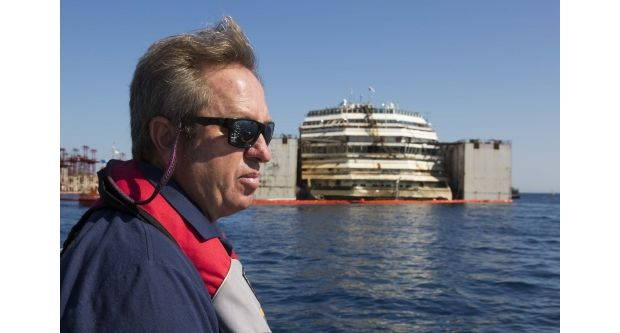
Nicholas Sloane (born 5 July 1961 in Kitwe, Zambia) is an engineer who works in marine salvage.
He is best known for leading the salvage operation of the wrecked Costa Concordia in September 2013. The ship had collided with rocks near Isola del Giglio, Tuscany in January 2012, and had been aground for 20 months before its successful salvage. The salvage was preceded by 16 months of preparatory work, and took a total of 19 hours to complete. In 2015 Sloane won the German Sea Prize for this salvage action.
Sloane has worked on plans to tow an iceberg from the Antarctic Ocean to Cape Town in South Africa.