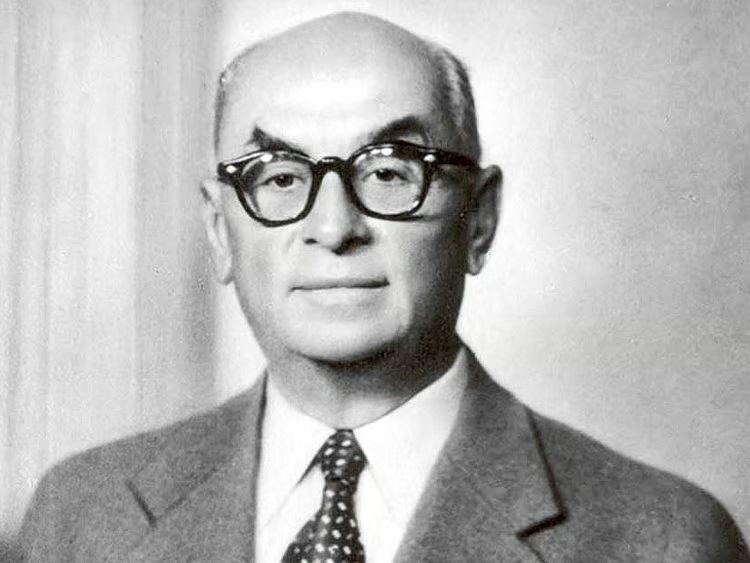
Celâl Bayar was born on May 15, 1882/83, in Umurbey, near Bursa, then part of the Ottoman Empire. The son of a mufti (Islamic jurist), he was educated at a French school operated by the Alliance Israélite Universelle, where he studied economics and finance.
Bayar initially worked at the Deutsche Orient Bank in Bursa before joining the Committee of Union and Progress (CUP), the Young Turk movement opposed to Sultan Abdülhamid II. Following the collapse of the Ottoman Empire, Bayar became a close ally of Mustafa Kemal Atatürk, organizing nationalist resistance in western Anatolia during the Turkish War of Independence (1919–23).
In 1920, he was elected as deputy for Smyrna to the last Ottoman Parliament, but after it was dissolved by occupying British forces, he fled to Ankara to join Atatürk’s Grand National Assembly (GNA). Bayar then served as minister of economy (1921–22) and later as minister of reconstruction and settlement (1922–24) in the early Turkish Republic before resigning to help establish Türkiye İş Bankası (İş Bank), the country’s first modern commercial bank.
Prime Minister and Economic Architect
In the 1930s, Bayar rose to prominence as a strong advocate of etatism, or state-directed economic development. Appointed minister of economy in 1932, he oversaw significant industrial and mining projects. By 1937, he was elevated to the post of prime minister, succeeding İsmet İnönü, but he resigned in early 1939 following Atatürk’s death.
Bayar was known for balancing state control with private enterprise, laying the foundation for Turkey’s mixed economy in the decades that followed.
President of Turkey (1950–1960)
In 1946, Bayar broke away from the ruling Republican People’s Party (CHP) and co-founded the Democrat Party (DP) with Adnan Menderes, Refik Koraltan, and Mehmed Fuad Köprülü. Their new party advocated political liberalization and economic reforms.
The Democrat Party won a landslide in the 1950 elections, and Bayar was elected as the third president of the Republic of Turkey. He was reelected in 1954 and again in 1957, presiding over a decade of dramatic political and economic change. Under Bayar’s leadership, Turkey emphasized private enterprise while restricting the state’s role largely to regulation.
However, political tensions grew as the Democrat Party cracked down on dissent, restricted press freedoms, and centralized power. Discontent among the military, opposition, and public culminated in the coup of May 27, 1960.
Imprisonment, Memoirs, and Later Life
Bayar was arrested and tried alongside other Democrat Party leaders on charges of treason and crimes against the state. In 1961, he was sentenced to death, but due to his advanced age, the punishment was commuted to life imprisonment. He was released in 1964 for health reasons and received a full pardon in 1966.
In retirement, Bayar wrote his multi-volume memoirs, Ben de Yazdım (“I, Too, Have Written”), which offered a firsthand account of Turkish politics from the Young Turks through the Democrat Party era.
Celâl Bayar lived to the age of 103, passing away on August 22, 1986, in Istanbul. His life spanned the Ottoman Empire, the Turkish War of Independence, Atatürk’s republic, and modern Turkey’s political transformations.
Quick Facts
| Attribute | Details |
|---|---|
| Full Name | Mahmud Celâl Bayar |
| Born | May 15, 1882/83, Umurbey, near Bursa, Ottoman Empire |
| Died | August 22, 1986, Istanbul |
| Title / Office | President of Turkey (1950–1960), Prime Minister (1937–1939) |
| Political Affiliation | Democrat Party, formerly CHP |
| Notable Achievements | Co-founder of Democrat Party, promoted etatism, architect of private-enterprise economic policy |
| Key Works | Ben de Yazdım (memoirs) |
| Historical Significance | Longest-lived Turkish statesman, central figure in transition from single-party to multiparty politics |