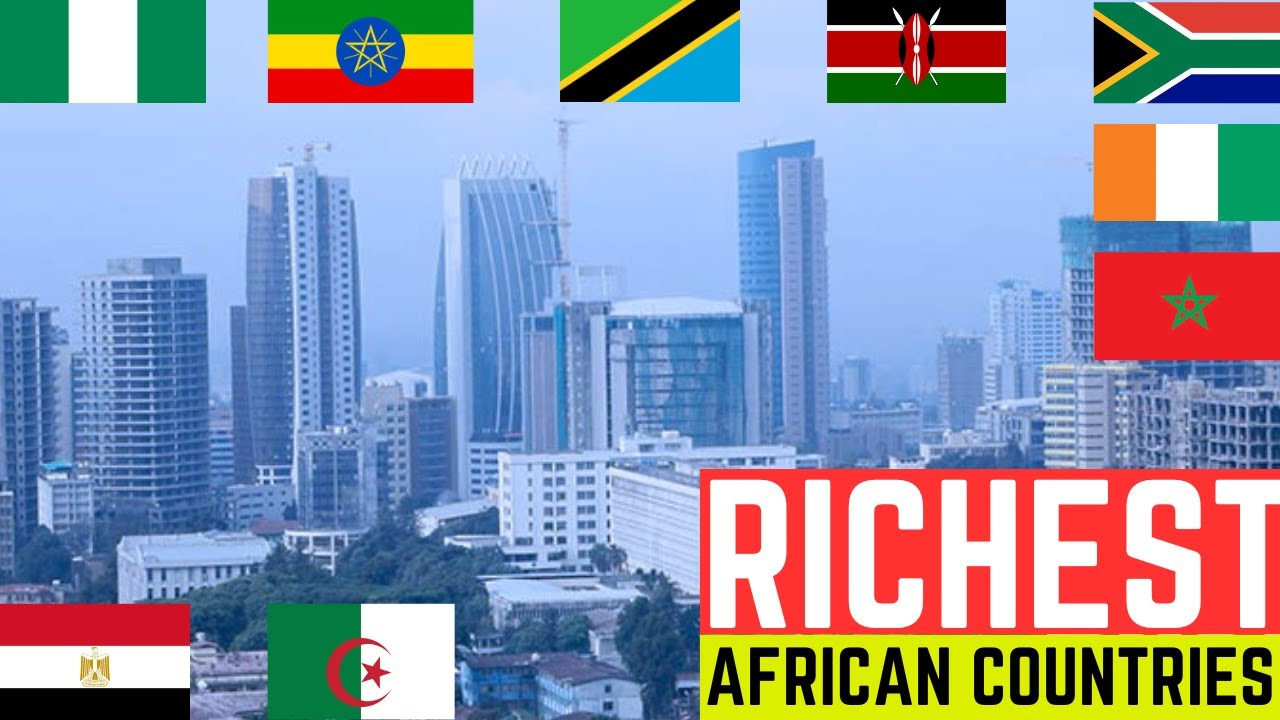
Africa’s richest economies in 2026 show a continent in transition, with established powerhouses still leading the table while fast-growing countries reshape the lower end of the top ten.
Latest nominal GDP projections from the International Monetary Fund place South Africa first, followed by Egypt and Nigeria. Algeria and Morocco complete the top five, while Angola, Kenya, the Democratic Republic of Congo, Ethiopia and Ghana round out the top ten.
The ranking is based on nominal GDP, meaning the value of goods and services produced in each economy is measured in current US dollars. It does not adjust for population size, income levels or cost of living. That makes it useful for comparing the size of national economies, but it does not necessarily show which country is richest per person.
South Africa remains Africa’s largest economy because of its diversified industrial base, advanced financial sector and deep corporate market. Egypt follows with a large population, infrastructure spending, energy activity and a recovery in tourism. Nigeria, Africa’s most populous country, ranks third after a major rebound in its projected dollar GDP.
The list also shows the importance of natural resources. Algeria and Angola remain heavily linked to oil and gas. DR Congo is rising on the back of copper and cobalt demand. Ghana still depends on gold, cocoa and oil.
At the same time, economies such as Kenya, Morocco and Ethiopia show how services, manufacturing, logistics, technology and infrastructure can expand national output beyond traditional commodity exports.
1. South Africa: $479.96 Billion
South Africa remains Africa’s largest economy in 2026, with nominal GDP projected at $479.96 billion.
The country’s economic strength comes from its diversity. South Africa has one of the continent’s most developed financial systems, strong capital markets, major mining operations, manufacturing capacity, telecommunications firms, retail groups and a large services sector.
Johannesburg remains a financial hub for Africa, while South African banks, insurers, retailers and industrial companies operate across the continent. Mining also remains central, with gold, platinum group metals, coal and other minerals supporting exports and investment.
However, South Africa still faces major structural challenges. Electricity supply problems, logistics delays, rail weaknesses, port inefficiencies and slow growth have limited its potential. High unemployment and inequality also remain serious concerns.
Even with those pressures, South Africa’s economic complexity keeps it ahead of the continent’s other large economies.
2. Egypt: $429.65 Billion
Egypt ranks second among Africa’s richest economies in 2026, with nominal GDP projected at $429.65 billion.
The country benefits from a large population, strategic location, energy activity, tourism, agriculture, construction and the Suez Canal. Its position between Africa, the Middle East and Europe gives it major trade and logistics importance.
Large infrastructure projects have shaped Egypt’s economy in recent years. Investment in roads, cities, ports, energy and industrial zones has helped support economic activity. The Suez Canal Economic Zone remains a key part of Egypt’s long-term investment strategy.
Tourism is another major driver. Egypt’s historical sites, Red Sea resorts and cultural attractions continue to bring in foreign exchange when global travel conditions are favourable.
Still, Egypt faces pressure from inflation, currency weakness, debt costs and household strain. Its economy is large and diversified, but maintaining stability remains a central policy challenge.
3. Nigeria: $377.37 Billion
Nigeria ranks third in Africa, with nominal GDP projected at $377.37 billion in 2026.
Nigeria remains the continent’s most populous country and one of its most important markets. Its economy is powered by oil, gas, telecommunications, banking, agriculture, entertainment, technology, trade and a large consumer base.
The projected GDP figure marks a major rebound in Nigeria’s dollar-denominated economic size. Reforms around the foreign exchange market, fuel subsidies and public finances have changed the country’s economic direction, although the effects have been difficult for many households and businesses.
Nigeria’s biggest opportunity is scale. With more than 200 million people, a young population and a fast-growing digital economy, the country has enormous long-term potential. Lagos remains one of Africa’s most important commercial and technology centres.
However, inflation, currency volatility, insecurity, infrastructure gaps, power shortages and oil dependence remain major constraints. Nigeria’s ranking shows strength, but its next challenge is turning size into broad-based prosperity.
4. Algeria: $317.17 Billion
Algeria ranks fourth, with nominal GDP projected at $317.17 billion.
The country’s economy remains heavily supported by hydrocarbons. Oil and gas exports provide a major share of government revenue, export earnings and foreign currency inflows.
Algeria has benefited from strong energy demand and its strategic role as a gas supplier, especially to Europe. Its large domestic market and state-led investment also support economic activity.
The government has tried to diversify the economy through manufacturing, agriculture, renewable energy and non-hydrocarbon exports. Progress has been gradual because the energy sector still dominates public finances.
Algeria’s position in the top five shows the continued power of natural resources in Africa’s economic rankings. Long-term growth will depend on how quickly it can broaden its productive base beyond oil and gas.
5. Morocco: $194.33 Billion
Morocco ranks fifth, with nominal GDP projected at $194.33 billion.
Morocco is one of Africa’s most diversified and strategically positioned economies. It has built strong sectors in tourism, agriculture, automotive manufacturing, aerospace, textiles, renewable energy and logistics.
The country has become a major manufacturing hub linked to European supply chains. Automotive production is one of Morocco’s strongest success stories, supported by industrial zones, port infrastructure and foreign investment.
Tourism also plays a major role, with cities such as Marrakech, Casablanca, Rabat, Tangier and Fez attracting visitors from Europe, the Middle East and beyond.
Morocco’s economic model benefits from infrastructure investment and trade links. However, agriculture remains exposed to drought, while youth employment and regional inequality remain important challenges.
Even so, Morocco’s diversified structure gives it one of Africa’s most resilient economic profiles.
6. Angola: $152.35 Billion
Angola ranks sixth, with nominal GDP projected at $152.35 billion.
The country remains one of Africa’s major oil producers. Crude exports still drive government revenue, foreign exchange earnings and much of the wider economy.
Angola has worked to improve fiscal discipline, attract investment and reduce public debt pressures. Reforms have targeted the business environment, state-owned enterprises and economic diversification.
However, oil dependence remains the country’s biggest structural challenge. When oil prices are strong, Angola benefits. When prices fall or production declines, the wider economy feels pressure.
The government has identified agriculture, mining, manufacturing and logistics as long-term diversification priorities. Turning those sectors into large engines of growth will determine whether Angola can reduce its exposure to oil cycles.
7. Kenya: $147.26 Billion
Kenya ranks seventh, with nominal GDP projected at $147.26 billion.
Kenya remains East Africa’s largest economy and one of the continent’s most important business hubs. Nairobi is a regional centre for finance, technology, diplomacy, logistics, media and innovation.
The country’s digital economy is a major advantage. Mobile money, fintech, startups and digital services have helped Kenya build a reputation as one of Africa’s most innovative markets.
Agriculture remains a key sector, supporting employment and exports through tea, coffee, horticulture and livestock. Transport and logistics also matter because Kenya links the port of Mombasa to Uganda, Rwanda, South Sudan and parts of the wider region.
Kenya’s growth story is strong, but the country also faces fiscal pressure, debt servicing costs, high living costs and infrastructure financing challenges. Its position in the top ten shows regional strength, but sustaining growth will require productivity gains and export expansion.
8. Democratic Republic of Congo: $123.41 Billion
The Democratic Republic of Congo ranks eighth, with nominal GDP projected at $123.41 billion.
DR Congo is one of Africa’s fastest-rising large economies, largely because of its enormous mineral wealth. The country holds major reserves of copper and cobalt, both of which are critical to electric vehicles, batteries, renewable energy systems and global industrial supply chains.
Demand for critical minerals has increased global interest in Congo’s mining sector. Large copper and cobalt projects have helped raise export earnings and investment attention.
However, the country faces serious development challenges. Insecurity in parts of eastern Congo, governance concerns, infrastructure gaps and poverty continue to limit the benefits of mineral wealth.
DR Congo’s place in the top ten shows the power of its resource base. The central question is whether mining growth can translate into broader national development.
9. Ethiopia: $121.53 Billion
Ethiopia ranks ninth, with nominal GDP projected at $121.53 billion.
The country has one of Africa’s largest populations and remains one of the continent’s most important long-term growth stories. Its economy has been supported by public investment, infrastructure, agriculture, industrial parks and a growing domestic market.
Ethiopia has faced major setbacks, including conflict, debt pressure, inflation and foreign exchange shortages. Even so, its underlying growth potential remains significant because of its population size, geographic position and industrial ambitions.
Manufacturing has been a major policy focus, with industrial parks designed to attract textile, apparel and light manufacturing investment. Agriculture remains central to employment and exports.
Ethiopia’s ranking shows that despite recent difficulties, it remains a major African economy with large long-term potential.
10. Ghana: $118.29 Billion
Ghana completes the top ten, with nominal GDP projected at $118.29 billion.
The country’s economy is driven by gold, cocoa, oil, services, agriculture and trade. Gold remains one of Ghana’s most important exports, while cocoa continues to support rural livelihoods and foreign exchange earnings.
Ghana has faced serious fiscal and debt challenges in recent years. High borrowing costs, inflation and currency pressure forced the country into a difficult adjustment period.
Reforms under an IMF-supported programme have focused on fiscal discipline, debt restructuring and macroeconomic stability. These measures are expected to support recovery, although many citizens and businesses have felt the pressure of austerity and higher costs.
Ghana’s place in the top ten shows the strength of its resource base and services sector. The next challenge is building more stable, inclusive and diversified growth.
Côte d’Ivoire Just Misses the Top Ten
Côte d’Ivoire narrowly misses the top ten despite strong growth.
The country has become one of West Africa’s strongest reform and growth stories. Its economy is supported by cocoa, cashew, infrastructure, construction, energy, services and manufacturing.
In the supplied ranking, Côte d’Ivoire was just outside the top ten after reaching roughly $112 billion in nominal GDP. That places it close to Ghana and Ethiopia, showing how competitive Africa’s middle tier has become.
Côte d’Ivoire’s exclusion does not mean weak performance. It shows that several African economies are expanding at the same time. The battle for positions six to twelve is becoming tighter as countries grow, currencies move and commodity prices affect dollar GDP values.
Why Nominal GDP Matters
Nominal GDP measures the size of an economy in current US dollars.
This makes it useful for ranking economies by market size, government revenue potential, investment weight and continental influence. Large nominal GDP economies often have deeper financial systems, larger consumer markets and stronger regional influence.
However, nominal GDP has limits. It can change because of exchange rates, inflation, rebasing, commodity prices or currency movements. A country can rise in nominal GDP without every citizen becoming wealthier.
That is why nominal GDP should be read alongside GDP per capita, real GDP growth, inflation, unemployment, debt and income distribution.
For example, Nigeria has a much larger economy than many African countries, but its population is also much larger. Kenya ranks seventh by nominal GDP, but its per-person income is different from countries with smaller populations and higher average output per citizen.
What the Ranking Says About Africa
The 2026 ranking shows that Africa’s economic power is still concentrated in a few major countries.
South Africa, Egypt, Nigeria, Algeria and Morocco remain the continent’s largest economic bloc. Together, they account for a major share of Africa’s nominal GDP and influence trade, investment, finance, manufacturing, energy and policy discussions.
But the lower half of the top ten shows change. Angola remains important because of oil. Kenya reflects the rise of services and technology in East Africa. DR Congo reflects global demand for critical minerals. Ethiopia reflects population scale and long-term industrial ambition. Ghana reflects commodities and reform-driven recovery.
Africa’s economic map is no longer only about oil and minerals. It is also about digital services, manufacturing, infrastructure, tourism, logistics and domestic consumer markets.
Biggest Takeaways
South Africa remains Africa’s largest economy in 2026, while Egypt and Nigeria complete the top three.
Nigeria’s projected rebound is one of the biggest stories in the ranking. If reforms strengthen investor confidence and oil production improves, the country could regain more economic momentum.
Kenya remains East Africa’s largest economy and a key regional hub. DR Congo’s rise shows the growing importance of critical minerals. Ethiopia’s return to the top ten highlights its long-term growth potential. Ghana’s position shows that reform programmes can help stabilise economies after debt and currency pressure.
The most competitive part of the ranking is now the lower top ten. Countries such as Côte d’Ivoire, Tanzania and Uganda are growing and could challenge for future positions.
Conclusion
Africa’s top 10 richest economies in 2026 show both continuity and change. South Africa, Egypt and Nigeria remain the continent’s biggest economies by nominal GDP, while Algeria and Morocco complete a familiar top five.
Behind them, the ranking shows a more dynamic picture. Angola remains powered by oil, Kenya by services and regional trade, DR Congo by critical minerals, Ethiopia by population and infrastructure, and Ghana by commodities and reform.
The IMF projections show that Africa’s economy is becoming more competitive. Several countries are expanding at the same time, and future rankings could shift quickly as exchange rates, reforms, commodity markets and industrial strategies change.
For now, South Africa leads, Egypt follows, and Nigeria remains a continental giant with renewed momentum. But the rise of Kenya, DR Congo, Ethiopia, Ghana and Côte d’Ivoire shows that Africa’s next economic chapter will be more diverse than the last.
Read Also: Kenya AgriConnect Compact Targets 2.4M Jobs