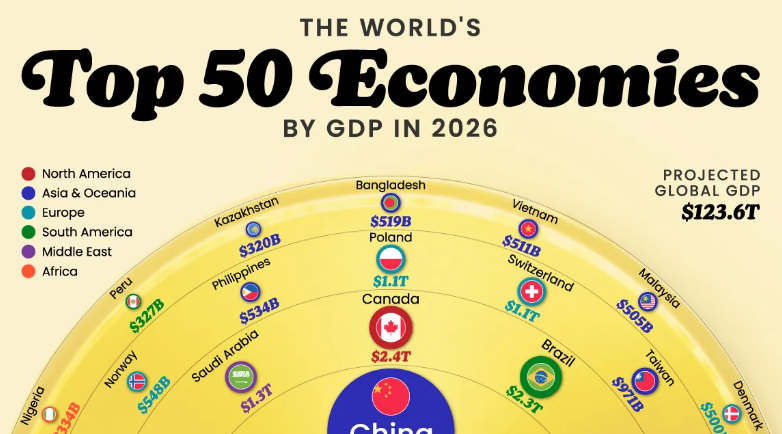
As the global economy continues to evolve, GDP projections for 2026 provide valuable insight into the future of the world’s largest economies. According to the International Monetary Fund (IMF), global economic output is forecast to reach $123.6 trillion in 2026, with the United States and China continuing to lead the pack.
In this article, we’ll explore the top 50 economies by GDP in 2026, focusing on the key countries that are driving global economic growth and the projections shaping the financial landscape.
Key Takeaways:
- U.S. real GDP is projected to hit $31.8 trillion in 2026, growing moderately by 2.1%.
- India is expected to surpass Japan, becoming the world’s fourth-largest economy by 2026.
- China’s GDP is projected to reach $20.7 trillion, adding significant economic output since 2021.
Let’s explore the top 50 economies by GDP in 2026, based on IMF projections.
Top Economies by Projected GDP in 2026
Below is a ranking of the top 50 economies by GDP in 2026:
| Rank | Country | Projected GDP in 2026 (B) |
|---|---|---|
| 1 | 🇺🇸 United States | $31,821 |
| 2 | 🇨🇳 China | $20,651 |
| 3 | 🇩🇪 Germany | $5,328 |
| 4 | 🇮🇳 India | $4,506 |
| 5 | 🇯🇵 Japan | $4,464 |
| 6 | 🇬🇧 United Kingdom | $4,226 |
| 7 | 🇫🇷 France | $3,559 |
| 8 | 🇮🇹 Italy | $2,702 |
| 9 | 🇷🇺 Russian Federation | $2,509 |
| 10 | 🇨🇦 Canada | $2,421 |
| 11 | 🇧🇷 Brazil | $2,293 |
| 12 | 🇪🇸 Spain | $2,042 |
| 13 | 🇲🇽 Mexico | $2,031 |
| 14 | 🇦🇺 Australia | $1,948 |
| 15 | 🇰🇷 South Korea | $1,937 |
| 16 | 🇹🇷 Türkiye | $1,576 |
| 17 | 🇮🇩 Indonesia | $1,550 |
| 18 | 🇳🇱 Netherlands | $1,413 |
| 19 | 🇸🇦 Saudi Arabia | $1,316 |
| 20 | 🇵🇱 Poland | $1,110 |
| 21 | 🇨🇭 Switzerland | $1,075 |
| 22 | 🇹🇼 Taiwan | $971 |
| 23 | 🇧🇪 Belgium | $761 |
| 24 | 🇮🇪 Ireland | $750 |
| 25 | 🇸🇪 Sweden | $712 |
| 26 | 🇦🇷 Argentina | $668 |
| 27 | 🇮🇱 Israel | $666 |
| 28 | 🇸🇬 Singapore | $606 |
| 29 | 🇦🇹 Austria | $604 |
| 30 | 🇦🇪 UAE | $601 |
| 31 | 🇹🇭 Thailand | $562 |
| 32 | 🇳🇴 Norway | $548 |
| 33 | 🇵🇭 Philippines | $534 |
| 34 | 🇧🇩 Bangladesh | $519 |
| 35 | 🇻🇳 Vietnam | $511 |
| 36 | 🇲🇾 Malaysia | $505 |
| 37 | 🇩🇰 Denmark | $500 |
| 38 | 🇨🇴 Colombia | $462 |
| 39 | 🇭🇰 Hong Kong SAR | $447 |
| 40 | 🇷🇴 Romania | $445 |
| 41 | 🇿🇦 South Africa | $444 |
| 42 | 🇨🇿 Czechia | $417 |
| 43 | 🇪🇬 Egypt | $400 |
| 44 | 🇮🇷 Iran | $376 |
| 45 | 🇵🇹 Portugal | $365 |
| 46 | 🇨🇱 Chile | $363 |
| 47 | 🇫🇮 Finland | $336 |
| 48 | 🇳🇬 Nigeria | $334 |
| 49 | 🇵🇪 Peru | $327 |
| 50 | 🇰🇿 Kazakhstan | $320 |
Global Total: $123,585 billion
Key Insights and Projections for 2026
1. U.S. Leads the Global Economy
The United States continues to lead the global economic pack with a projected GDP of $31.8 trillion. The U.S. economy is expected to grow moderately at 2.1%, adding nearly $2 trillion to its GDP. The U.S. has consistently expanded its economic output, reflecting its position as a global leader in technology, finance, and services.
2. China’s Growth Continues
China’s GDP is projected to reach $20.7 trillion, maintaining its position as the second-largest economy globally. While growth has slowed compared to previous years, China remains a critical player in global manufacturing, technology, and trade.
3. India’s Rising Economic Power
India is projected to surpass Japan as the fourth-largest economy by 2026, with a GDP of $4.5 trillion. The country’s fast-growing tech and service sectors, along with its expanding consumer market, are key drivers of its economic rise.
4. European Powerhouses
Germany, the largest economy in Europe, is projected to have a GDP of $5.3 trillion, followed by France and Italy at $3.6 trillion and $2.7 trillion, respectively. These economies will continue to play significant roles in global trade and finance.
5. Emerging Economies
Countries like Brazil, Mexico, and Indonesia are showing steady growth, with projections indicating that their GDPs will continue to rise, contributing to global economic diversification.
Regional Differences in Economic Projections
While the global economy continues to grow, different regions are facing unique challenges and opportunities:
- Asia-Pacific: Economies in this region, particularly China, India, and Japan, will continue to drive global growth, with trade tensions and tariffs being a key concern.
- Americas: The U.S. and Brazil are leading in the Americas, but concerns around inflation, debt, and political instability will need to be addressed for sustained growth.
- Europe: With Germany and France leading, the economic landscape in Europe faces challenges such as Brexit impacts, aging populations, and economic restructuring.
Final Thoughts on the World’s Top 50 Economies in 2026
As we look ahead to 2026, the top 50 economies by GDP will continue to shape the global economic landscape. The U.S., China, and India will dominate, with Europe and emerging markets playing key roles in global economic diversification. While challenges like trade tensions, inflation, and geopolitical instability persist, the global economy is on track to reach $123.6 trillion, with varied opportunities and risks across different regions.
This forecast offers a comprehensive view of the world’s economic future and highlights how global leaders are positioning themselves for continued success in the years to come.