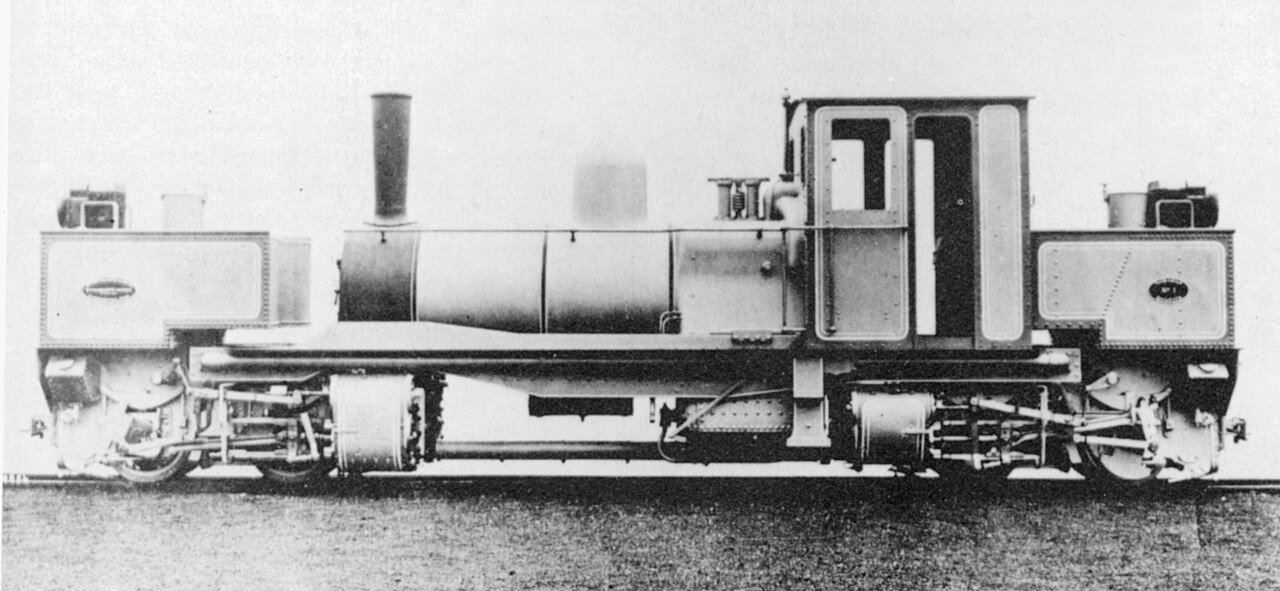
The 0-4-0+0-4-0 wheel arrangement is a distinctive articulated steam locomotive configuration, best known for its use in the early Garratt locomotives. In this setup, the locomotive consists of two independent 0-4-0 power units—each with four coupled driving wheels—mounted back-to-back or face-to-face, supporting a central boiler and cab. This innovative arrangement allowed for exceptional traction and flexibility, especially on lightly laid or narrow-gauge tracks.
The first example of this configuration was built in 1909 for the Tasmanian Government Railways (TGR), marking the birth of the Garratt locomotive concept.
Design Overview
Under the Whyte notation system, 0-4-0+0-4-0 indicates:
- No leading wheels on either engine unit,
- Four coupled driving wheels on two axles per unit,
- No trailing wheels,
- And a jointed frame allowing articulation.
In the UIC system, this configuration is classified as B+B, while in French and Turkish notations it corresponds to 020+020 and 22+22, respectively. The Russian classification describes it as 0-2-0+0-2-0.
The key advantage of this arrangement was that all locomotive weight contributed to traction, as the entire engine mass rested on the powered wheels. However, the absence of leading or trailing wheels made the design less stable at high speeds, limiting its performance to slower, industrial, or narrow-gauge applications.
Early Development and First Use
The first Garratt locomotive ever constructed, K1, belonged to the Tasmanian Government Railways K class. Built by Beyer, Peacock & Company in Manchester, England, K1 and its twin K2 were delivered to Tasmania in 1909 for service on the 2 ft (610 mm) gauge North East Dundas Tramway.
The K class Garratts featured:
- Compound steam expansion, with two high-pressure cylinders on the rear unit and two low-pressure cylinders on the front.
- Face-to-face cylinder arrangement, unlike later Garratts, which positioned their engine units back-to-back.
These pioneering locomotives demonstrated the mechanical viability of the Garratt principle, laying the foundation for one of the most successful articulated steam locomotive designs in history. K1 has been restored to working order and now operates on the Welsh Highland Railway in Wales.
Production and Variants
A total of 34 locomotives featuring the 0-4-0+0-4-0 configuration were built by various manufacturers between 1909 and the late 20th century. While Beyer, Peacock & Company produced only a few (including the Tasmanian and Darjeeling locomotives), the design was later adopted and modified by builders such as St. Léonard, Du Haine Saint-Pierre, and Girdlestone Rail.
Key Examples
| Gauge | Railway / Country | Class or Name | Builder | Year |
|---|---|---|---|---|
| 2 ft (610 mm) | Tasmanian Government Railways | K class | Beyer, Peacock | 1909 |
| 2 ft (610 mm) | Darjeeling Himalayan Railway, India | D class | Beyer, Peacock | 1910 |
| 600 mm | C.F. Vicinaux du Mayumbe, Belgian Congo | Classes A–E | St. Léonard, Belgium | 1911–1927 |
| 750 mm | Mines du Zaccar, Algeria | – | Du Haine Saint-Pierre | 1936–1937 |
| 500 mm | Southern Fuegian Railway, Argentina | “Engineer Porta” | Argentina | 1994 |
| 500 mm | Southern Fuegian Railway, Argentina | “Engineer Zubieta” | Girdlestone Rail, South Africa | 2006 |
Notable Uses and Developments
Australia
The Tasmanian Government Railways K class remains historically significant as the first-ever Garratt locomotive class. Its articulated compound engine design proved ideal for Tasmania’s steep gradients and tight curves, though the configuration was soon replaced by larger Garratt types with additional driving wheels for improved power and stability.
Argentina
The Southern Fuegian Railway (Ferrocarril Austral Fueguino – FCAF) commissioned a modern 0-4-0+0-4-0 Garratt named “Engineer Porta” in 1994, inspired by designs from steam innovator Livio Dante Porta. This locomotive incorporated modern insulation, efficient boilers, and larger steam passages, improving fuel economy and doubling train capacity.
A second unit, “Engineer Zubieta”, featuring superheating and other upgrades, was built in 2006 by Girdlestone Rail in South Africa. Both engines remain in service, hauling tourist trains through the Patagonian landscape.
United Kingdom
The standard-gauge Garratt “William Francis”, built in 1937 by Beyer, Peacock & Company for Guest, Keen & Baldwins, is one of the few preserved examples in the UK. It can be seen at the Bressingham Steam Museum, featuring a back-to-back engine arrangement typical of later Garratts.
Performance and Limitations
The 0-4-0+0-4-0 configuration provided exceptional traction because the full engine mass was available for adhesion. However, its lack of leading and trailing wheels caused instability at higher speeds and limited its use to industrial railways, mining lines, and narrow-gauge routes.
As Garratt technology advanced, designers favored more stable configurations such as 2-4-0+0-4-2 and 2-6-0+0-6-2, which added guiding wheels for smoother tracking on mainline railways.
Legacy
The 0-4-0+0-4-0 Garratt holds a unique place in railway engineering history as the origin of the Garratt concept, a design that revolutionized heavy-haul steam locomotive operations across Africa, Asia, and Australia.
Although later Garratts evolved into larger and more complex configurations, the early 0-4-0+0-4-0 types demonstrated the efficiency, flexibility, and adaptability of articulated locomotives on difficult terrain.
Preserved locomotives such as K1 in Wales and the Engineer Porta in Argentina continue to honor this pioneering era of steam innovation.