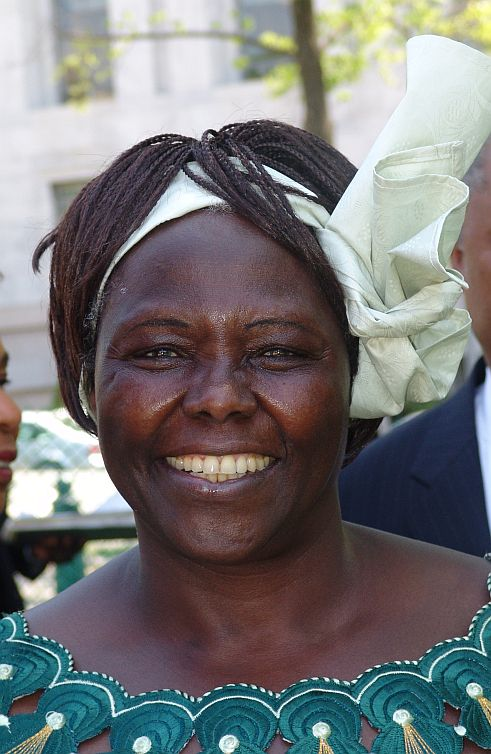
Wangari Muta Maathai remains one of Africa’s most recognized environmental and political figures, whose activism transformed Kenya’s environmental policy and contributed to global climate discourse. Born on 1 April 1940 in Ihithe village, Nyeri, Maathai rose from rural beginnings to become the first African woman to win the Nobel Peace Prize in 2004, while also shaping national debates on governance, gender, and development.
Her work connected environmental conservation with social justice, positioning her at the intersection of grassroots activism and international advocacy.
Wangari Maathai Early Life and Education
Maathai was born into a Kikuyu farming family in colonial Kenya. Her early exposure to rural life influenced her later focus on environmental conservation.
She received primary and secondary education before benefiting from the “Kennedy Airlifts,” a scholarship program that enabled African students to study abroad.
In 1964, she graduated with a degree in biological sciences from Mount St. Scholastica College in Kansas, United States.
She later pursued further studies in Germany and Kenya, eventually becoming the first woman in East and Central Africa to earn a doctorate degree.
Her academic achievements culminated in her appointment as the first woman to chair a department at the University of Nairobi.
Wangari Maathai and the Green Belt Movement
In 1977, Maathai founded the Green Belt Movement (GBM), an organization focused on tree planting, environmental conservation, and women’s empowerment.
The initiative aimed to address issues such as deforestation, soil erosion, and rural poverty.
Through the movement, rural women were mobilized to plant trees, creating both environmental and economic benefits.
The Green Belt Movement became a model for community-based environmental action, gaining international recognition.
Wangari Maathai and Gender Politics
Maathai’s activism challenged traditional gender roles in Kenyan society.
Her public profile and independent stance often placed her at odds with societal expectations.
Her divorce in 1979 attracted significant public attention, with her former husband describing her as “too educated, too strong, too successful.”
The case highlighted broader gender dynamics and the resistance faced by women in leadership positions.
Maathai’s response, including modifying the spelling of her name, symbolized her assertion of independence.
Wangari Maathai Political Activism and State Opposition
Maathai’s environmental work increasingly intersected with politics.
She opposed development projects that she argued threatened public spaces and environmental sustainability.
One of her most notable campaigns was against the proposed construction of a 60-storey complex in Uhuru Park during the administration of Daniel arap Moi.
Her activism drew criticism from government officials, who viewed her as a disruptive figure.
Despite this, her efforts contributed to the cancellation of the project, marking a significant moment in environmental activism in Kenya.
She later defended other public spaces, including Jeevanjee Gardens and Karura Forest, further establishing her role in environmental advocacy.
Wangari Maathai and Global Networks
Maathai leveraged international networks to support her activism.
Her education in the United States and engagement with global organizations enabled her to build alliances that amplified her work.
She collaborated with institutions such as the United Nations Environment Programme (UNEP), headquartered in Nairobi.
Her ability to connect local activism with global platforms strengthened her influence.
Wangari Maathai Political Career
Maathai entered formal politics in the 1990s, reflecting the broader democratization movement in Kenya.
She ran for president in 1997 and 2002, although she was unsuccessful.
In 2002, she was elected as Member of Parliament for Tetu and later appointed Assistant Minister for Environment and Natural Resources in 2003.
Her political role allowed her to influence policy at the national level.
Wangari Maathai Nobel Peace Prize
In 2004, Maathai was awarded the Nobel Peace Prize, becoming the first African woman to receive the honor.
The award recognized her contribution to sustainable development, democracy, and peace.
Her global recognition elevated her profile and brought international attention to environmental issues in Africa.
Wangari Maathai Legacy and Debate
Maathai’s legacy is complex.
While she is widely celebrated internationally, her activism challenged entrenched political structures in Kenya.
Some critics argue that her global recognition overshadowed her confrontations with the political establishment.
Others view her as a pioneer who reshaped environmental and political discourse.
Wangari Maathai Final Years and Death
Maathai continued her advocacy through the Green Belt Movement and international engagements until her death on 25 September 2011.
She died at the age of 71 after battling cancer.
Outlook on Environmental Activism in Africa
The life of Wangari Maathai illustrates the potential of grassroots movements to influence national and global policy.
Her work demonstrates how environmental issues intersect with governance, gender, and economic development.
Her legacy continues to shape environmental activism in Africa and beyond.