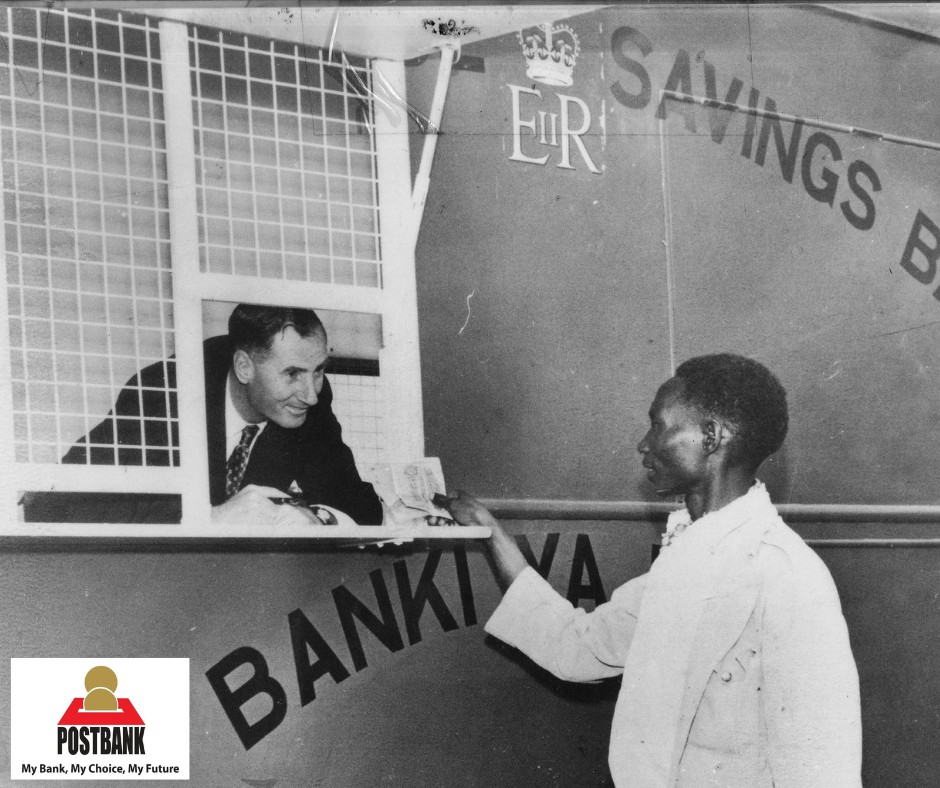
The Kenya Post Office Savings Bank (Postbank) was established in 1910 regulated by the Kenya Post Office Savings Bank Act Cap 493B.Similar Savings services were offered across the East Africa region. When the East African Community broke up in 1977, the Kenya Government established its own savings bank. Postbank is primarily engaged in the mobilization of savings for national development. The Bank is wholly owned by the Government of Kenya and reports to the Ministry of Finance. The Government is represented at the board of directors by the Permanent Secretary, Treasury. Governance of the bank is vested in the Board of directors and the office of the Managing Director, supported by Directorates and departments. Postbank is committed to the standards of corporate governance as set by the government and the Central Bank of Kenya for the public sector. The Board of Directors is responsible for the long term strategic direction for profitable growth for the bank while being accountable to the shareholder for ensuring that Postbank complies with the law and the highest standards of corporate governance and business ethics. The Kenya Post Office Savings Bank’s registered headquarters is at Postbank House, Banda Street, Nairobi Kenya
Postbank Kenya: A Historical Pillar in the Rise of Financial Inclusion
Established more than a century ago, Postbank Kenya is not just another bank — it is a symbol of early financial access for Africans, rooted in colonial infrastructure, yet molded by Kenya’s unique path to independence and modernity.
🚂 The Foundation: Transport and Communication in Colonial East Africa
In 1895, when East Africa became a British protectorate, it was admitted into the Postal Union, linking the region to the international postal and communications network. At the time, Thomas E.C. Remington, the Postmaster General, operated out of Zanzibar — the Swahili Coast’s commercial hub.
As the Uganda Railway construction commenced in 1896, attention shifted to Mombasa, which emerged as a crucial port town. In 1899, Remington relocated to Mombasa — just before the railway’s extension into Uganda prompted the 1903 amalgamation of Kenya and Uganda’s postal services. Later, Tanganyika would join in the 1920s.
By 1905, Nairobi had become the new capital. Along with the capital shift came financial development. A money market emerged, trading in the East Africa Protectorate Pice and Rupee, governed by the Mombasa Currency Board.
🏦 A Bank for Africans: The Birth of the Post Office Savings Bank
In 1910, recognizing the need for secure banking services among working Africans, the colonial postal services launched the Post Office Savings Bank — the first institution in East Africa to offer formal banking to the local population.
By March 1911, over 1,200 accounts had been opened — more than 600 by Africans. However, limited access meant only those in or near Nairobi could benefit directly.
The decade ended with the East Africa Currency Board (EACB) replacing the Mombasa board in 1919, introducing silver Florin coins inscribed in Latin. These coins, convertible to the British sterling, replaced the Rupee and centralized currency control in London.
🌍 Regional Banking Footprint: Serving East Africa
By 1931, the Post Office Savings Bank was serving clients across Kenya, Uganda, and Tanganyika (later Tanzania). Throughout the mid-20th century, especially during the rise and operations of the East African Community (EAC), the bank played a central role in financial accessibility across the region.
Customers could deposit and withdraw from various branches, creating a connected regional savings culture.
🇰🇪 Postbank Kenya and the Collapse of the EAC

In the 1970s, the East African Community began to decline, culminating in its collapse in 1977. In response, the bank transitioned to a national mandate, becoming known as Kenya Post Office Savings Bank — or simply Postbank Kenya.
From this point, the institution focused on providing savings and financial services exclusively to Kenyans, continuing its mission to promote thrift and accessible banking.
🏛️ Regulation and Legacy
Unlike commercial banks in Kenya regulated by the Central Bank of Kenya, Postbank Kenya is governed by the Government of Kenya and reports directly to the Ministry of Finance. Its operations remain aligned with national development goals, making it a trusted state financial institution.
Today, Postbank Kenya stands as a testament to the evolution of savings culture in the country — from colonial infrastructure to a modern institution encouraging financial inclusion for all Kenyans.
Did you know? Postbank Kenya helped pioneer savings habits in East Africa and continues to serve as a vital institution in Kenya’s financial landscape.