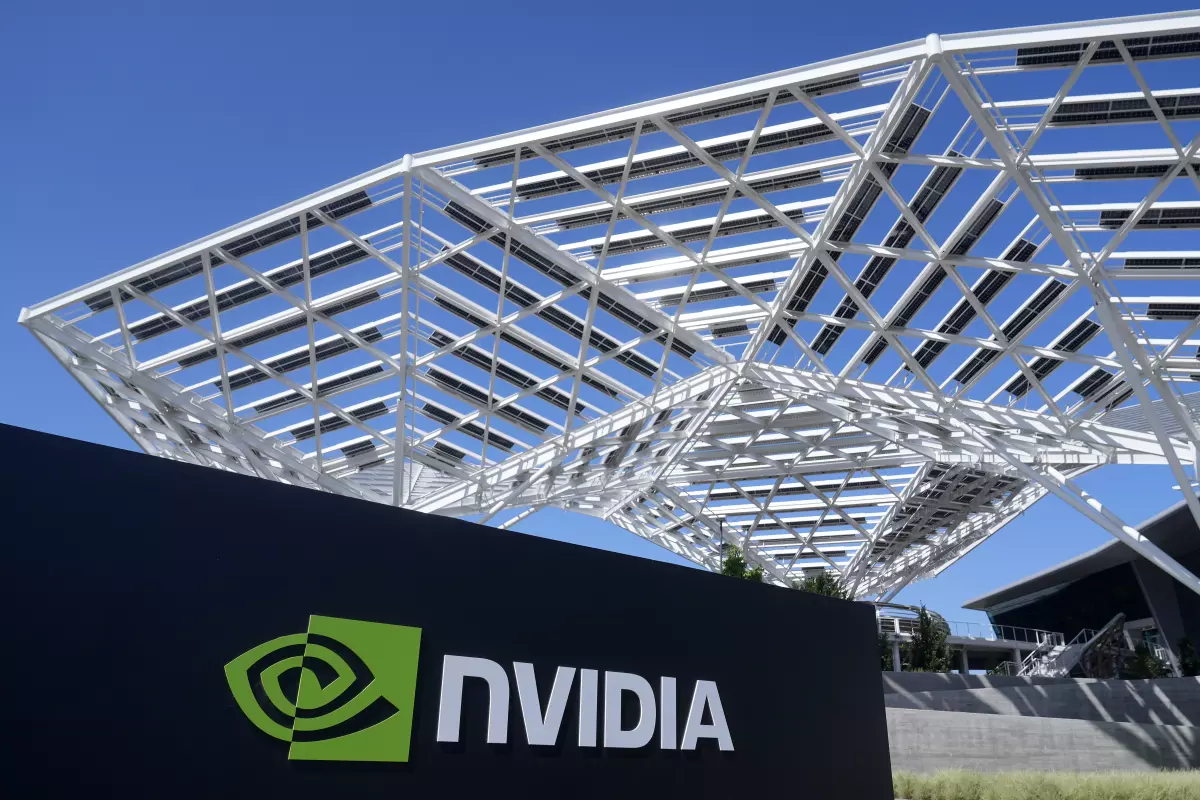
Nvidia Corp. has reached a historic milestone, achieving a market capitalization of $5 trillion on Wednesday, October 29, 2025. This remarkable feat comes just four months after the company broke through the $4 trillion barrier, highlighting the growing influence of artificial intelligence (AI) and the key role that Jensen Huang, Nvidia’s Chief Executive, is playing in the company’s meteoric rise.
AI Boom Driving Nvidia’s Meteoric Growth
Shares of Nvidia surged as much as 5.6%, hitting $212.19 by 11 a.m. Eastern Time. The company has seen an accelerated rally driven by strategic partnerships and its critical role in the AI revolution. Huang’s expansion of Nvidia’s AI chip supply to major global companies like Nokia Oyj, Samsung Electronics Co., and Hyundai Motor Group has contributed significantly to Nvidia’s rise in market value.
Nvidia’s success is directly tied to the AI bull market, which has been fueled by optimism around the transformative potential of AI to reshape the global economy. Nvidia’s 50% stock price increase this year alone is responsible for almost 20% of the S&P 500 index’s 17% gain in 2025, underscoring its pivotal role in the broader tech market. In comparison, Microsoft Corp. and Apple Inc., each valued at around $4 trillion, are the only companies that come close to Nvidia’s market dominance in the tech sector.
A New Era of AI Expansion and Investment
Nvidia’s continued dominance in the AI space is evident in its recent partnerships and forward-looking projects. Huang remains bullish, dismissing concerns about an AI “bubble” and instead emphasizing the potential of Nvidia’s next-generation chips. He confidently stated that these chips are on track to generate half a trillion dollars in revenue, marking the company as a leader in both innovation and financial performance.
In addition to AI advancements, Nvidia unveiled new systems to bridge the gap between quantum computing and artificial intelligence, further reinforcing its position at the forefront of the next tech revolution.
The stock’s meteoric rise means that Nvidia’s weighting in the S&P 500 has now reached nearly 9%, two percentage points higher than its closest competitors. With a valuation surpassing that of entire stock markets such as the Netherlands, Spain, UAE, Italy, and Poland, Nvidia now ranks among the top five stock markets globally, trailing only the United States, China, Japan, Hong Kong, and India. Remarkably, Nvidia is just $250 billion away from surpassing these markets as well.
Jensen Huang’s Personal Wealth Skyrockets
Nvidia’s success has also significantly impacted Jensen Huang’s personal fortune. As of now, Huang’s net worth exceeds $180 billion, a staggering increase of nearly $68 billion since the start of the year, and $16 billion since the close of trading on Monday. This immense wealth has solidified Huang’s position as one of the most influential figures in tech.
Wall Street Analysts Remain Bullish
Wall Street analysts remain overwhelmingly optimistic about Nvidia’s future. More than 90% of analysts covering the company have given its stock a buy-equivalent rating, while only one analyst, Jay Goldberg from Seaport Global Securities, has issued a sell recommendation. Despite the positive outlook, there are concerns that Nvidia may face competition from industry rivals like Advanced Micro Devices Inc. (AMD) and Broadcom Inc., which could challenge Nvidia’s dominance in the long run.
Valuation and Future Outlook
Nvidia’s remarkable gains have led some to question whether the stock can continue its rapid ascent. The company’s stock price has surged by more than 1,300% since the end of 2022, leaving investors wondering whether the lofty expectations tied to AI advancements are sustainable. However, Dan Eye, Chief Investment Officer at Fort Pitt Capital Group, argues that while Nvidia’s current stock price is high, it is priced for elevated expectations. With shares priced at less than 34 times estimated earnings, Nvidia’s valuation appears to be reasonable when compared to its peers in the semiconductor industry, where the Philadelphia Stock Exchange Semiconductor Index is priced at 29 times.
“If what everyone is betting on with AI comes to fruition, then valuations are probably justified, but certainly some of it might be difficult to live up to,” said Eye. “It’s been tough to not own Nvidia, but it really is priced for elevated expectations.”
Global Impact and Nvidia’s Leadership Role
Nvidia’s success underscores the growing significance of artificial intelligence as a driving force in the global economy. The company’s rise to a $5 trillion market cap is a testament to the increasing importance of AI in various industries, from automotive to telecommunications and consumer electronics. Nvidia’s GPUs (graphics processing units), which are crucial for AI processing, have made it an indispensable partner to the world’s leading tech giants.
As the AI race continues, Nvidia’s market dominance is likely to only grow, positioning it as one of the most influential companies in the 21st century’s technology landscape.
Conclusion
Nvidia’s $5 trillion market capitalization marks a historic achievement for the company, solidifying its status as a leader in artificial intelligence and semiconductor innovation. As the driving force behind the AI revolution, Nvidia’s growth continues to reshape the tech industry and fuel Wall Street’s optimism. With Jensen Huang at the helm, Nvidia is well-positioned to continue its dominance, but the path forward will require managing heightened expectations and potential competition. For investors, competitors, and industry observers alike, Nvidia’s journey is far from over.