The first humans settled in New Caledonia around 1600 B.C. The Lapita were skilled navigators, and evidence of their pottery around the Pacific has served as a guide for understanding human expansion in the region. Successive waves of migrants from other islands in Melanesia intermarried with the Lapita, giving rise to the Kanak ethnic group considered indigenous to New Caledonia. British explorer James COOK was the first European to visit New Caledonia in 1774, giving it the Latin name for Scotland. Missionaries first landed in New Caledonia in 1840. In 1853, France annexed New Caledonia to preclude any British attempt to claim the island. France declared it a penal colony in 1864 and sent more than 20,000 prisoners to New Caledonia in the ensuing three decades.
Nickel was discovered in 1864, and French prisoners were directed to mine it. France brought in indentured servants and enslaved labor from elsewhere in Southeast Asia to work the mines, blocking Kanaks from accessing the most profitable part of the local economy. In 1878, High Chief ATAI led a rebellion against French rule. The Kanaks were relegated to reservations, leading to periodic smaller uprisings and culminating in a large revolt in 1917 that colonial authorities brutally suppressed. During World War II, New Caledonia became an important base for Allied troops, and the US moved its South Pacific headquarters to the island in 1942. Following the war, France made New Caledonia an overseas territory and granted French citizenship to all inhabitants in 1953, thereby permitting the Kanaks to move off the reservations.
The Kanak nationalist movement began in the 1950s, but most voters chose to remain a territory in an independence referendum in 1958. The European population of New Caledonia boomed in the 1970s with a renewed focus on nickel mining, reigniting Kanak nationalism. Key Kanak leaders were assassinated in the early 1980s, leading to escalating violence and dozens of fatalities. The Matignon Accords of 1988 provided for a 10-year transition period. The Noumea Accord of 1998 transferred increasing governing responsibility from France to New Caledonia over a 20-year period and provided for three independence referenda. In the first held in 2018, voters rejected independence by 57% to 43%; in the second held in 2020, voters rejected independence 53% to 47%. In the third referendum held in 2021, voters rejected independence 96% to 4%; however, a boycott by key Kanak groups spurred challenges about the legitimacy of the vote. Pro-independence parties subsequently won a majority in the New Caledonian Government for the first time. France and New Caledonia officials remain in talks about the status of the territory.
Geography
Location
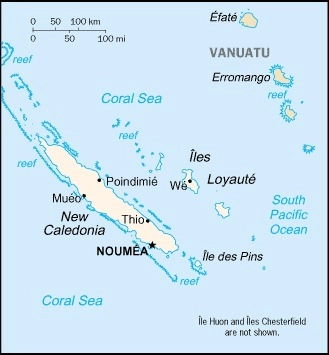
Oceania, islands in the South Pacific Ocean, east of Australia
Geographic coordinates
21 30 S, 165 30 E
Map references
Oceania
Area
total : 18,575 sq km
land: 18,275 sq km
water: 300 sq km
comparison ranking: total 155
Area – comparative
slightly smaller than New Jersey
Land boundaries
total: 0 km
Coastline
2,254 km
Maritime claims
territorial sea: 12 nm
exclusive economic zone: 200 nm
Climate
tropical; modified by southeast trade winds; hot, humid
Terrain
coastal plains with interior mountains
Elevation
highest point: Mont Panie 1,628 m
lowest point: Pacific Ocean 0 m
Natural resources
nickel, chrome, iron, cobalt, manganese, silver, gold, lead, copper
Land use
agricultural land: 10.1% (2022 est.)
arable land: 0.3% (2022 est.)
permanent crops: 0.2% (2022 est.)
permanent pasture: 9.5% (2022 est.)
forest: 45.8% (2022 est.)
other: 44.1% (2022 est.)
Irrigated land
100 sq km (2012)
Population distribution
most of the populace lives in the southern part of the main island, in and around the capital of Noumea
Natural hazards
cyclones, most frequent from November to March
volcanism: Matthew and Hunter Islands are historically active
Geography – note
consists of the main island of New Caledonia (one of the largest in the Pacific Ocean), the archipelago of Iles Loyauté, and numerous small, sparsely populated islands and atolls
People and Society
Population
total: 304,167 (2024 est.)
male: 151,389
female: 152,778
comparison rankings: total 180; female 181; male 181
Nationality
noun: New Caledonian(s)
adjective: New Caledonian
Ethnic groups
Kanak 39.1%, European 27.1%, Wallisian, Futunian 8.2%, Tahitian 2.1%, Indonesian 1.4%, Ni-Vanuatu 1%, Vietnamese 0.9%, other 17.7%, unspecified 2.5% (2014 est.)
Languages
French (official), 33 Melanesian-Polynesian dialects
major-language sample(s):
The World Factbook, une source indispensable d’informations de base. (French)
The World Factbook, the indispensable source for basic information.
French audio sample:
Religions
Christian 85.2%, Muslim 2.8%, other 1.6%, unaffiliated 10.4% (2020 est.)
Age structure
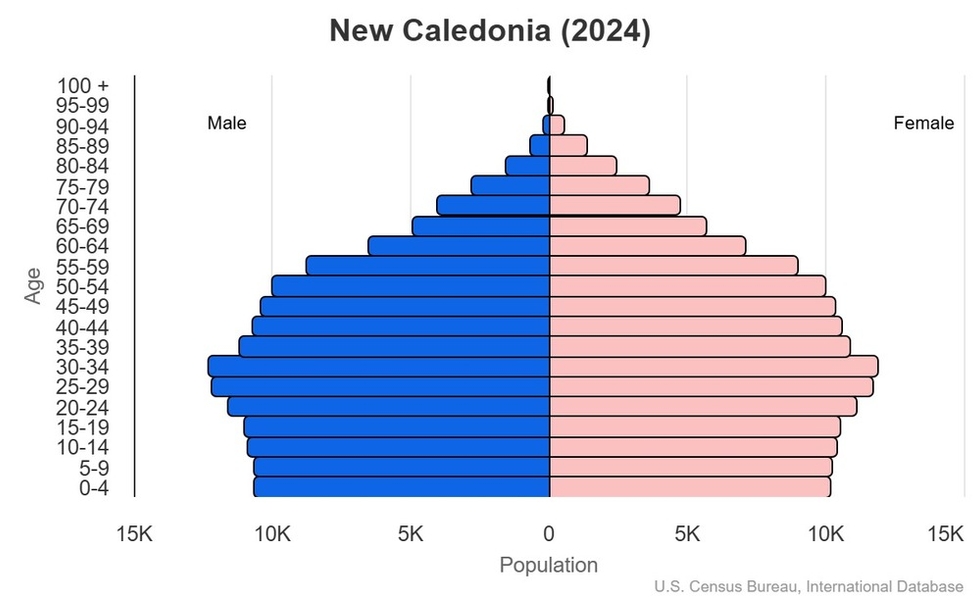
0-14 years: 20.7% (male 32,238/female 30,858)
15-64 years: 68.4% (male 104,825/female 103,349)
65 years and over: 10.8% (2024 est.) (male 14,326/female 18,571)
2024 population pyramid:
Dependency ratios
total dependency ratio: 46.1 (2024 est.)
youth dependency ratio: 30.3 (2024 est.)
elderly dependency ratio: 15.8 (2024 est.)
potential support ratio: 6.3 (2024 est.)
Median age
total: 34.3 years (2024 est.)
male: 33.5 years
female: 35.1 years
comparison ranking: total 103
Population growth rate
1.14% (2024 est.)
comparison ranking: 80
Birth rate
13.8 births/1,000 population (2024 est.)
comparison ranking: 123
Death rate
6 deaths/1,000 population (2024 est.)
comparison ranking: 157
Net migration rate
3.6 migrant(s)/1,000 population (2024 est.)
comparison ranking: 30
Population distribution
most of the populace lives in the southern part of the main island, in and around the capital of Noumea
Urbanization
urban population: 72.7% of total population (2023)
rate of urbanization: 1.72% annual rate of change (2020-25 est.)
Major urban areas – population
198,000 NOUMEA (capital) (2018)
Sex ratio
at birth: 1.05 male(s)/female
0-14 years: 1.04 male(s)/female
15-64 years: 1.01 male(s)/female
65 years and over: 0.77 male(s)/female
total population: 0.99 male(s)/female (2024 est.)
Infant mortality rate
total: 4.8 deaths/1,000 live births (2024 est.)
male: 5.8 deaths/1,000 live births
female: 3.9 deaths/1,000 live births
comparison ranking: total 178
Life expectancy at birth
total population: 79.3 years (2024 est.)
male: 75.4 years
female: 83.3 years
comparison ranking: total population 65
Total fertility rate
1.83 children born/woman (2024 est.)
comparison ranking: 135
Gross reproduction rate
0.89 (2024 est.)
Contraceptive prevalence rate
NA
Drinking water source
improved:
urban: NA
rural: NA
total: 99.3% of population
unimproved:
urban: NA
rural: NA
total: 0.7% of population (2020 est.)
Physician density
0.24 physicians/1,000 population (2018)
Sanitation facility access
improved:
urban: NA
rural: NA
total: 100% of population
unimproved:
urban: NA
rural: NA
total: 0% of population (2020 est.)
Currently married women (ages 15-49)
22.5% (2023 est.)
Literacy
total population: 96.9%
male: 97.3%
female: 96.5% (2015)
Environment
Environment – current issues
preservation of coral reefs; prevention of invasive species; limiting erosion caused by nickel mining and forest fires
Climate
tropical; modified by southeast trade winds; hot, humid
Land use
agricultural land: 10.1% (2022 est.)
arable land: 0.3% (2022 est.)
permanent crops: 0.2% (2022 est.)
permanent pasture: 9.5% (2022 est.)
forest: 45.8% (2022 est.)
other: 44.1% (2022 est.)
Urbanization
urban population: 72.7% of total population (2023)
rate of urbanization: 1.72% annual rate of change (2020-25 est.)
Air pollutants
carbon dioxide emissions: 5.33 megatons (2016 est.)
Waste and recycling
municipal solid waste generated annually: 108,157 tons (2016 est.)
Government
Country name
conventional long form: Territory of New Caledonia and Dependencies
conventional short form: New Caledonia
local long form: Territoire des Nouvelle-Calédonie et dépendances
local short form: Nouvelle-Calédonie
etymology: the name came from British explorer Captain James COOK in 1774 and uses the Latin name for Scotland, Caledonia
Government type
parliamentary democracy (Territorial Congress); an overseas collectivity of France
Dependency status
special collectivity of France
note: independence referenda took place in 2018, 2020, and 2021, with a majority voting in each case to reject independence in favor of the status quo
Capital
name: Noumea
geographic coordinates: 22 16 S, 166 27 E
time difference: UTC+11 (16 hours ahead of Washington, DC, during Standard Time)
etymology: established in 1854 as Port-de-France, the settlement was renamed Noumea in 1866 to avoid confusion with Fort-de-France in Martinique; the name Noumea may come from the local name of the peninsula the city was founded on
Administrative divisions
3 provinces; Province Iles (Islands Province), Province Nord (North Province), and Province Sud (South Province)
Legal system
civil law system based on French civil law
Constitution
history: 4 October 1958 (French Constitution with changes as reflected in the Noumea Accord of 5 May 1998)
amendment process: French constitution amendment procedures apply
Citizenship
see France
Suffrage
18 years of age; universal
Executive branch
chief of state: President Emmanuel MACRON (since 14 May 2017); represented by High Commissioner Jacques BILLANT (since 3 May 2025)
head of government: President of the Government Alcide PONGA (since 8 January 2025)
cabinet: Cabinet elected from and by the Territorial Congress
elections/appointments: French president directly elected by absolute majority popular vote in 2 rounds if needed for a 5-year term (eligible for a second term); high commissioner appointed by the French president on the advice of the French Ministry of Interior; president of New Caledonia elected by Territorial Congress for a 5-year term (no term limits); election last held on 8 July 2021 (next to be held in 2026)
election results:
2025: Alcide PONGA (The Republicans) elected president by Territorial Congress with 6 of 11 votes
2021: Louis MAPOU (PALIKA) elected president by Territorial Congress with 6 of 11 votes
Legislative branch
legislature name: Territorial Congress (Congrès du Territoire)
legislative structure: unicameral
number of seats: 54 (indirectly elected)
electoral system: proportional representation
scope of elections: full renewal
term in office: 5 years
most recent election date: 5/12/2019
parties elected and seats per party: Future With Confidence 18, UNI 9, UC 9, CE 7, FLNKS 6, Oceanic Awakening 3, PT 1, LKS 1 (Anti-Independence 28, Pro-Independence 26)
expected date of next election: December 2025
note 1: the Customary Senate is the assembly of the various traditional councils of the Kanaks, the indigenous population; it rules on laws affecting Kanaks
note 2: New Caledonia indirectly elects 2 members to the French Senate and directly elects 2 members to the French National Assembly (see France entry for electoral details)
Judicial branch
highest court(s): Court of Appeal or Cour d’Appel; organized into civil, commercial, social, and pre-trial investigation chambers; court bench normally includes the court president and 2 counselors); Administrative Court (number of judges NA)
judge selection and term of office: judge appointment and tenure based on France’s judicial system
subordinate courts: Courts of First Instance include: civil, juvenile, commercial, labor, police, criminal, assizes, and also a pre-trial investigation chamber; Joint Commerce Tribunal; administrative courts
note: final appeals beyond the Court of Appeal are referred to the Court of Cassation or Cour de Cassation (in Paris); final appeals beyond the Administrative Court are referred to the Administrative Court of Appeal (in Paris)
Political parties
Caledonia Together or CE
Caledonian Union or UC
Future With Confidence or AEC
Kanak Socialist Front for National Liberation or FLNKS (alliance includes PALIKA, UNI, UC, and UPM)
Labor Party or PT
National Union for Independence or UNI
Oceanian Awakening
Party of Kanak Liberation or PALIKA
Socialist Kanak Liberation or LKS
The Republicans (formerly The Rally or UMP)
Diplomatic representation in the US
none (overseas territory of France)
Diplomatic representation from the US
embassy: none (overseas territory of France)
International organization participation
ITUC (NGOs), PIF, SPC, UPU, WFTU (NGOs), WMO
Independence
none (overseas collectivity of France)
note: in three independence referenda, on 4 November 2018, 4 October 2020, and 12 December 2021, the majority voted to reject independence in favor of maintaining the status quo
National holiday
Fête de la Fédération, 14 July (1790); note – the local holiday is New Caledonia Day, 24 September (1853)
Flag description
two official flags: the flag of France and the Kanak (ethnic Melanesian) flag have equal status; the latter consists of three equal horizontal bands of blue (top), red, and green; a large yellow disk shifted slightly to the hoist side is edged in black and displays a black fleche faîtière symbol, a native rooftop adornment
National symbol(s)
flèche faîtière (native rooftop adornment), kagu bird
National colors
grey, red
National anthem
name: “Soyons unis, devenons freres” (Let Us Be United, Let Us Become Brothers)
lyrics/music: Chorale Melodia (a local choir)
note: adopted 2008; contains a mixture of lyrics in both French and Nengone (an indigenous language); as a self-governing territory of France, in addition to the local anthem, “La Marseillaise” is official (see France)
National heritage
total World Heritage Sites: 1 (natural); note – excerpted from the France entry
selected World Heritage Site locales: Lagoons of New Caledonia
Economy
Economic overview
upper-middle-income French Pacific territorial economy; enormous nickel reserves; ongoing French independence negotiations; large Chinese nickel exporter; luxury eco-tourism destination; large French aid recipient; high cost-of-living; lingering wealth disparities
Real GDP (purchasing power parity)
$10.266 billion (2021 est.)
$11.11 billion (2017 est.)
$10.89 billion (2016 est.)
note: data are in 2015 dollars
comparison ranking: 167
Real GDP growth rate
3.5% (2022 est.)
-2.1% (2021 est.)
-2.4% (2020 est.)
note: annual GDP % growth based on constant local currency
comparison ranking: 97
Real GDP per capita
$35,700 (2021 est.)
$31,100 (2015 est.)
$32,100 (2014 est.)
comparison ranking: 67
GDP (official exchange rate)
$9.623 billion (2022 est.)
note: data in current dollars at official exchange rate
Inflation rate (consumer prices)
1.4% (2017 est.)
0.6% (2016 est.)
0.6% (2015 est.)
note: annual % change based on consumer prices
comparison ranking: 39
GDP – composition, by sector of origin
agriculture: 1.8% (2019 est.)
industry: 22.3% (2019 est.)
services: 65.2% (2019 est.)
note: figures may not total 100% due to non-allocated consumption not captured in sector-reported data
comparison rankings: services 56; industry 126; agriculture 162
GDP – composition, by end use
household consumption: 65.6% (2017 est.)
government consumption: 23.5% (2017 est.)
investment in fixed capital: 27.9% (2017 est.)
investment in inventories: -0.1% (2017 est.)
exports of goods and services: 21% (2017 est.)
imports of goods and services: -37.9% (2017 est.)
note: figures may not total 100% due to rounding or gaps in data collection
Agricultural products
coconuts, vegetables, fruits, pork, beef, maize, eggs, bananas, yams, oranges (2023)
note: top ten agricultural products based on tonnage
Industries
nickel mining and smelting
Industrial production growth rate
4.3% (2014 est.)
note: annual % change in industrial value added based on constant local currency
comparison ranking: 66
Labor force
130,800 (2024 est.)
note: number of people ages 15 or older who are employed or seeking work
comparison ranking: 180
Unemployment rate
11.2% (2024 est.)
10.9% (2023 est.)
10.7% (2022 est.)
note: % of labor force seeking employment
comparison ranking: 165
Youth unemployment rate (ages 15-24)
total: 32.7% (2024 est.)
male: 30.2% (2024 est.)
female: 35.7% (2024 est.)
note: % of labor force ages 15-24 seeking employment
comparison ranking: total 19
Remittances
6.45% of GDP (2022 est.)
6.17% of GDP (2021 est.)
6.57% of GDP (2020 est.)
note: personal transfers and compensation between resident and non-resident individuals/households/entities
Budget
revenues: $1.995 billion (2015 est.)
expenditures: $1.993 billion (2015 est.)
Public debt
6.5% of GDP (2015 est.)
comparison ranking: 199
Current account balance
-$654.237 million (2016 est.)
-$1.119 billion (2015 est.)
-$1.3 billion (2014 est.)
note: balance of payments – net trade and primary/secondary income in current dollars
comparison ranking: 128
Exports
$1.92 billion (2021 est.)
$1.8 billion (2020 est.)
$1.79 billion (2019 est.)
note: balance of payments – exports of goods and services in current dollars
comparison ranking: 166
Exports – partners
China 75%, Japan 9%, Taiwan 3%, India 3%, France 2% (2023)
note: top five export partners based on percentage share of exports
Exports – commodities
iron alloys, nickel, nickel ore, processed crustaceans, shellfish (2023)
note: top five export commodities based on value in dollars
Imports
$2.26 billion (2021 est.)
$2.1 billion (2020 est.)
$2.48 billion (2019 est.)
note: balance of payments – imports of goods and services in current dollars
comparison ranking: 174
Imports – partners
France 36%, Singapore 16%, Australia 15%, China 6%, NZ 3% (2023)
note: top five import partners based on percentage share of imports
Imports – commodities
refined petroleum, coal, cars, aircraft, packaged medicine (2023)
note: top five import commodities based on value in dollars
Exchange rates
Comptoirs Francais du Pacifique francs (XPF) per US dollar –
Exchange rates:
110.306 (2024 est.)
110.347 (2023 est.)
113.474 (2022 est.)
100.88 (2021 est.)
104.711 (2020 est.)
Energy
Electricity access
electrification – total population: 100% (2022 est.)
Electricity
installed generating capacity: 1.174 million kW (2023 est.)
consumption: 3.02 billion kWh (2023 est.)
transmission/distribution losses: 66.3 million kWh (2023 est.)
comparison rankings: transmission/distribution losses 41; consumption 143; installed generating capacity 131
Electricity generation sources
fossil fuels: 73.8% of total installed capacity (2023 est.)
solar: 7.3% of total installed capacity (2023 est.)
wind: 1.4% of total installed capacity (2023 est.)
hydroelectricity: 17.5% of total installed capacity (2023 est.)
Coal
consumption: 1.026 million metric tons (2023 est.)
imports: 1.001 million metric tons (2023 est.)
proven reserves: 2 million metric tons (2023 est.)
Petroleum
refined petroleum consumption: 17,000 bbl/day (2023 est.)
Carbon dioxide emissions
4.887 million metric tonnes of CO2 (2023 est.)
from coal and metallurgical coke: 2.312 million metric tonnes of CO2 (2023 est.)
from petroleum and other liquids: 2.575 million metric tonnes of CO2 (2023 est.)
comparison ranking: total emissions 137
Energy consumption per capita
(2019)
Communications
Telephones – fixed lines
total subscriptions: 46,000 (2021 est.)
subscriptions per 100 inhabitants: 16 (2022 est.)
comparison ranking: total subscriptions 158
Telephones – mobile cellular
total subscriptions: 260,000 (2021 est.)
subscriptions per 100 inhabitants: 90 (2021 est.)
comparison ranking: total subscriptions 181
Broadcast media
the publicly owned French Overseas Network (RFO), which operates in France’s overseas departments and territories, broadcasts over the RFO Nouvelle-Calédonie TV and radio stations; a small number of privately owned radio stations also broadcast
Internet country code
.nc
Internet users
percent of population: 82% (2017 est.)
Broadband – fixed subscriptions
total: 56,000 (2022 est.)
subscriptions per 100 inhabitants: 19 (2022 est.)
comparison ranking: total 145
Transportation
Airports
21 (2025)
comparison ranking: 134
Heliports
2 (2025)
comparison ranking: 130
Merchant marine
total: 23 (2023)
by type: general cargo 5, oil tanker 1, other 17
comparison ranking: total 146
Ports
total ports: 3 (2024)
large: 0
medium: 0
small: 1
very small: 2
ports with oil terminals: 1
key ports: Baie de Kouaoua, Baie Ugue, Noumea
Military and Security
Military and security forces
no regular military forces; Territorial Directorate of the National Police of New Caledonia (DTPN), Gendarmerie of New Caledonia (2025)
Military – note
defense is the responsibility of France, which bases land, air, and naval forces on New Caledonia (Forces Armées de la Nouvelle-Calédonie, FANC)