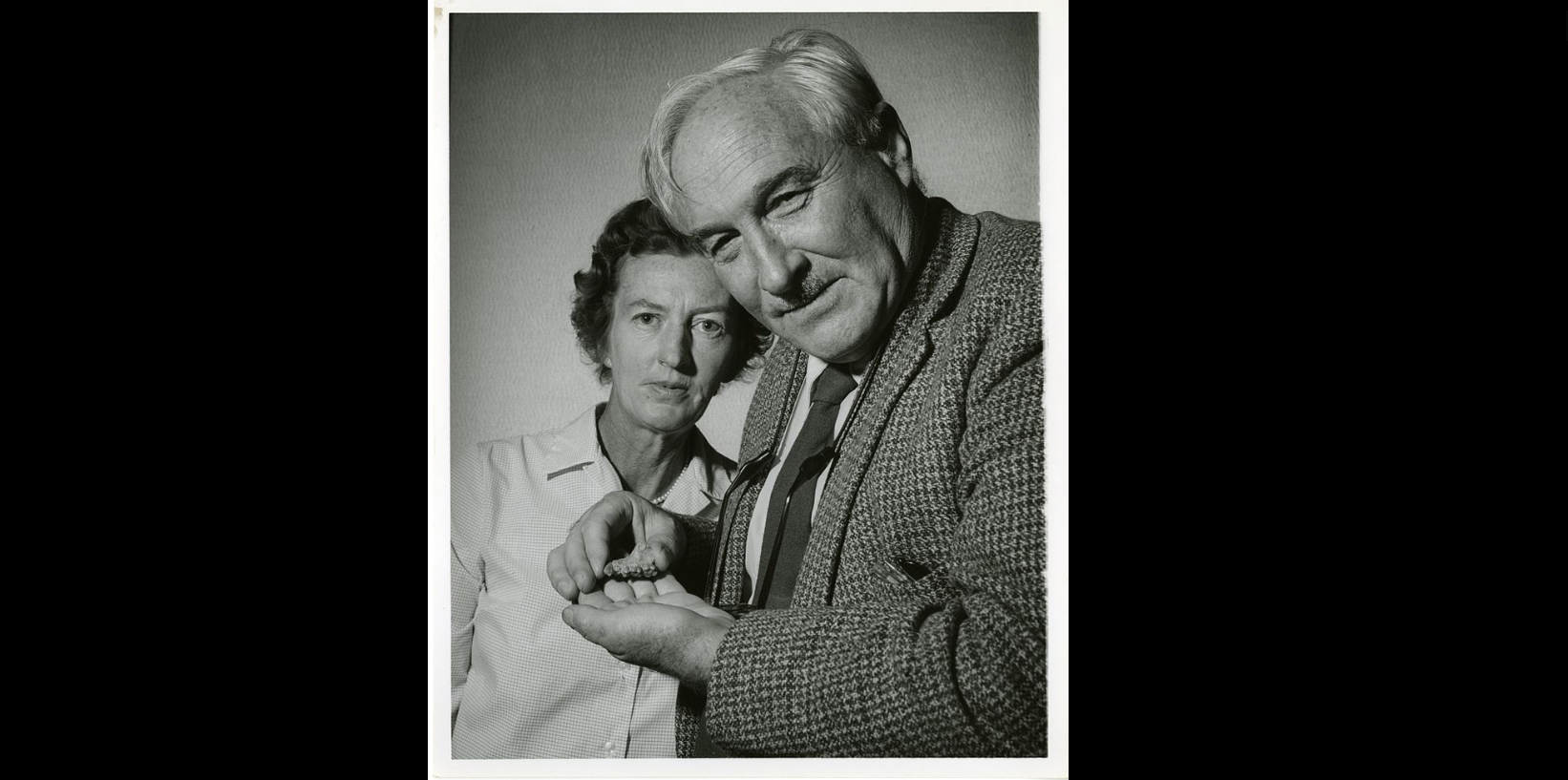
Louis Leakey was a visionary palaeoanthropologist and archaeologist whose groundbreaking work in East Africa fundamentally transformed the understanding of human evolution. Born in Kabete, British East Africa (now Kenya), on 7 August 1903, he is renowned for providing compelling evidence that humans evolved in Africa, particularly through his excavations at Olduvai Gorge with his wife, Mary Leakey.
Raised among the Kikuyu people, Louis absorbed African languages and customs from an early age. This intimate cultural knowledge would later prove invaluable in both his archaeological fieldwork and his advocacy for indigenous communities.
Leakey’s influence stretched far beyond fossils. He launched a generation of primatologists by mentoring Jane Goodall, Dian Fossey, and Birutė Galdikas, famously referred to as “The Trimates.”
His family legacy also endured—Mary Leakey went on to discover the Laetoli footprints, and his son Richard Leakey became a prominent figure in both science and conservation.
Early Life and Education
Born to missionary parents, Leakey’s childhood in colonial Kenya was steeped in both nature and native culture. He spoke Gikuyu fluently, hunted with local children, and was initiated into the Kikuyu tribe. His father, Canon Harry Leakey, instilled in him a deep appreciation for East Africa’s biodiversity and archaeological potential.
After a difficult stint in British boarding schools, Leakey earned a scholarship to St. John’s College, Cambridge, where he studied anthropology and archaeology, graduating with high honors. His academic work was supplemented by field experience in Tanganyika (modern-day Tanzania) and Kenya, where he made his earliest discoveries.
Scientific Breakthroughs
In the late 1920s and early 1930s, Leakey began a series of excavations in the Rift Valley, uncovering tools and fossils that hinted at Africa’s central role in human prehistory.
His most significant collaboration began in the 1930s with Mary Leakey, a brilliant illustrator-turned-paleontologist. Together, they conducted pioneering digs at Olduvai Gorge, where in 1959, Mary discovered the skull of Paranthropus boisei (Zinjanthropus)—a sensational find that convinced many that Africa was indeed the cradle of humanity.
In 1960, Leakey and his team uncovered Homo habilis, an early human species believed to have used stone tools. These discoveries, supported by radiometric dating, revolutionized theories of human evolution and earned global attention.
Mentorship and The Trimates
Understanding the importance of studying primates in their natural habitat, Leakey supported and mentored three women—Jane Goodall, Dian Fossey, and Birutė Galdikas—each of whom studied chimpanzees, gorillas, and orangutans, respectively.
Leakey believed women had superior observational abilities in the field and funded their research through the Tigoni Primate Research Center and later with support from the Leakey Foundation, which he helped establish in 1968.
Legacy in Kenyan Politics and Conservation
Leakey was also involved in Kenyan social and political life, especially during the Mau Mau Rebellion. Though aligned with colonial authorities as an intelligence officer, he advocated land reform and Kikuyu rights, warning that failure to address inequality could lead to conflict—a warning that proved prophetic.
Throughout his life, he balanced science with activism, working on education, wildlife protection, and museum development in Kenya. He was instrumental in building the Coryndon Museum (now the National Museums of Kenya) and later directed the Centre for Prehistory and Paleontology.
Later Years and Death
In his final years, arthritis and heart problems limited his fieldwork. He spent time lecturing in the UK and U.S., raising funds and guiding future researchers. Despite professional tensions with Mary, the couple remained a scientific powerhouse until his death.
On 1 October 1972, Louis Leakey died in London at the age of 69. He was buried in Limuru, Kenya. His grave is marked with a personal inscription arranged by his secretary, Rosalie Osborn, reading ILYUA—”I’ll love you always.”
Impact and Recognition
Louis Leakey remains one of the most influential figures in anthropology. His field methods, cultural advocacy, and belief in Africa as the birthplace of humanity laid the foundation for modern paleoanthropology.
He was a central figure in the first Pan-African Congress on Prehistory, founded research institutions, mentored women in science, and helped create the Leakey Foundation to fund future studies of human origins.
His family legacy endures: Richard Leakey advanced conservation and scientific leadership, and the Leakey name remains synonymous with the search for human beginnings.