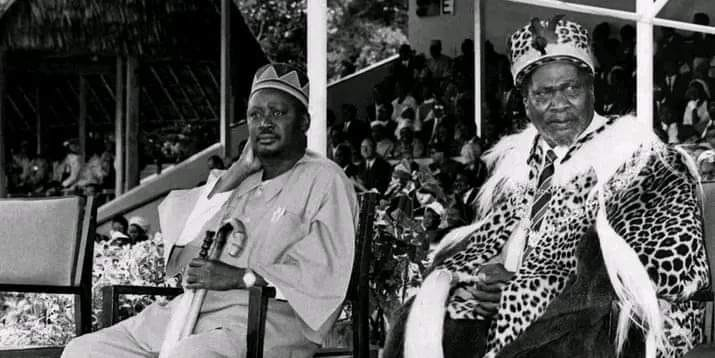
Jomo Kenyatta’s presidency began on 12 December 1964 when Kenya became a republic, and he became the country’s first president, marking the transition from colonial rule to African self-governance. A pivotal figure in Kenya’s fight for independence, Kenyatta led the country until his death in August 1978. His rule was defined by economic growth, authoritarianism, centralization of power, and a cult of personality that still shapes Kenya’s political culture.
Following his tenure as prime minister after the 1963 general election, Kenyatta smoothly transitioned to the presidency in 1964, unopposed, due to the elimination of opposition and dominance of the Kenya African National Union (KANU). Although democratic processes existed in theory, Kenya effectively functioned as a de facto one-party state.
Consolidation of Power and the One-Party State
In his first years as president, Kenyatta swiftly moved to centralize power. The 1964 army mutiny, suppressed with British help, showed his intolerance for dissent. By co-opting rivals like Daniel arap Moi and Ronald Ngala, and dissolving opposition parties such as KADU, he established KANU’s supremacy.
Subsequent elections—in 1969 and 1974—saw no opposing presidential candidates. Parliament became an instrument of presidential will. The 1966 constitutional amendment gave Kenyatta power to detain individuals without trial, reinforcing his authoritarian grip.
Election Results and Political Legitimacy
In the 1969 general elections, KANU won 100% of the vote, and all 158 parliamentary seats. Out of 4.6 million registered voters, 2.6 million voted—a 56.5% turnout. An additional 12 MPs were appointed directly by Kenyatta. This electoral monopoly further marginalized dissenting voices, especially after the Kenya People’s Union (KPU)—led by Oginga Odinga—was banned following the Kisumu massacre.
Formation of Cabinet and Governance
Kenyatta’s first cabinet, formed in 1963 as prime minister, continued after his 1964 swearing-in. Key figures included:
- Jaramogi Oginga Odinga – Vice President
- Thomas J. Mboya – Justice
- James Gichuru – Finance
- Dr. Njoroge Mungai – Health
- Joseph Murumbi – State
- Bruce McKenzie – Agriculture
The cabinet reflected a balance between ethnic groups but remained Kikuyu-dominated, fuelling perceptions of tribal favoritism.
Economic Policy and Development
Despite adopting the rhetoric of “African Socialism,” Kenyatta’s government pursued a capitalist model. A 1965 sessional paper emphasized private investment and minimal state control, welcoming foreign capital, especially from Britain and the United States.
Economic growth averaged 6.6% per year, with robust foreign investment, but wealth remained concentrated. Through “Africanization”, Asian and European businesses were restricted, but economic power merely shifted to a politically connected African elite, many from Kenyatta’s Kikuyu ethnic group.
Corruption and Elite Enrichment
Corruption flourished under Kenyatta. His family amassed vast land holdings, particularly in the Rift Valley and Coast, triggering resentment among landless peasants. Allegations of involvement in ruby mining, the charcoal trade, and even ivory smuggling were widespread.
His family also invested in the hospitality industry, including ownership of Leonard Beach Hotel. Despite this, the Kenyan press largely ignored his personal enrichment until after his death.
Land, Healthcare, and Education Reform
Kenyatta’s government implemented land reforms financed by £27 million in British aid. However, the process favored politically connected land-buying companies, with much land ending up in the hands of Kikuyu elites. Many indigenous claims were ignored, sparking discontent, particularly among Nandi and Luo communities.
Kenyatta expanded healthcare and education:
- Free medical services for children were introduced in 1965.
- Life expectancy rose from 45 (pre-independence) to 55 by 1978.
- Primary school enrolment rose to 85%, and University of Nairobi was founded.
Despite improvements, rapid population growth strained services, prompting unsuccessful family planning campaigns.
Foreign Policy and Cold War Alignment
Kenyatta’s foreign policy was pro-Western but officially non-aligned. He maintained strong ties with Britain, USA, and Israel, even allowing Israeli jets to refuel during the 1976 Entebbe raid.
Relations with China and the Soviet Union were tense. Kenyatta expelled Chinese diplomats and closed the Lumumba Institute, accusing it of communist subversion.
He was instrumental in regional diplomacy, signing the East African Co-operation Treaty in 1967 and mediating in the Congo Crisis under the OAU.
Suppression of Dissent and Assassinations
Kenyatta’s regime tolerated no serious opposition. After Odinga formed the KPU, the June 1966 elections targeted defectors. Violence, state propaganda, and administrative harassment followed.
Prominent leftists like Pio Gama Pinto and J.M. Kariuki were assassinated under suspicious circumstances. Though never conclusively linked to Kenyatta, their deaths solidified his image as a ruler intolerant of dissent.
Cultural Policy and National Identity
Kenyatta promoted Swahili, indigenous culture, and African traditions, using state media to shape a national identity. Yet, English remained the dominant language of administration and education.
Despite state efforts, ethnic identity remained more salient than national unity. Kikuyu dominance continued to fuel ethnic resentment.
Legacy and Criticism
Jomo Kenyatta was celebrated as the “Father of the Nation” and given the honorific Mzee (elder). He was respected abroad as a moderate African leader and anti-communist ally.
Yet, his mixed legacy includes:
- Authoritarianism
- Ethnic favoritism
- Unresolved land injustices
- Human rights violations, including detentions without trial
Despite early ties to the Mau Mau rebellion, he turned on former fighters, labelling them outlaws. The 1973 New York Times praised Kenya’s economic model, but Amnesty International criticized its political repression.
In conclusion, Jomo Kenyatta’s presidency laid the institutional and economic foundation for independent Kenya. However, his legacy remains contested—revered by some as a visionary statesman, and reviled by others for entrenching tribalism, corruption, and authoritarianism.