


The United Nations Educational, Scientific and Cultural Organization (UNESCO) designates World Heritage Sites as places of outstanding cultural or natural importance, under the 1972 World Heritage Convention. Uganda ratified the convention on 20 November 1987, making its historic and natural sites eligible for inclusion.
Uganda has three World Heritage Sites and eight more sites on its tentative list. The first two, Bwindi Impenetrable National Park and Rwenzori Mountains National Park, were inscribed in 1994 for their natural significance. In 2001, the Kasubi Tombs were added for their cultural importance.
World Heritage Sites
| Site | Image | Location (Region) | Year Listed | UNESCO Data | Description |
|---|---|---|---|---|---|
| Bwindi Impenetrable National Park | Rainforest with numerous ferns | Kanungu District, Western Uganda | 1994 | 682; vii, x (Natural) | Located in the Albertine Rift, Bwindi is a biodiversity hotspot, home to over 100 fern species, 200 butterfly species, and 347 bird species. It shelters a major population of endangered mountain gorillas, alongside unique montane forests that survived as a Pleistocene refugium. |
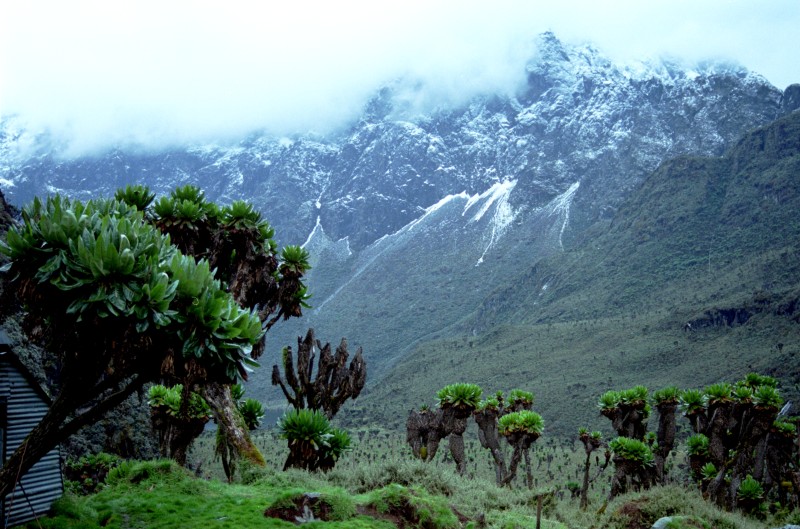
| Rwenzori Mountains National Park | Cloud-covered mountains | Kasese District, Western Uganda | 1994 | 684; vii, x (Natural) | Encompasses the Rwenzori Mountains (Mountains of the Moon), including Mount Stanley (5,109 m), Africa’s third-highest peak. The park features glaciers, rivers, waterfalls, and rich montane flora such as giant lobelias and heathers. Wildlife includes forest elephants, chimpanzees, and duikers. It was on the endangered list from 1999 to 2004. |
| Tombs of Buganda Kings at Kasubi | Traditional reed-and-thatch mausoleum | Kampala | 2001 | 1022; i, iii, iv, vi (Cultural) | Burial grounds of Buganda kings (Kabakas), established in 1882 as a palace and converted into a tomb in 1884. The site symbolizes Baganda spirituality and heritage. After a 2010 fire destroyed key structures, it was listed as endangered, but was removed from the list in 2023 following restoration. |
Tentative List
UNESCO requires countries to place potential sites on a tentative list before they can be formally nominated. As of 2025, Uganda has eight tentative sites.
| Site | Image | Location | Year Listed | Criteria | Description |
|---|---|---|---|---|---|
| Bigo bya Mugenyi (Archaeological Earthworks) | — | Sembabule | 1997 | i, ii, iii, vi (Cultural) | A complex of earthworks along the Katonga River, believed to date from the Bacwezi dynasty (14th–16th centuries). |
| Ntusi (Mounds and Basin) | — | Sembabule | 1997 | i, iii, iv, vi (Cultural) | A Late Iron Age site with man-made mounds, bones, and pottery, linked to Bigo bya Mugenyi. |
| Nyero and Rock Art Sites | Rock paintings | Kumi, Eastern Uganda | 1997 | i, iii, vi (Cultural) | Ancient geometric rock paintings, including concentric circles, dating to the Late Iron Age. |
| Mgahinga Gorilla National Park | Gorilla habitat | Kisoro, Western Uganda | 2007 | vii, viii, ix, x (Natural) | Part of the Virunga Mountains, shared with Rwanda and DR Congo. Hosts gorillas, golden monkeys, elephants, and volcanoes. |
| Mount Elgon Transboundary Ecosystem* | Satellite view of volcano | Eastern Uganda / Kenya | 2024 | ix, x (Natural) | An extinct stratovolcano, one of East Africa’s oldest, supporting diverse Afromontane habitats and unique bird species. |
| Geometric Rock Art in Lake Victoria Region* | — | Eastern Uganda, Kenya, Tanzania | 2024 | iii, vi (Cultural) | Prehistoric rock art with finger-painted motifs over 4,000 years old, retaining spiritual significance. |
| Kibiro Salt-Producing Village | Salt pans on Lake Albert | Hoima, Western Uganda | 2025 | i, iii, iv, vi (Cultural) | A traditional salt production village where women harvest salt from saline soils, exchanged for fish and crops. |
| Palabek Cultural Landscapes | — | Lamwo, Northern Uganda | 2025 | iii, v (Cultural) | Historic stone-walled enclosures (17th–20th centuries), built for defense and community living, linked to conflicts and survival traditions. |
Significance
Uganda’s World Heritage Sites illustrate its dual heritage:
- Natural wonders (Bwindi and Rwenzori) protect some of the planet’s rarest ecosystems and species.
- Cultural treasures (Kasubi Tombs and tentative sites like Kibiro and Palabek) highlight Uganda’s rich traditions, archaeology, and historical resilience.
These sites are vital for global heritage, tourism, and conservation, strengthening Uganda’s position as a cultural and ecological crossroads in Africa.




