


As night descended upon Nairobi on December 30, 2007, tension thickened around the Kenyatta International Conference Centre (KICC). Inside, confusion reigned. For hours, returning officers were missing, tallies clashed with earlier figures, and uneasy whispers filled the vast counting hall. Election officials hunched over papers, searching for clarity in numbers that no longer made sense. At the center of it all stood Samuel Kivuitu, the weary chairman of the Electoral Commission of Kenya (ECK), visibly troubled and adrift in uncertainty. When he finally spoke, his words unsettled the nation:
“I do not know where some of my returning officers are.”
The statement echoed like a confession. If the very person declaring the results could not account for his officers, where were the figures coming from? That question hung unanswered as suspicion spread through the crowd.
The Announcement That Shattered Kenya’s Calm
Outside KICC, the atmosphere had turned volatile. GSU officers and riot police formed tight barricades, pushing journalists back and clearing the corridors with an almost military precision. Inside, in a locked room filled with uneasy officials and party agents, Kivuitu announced what millions had feared:
“I, Samuel Kivuitu, declare Mwai Kibaki duly elected President of the Republic of Kenya.”
The declaration came under guard, surrounded by disbelief. Cameras flickered. Reporters were expelled. And in that moment, the fate of a nation shifted.
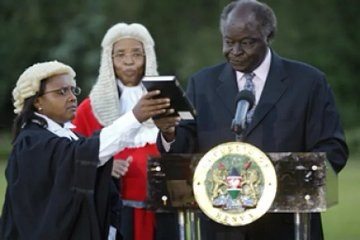
Moments later, live television screens across Kenya switched scenes—from chaos at KICC to a floodlit lawn at State House. The contrast was stark: neat grass, sharp hedges, and soldiers standing like statues in the cold night. A handful of government officials stood solemnly, among them Martha Karua, the Minister of Justice, who insisted the ceremony must proceed without delay.
The Oath Under Floodlights
When Kibaki stepped forward, he looked exhausted, his demeanor grave. The ceremony, brief and uncelebratory, unfolded under the glare of floodlights. As he took the oath, a slip of the tongue froze the crowd:
“Nitafanya kazi zangu za uhalifu…” — “I will perform my duties of crime.”
He quickly corrected himself: “…za urais” — “of the presidency.”
But the damage was done. The Freudian slip, caught by microphones, lingered in the air like an omen. Nervous laughter followed, and within minutes, the hurried ritual was over.
Across Kenya, millions watched in disbelief. Until that night, hope had persisted that justice might prevail—that recounts or legal recourse could correct the irregularities. But when the image of Kibaki’s nighttime swearing-in spread across the airwaves, hope gave way to rage. Many saw it not as a constitutional act but as theft in plain sight, sealed under the cover of darkness.
Kenya in Flames
Violence exploded almost immediately. In Kisumu, police opened fire on demonstrators. In Nairobi’s slums, anger turned to arson as homes and shops burned through the night. In the Rift Valley, long-suppressed ethnic tensions ignited into brutal revenge attacks. One of the darkest scenes unfolded in Eldoret, where a church sheltering families was set ablaze, killing dozens who had sought refuge within its walls.
By dawn, Kenya was in chaos. What had begun as a disputed election spiraled into one of the bloodiest episodes in the country’s history. Over the following weeks, more than 2,000 people were killed and hundreds of thousands displaced. Families fled their homes, entire neighborhoods were divided by fear, and the image of the oath under floodlights became a haunting symbol of betrayal.
A Nation Forever Changed
The manicured lawns of State House remained untouched by the smoke and screams beyond its gates. Yet that hurried oath, whispered into the Nairobi night, had opened a wound that would not heal easily. It did not merely affirm a presidency—it fractured a nation.
The Kibaki Night Swearing will forever be remembered as the moment Kenya’s democratic promise dimmed under floodlights. It was not just a ceremony; it was a turning point that unleashed fury, reshaped politics, and scarred the national psyche for generations.


