


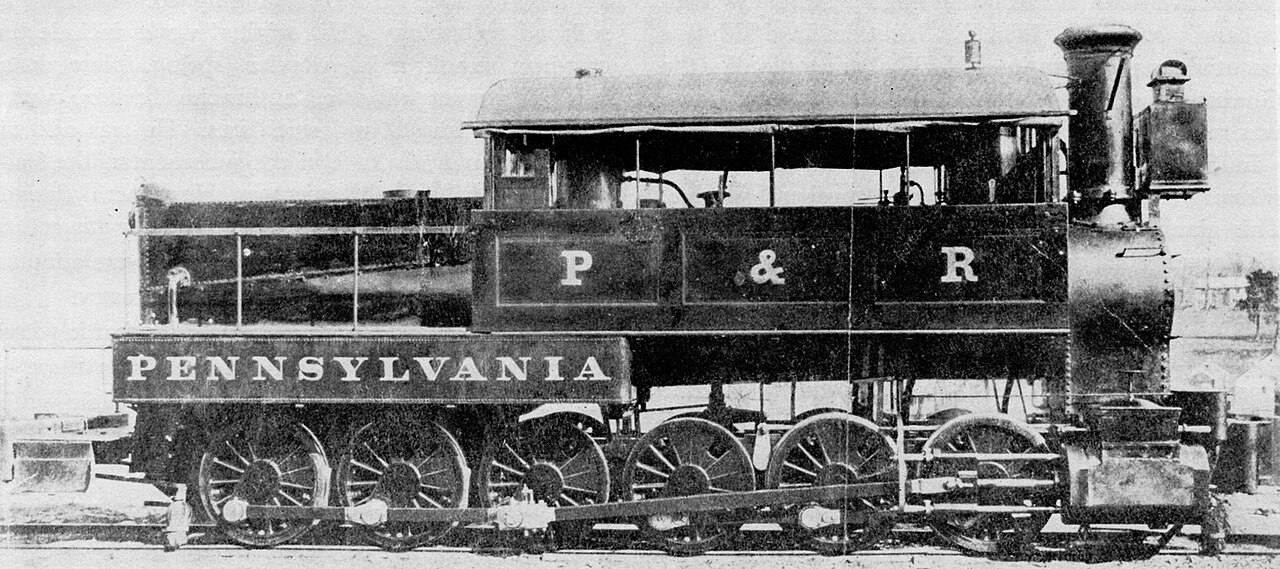
The 0–12–0 steam locomotive is a rare and powerful wheel arrangement classified under the Whyte notation system. It features no leading wheels, twelve coupled driving wheels on six axles, and no trailing wheels. This configuration was designed for maximum traction and heavy freight service, particularly in steep or mountainous terrain.
Classification Equivalents
Equivalent classifications for the 0–12–0 arrangement in other systems include:
- UIC classification: F
- French classification: 060
- Turkish classification: 66
- Swiss classification: 6/6
Each of these denotes six driven axles without leading or trailing axles, emphasizing the locomotive’s design for power over speed.
The Pennsylvania Locomotive
The first known 0–12–0 locomotive was the Pennsylvania, built in 1863 by Jame Milholland for the Philadelphia and Reading Railroad at its own shops. At the time of its construction, it was the heaviest steam locomotive in the world, weighing approximately 50 tons.
It was designed primarily as a pusher engine for coal trains on the Falls Grades near Philadelphia, where extreme traction was required. The locomotive’s weight distribution and lack of leading or trailing axles made it ideal for slow, heavy-duty work but unsuitable for high-speed travel.
Tank Engine Variants (0–12–0T)
Only two classes of 0–12–0T (tank) locomotives were ever built, both in Europe. These engines carried their own fuel and water onboard instead of using a separate tender.
Austrian Erzberg Railway (1912)
In 1912, the Lokomotivfabrik Floridsdorf in Austria produced three rack locomotives of this type for the Erzberg Railway (Erzbergbahn). Initially classified as Class 269 under the kkStB (Imperial Royal Austrian State Railways), these locomotives later served under several regimes:
- BBÖ (Austrian Federal Railways) after World War I,
- Deutsche Reichsbahn after the 1938 Anschluss, and
- ÖBB (Austrian Federal Railways) after World War II.
These heavy-duty locomotives worked the steep Erzberg iron ore line and remained in operation until the 1970s, demonstrating the longevity and durability of the design.
Bulgarian State Railways (1922)
The only other 0–12–0T locomotives were ten engines built in 1922 by Hanomag for the Bulgarian State Railways (BDŽ). Originally numbered 4001–4010, they were renumbered 45.01 to 45.10 in 1935–1936.
These were two-cylinder compound locomotives, designed for high power and efficiency:
- Boiler pressure: 15 kg/cm² (1.47 MPa; 213 psi)
- Cylinders:
- High-pressure: 620 × 700 mm (24.4 × 27.6 in)
- Low-pressure: 900 × 700 mm (35.4 × 27.6 in)
- Driving wheel diameter: 1,340 mm (52.8 in)
- Locomotive weight: 101 tonnes (99 long tons; 111 short tons)
These locomotives were built for mountainous routes, where adhesion and torque mattered more than speed, and served the BDŽ for several decades.
Engineering Characteristics
The 0–12–0 arrangement offered exceptional tractive effort by distributing the locomotive’s weight evenly across six driving axles. However, its rigid wheelbase limited maneuverability, making it difficult to operate on tight curves or lighter tracks.
While the design proved effective for industrial and mining operations, it was rarely adopted due to complex maintenance and restricted usability compared to articulated locomotives such as the Mallet type.
Legacy
Although few 0–12–0 locomotives were built, they represent a fascinating chapter in the evolution of heavy freight railway engineering. Their designs influenced later high-traction locomotives and demonstrated the limits of rigid-frame configurations before the widespread adoption of articulated locomotives in the 20th century.


