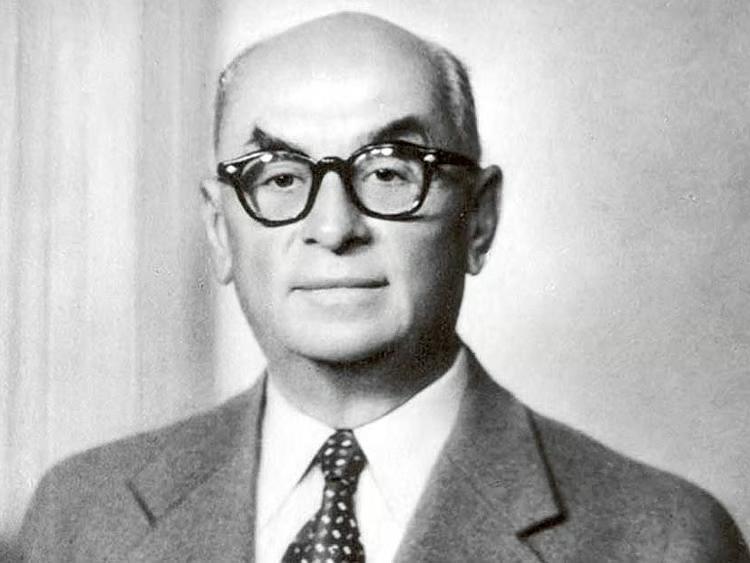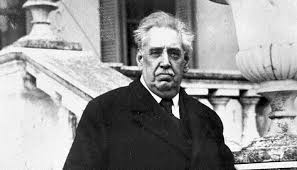
José Batlle y Ordóñez was born on May 21, 1856, in Montevideo, Uruguay, into one of the country’s most prominent political families. He was the son of General Lorenzo Batlle, president of Uruguay from 1868 to 1872, and the grandson of José Batlle y Carréo, a notable colonial-era figure in Montevideo.
Educated at the University of Montevideo and later at the Sorbonne in Paris, Batlle y Ordóñez combined legal training with exposure to European liberal thought. In 1886 he founded the newspaper El Día, which became both a platform for his political vision and a Colorado Party voice. By 1890 he was working to transform the Colorado Party into a modern nationwide democratic organization.
Political Rise and First Presidency (1903–1907)
Batlle y Ordóñez entered politics as a deputy in 1893 and a senator in 1896, soon becoming president of the Senate and a central figure in his party. He made an unsuccessful bid for the presidency in 1900 but achieved victory in 1903 by a narrow margin.
His election triggered resistance from the opposition Blanco Party, leading to a civil war in 1904. After his forces triumphed, Batlle consolidated power and ensured that the Colorado Party firmly controlled the government. He held free and fair elections in 1905, which reinforced his legitimacy. At the close of his term in 1907, he stepped down peacefully, demonstrating a rare commitment to constitutional order at the time.
Second Presidency and Reforms (1911–1915)
Reelected in 1911, Batlle y Ordóñez accelerated reforms that reshaped Uruguay into a modern welfare state. His administration:
- Introduced progressive labor laws, including protections for workers.
- Nationalized public utilities and services to strengthen state control of the economy.
- Ended the death penalty and championed social rights, including protections for illegitimate children.
- Restricted the profits of foreign-owned companies while encouraging immigration and infrastructure development.
These measures earned him recognition as one of Latin America’s pioneering social reformers.
Later Years and Constitutional Reform
Concerned with the concentration of executive power, Batlle y Ordóñez advocated a collegiate executive system. His plan sparked fierce national debate and division within the Colorado Party. The 1919 constitution instead introduced a dual executive system: a president alongside a National Executive Council.
Though this was considered a compromise and a setback for his original vision, Batlle y Ordóñez remained influential, serving as president of the council in 1920 and again in 1926. His family’s political legacy continued: his nephew Luis Batlle Berres served as president (1947–51), and his grandnephew Jorge Batlle Ibáñez became president in 2000.
Batlle y Ordóñez died in Montevideo on October 20, 1929, remembered as the architect of modern Uruguay’s welfare state.
Quick Facts
| Attribute | Details |
|---|---|
| Full Name | José Batlle y Ordóñez |
| Born | May 21, 1856, Montevideo, Uruguay |
| Died | October 20, 1929, Montevideo (aged 73) |
| Title / Office | President of Uruguay (1903–1907, 1911–1915) |
| Political Party | Colorado Party |
| Professions | Lawyer, journalist, statesman |
| Notable Reforms | Welfare state policies, labor rights, end of death penalty, nationalization of services |
| Family Legacy | Son of Pres. Lorenzo Batlle; nephew Luis Batlle Berres (president, 1947–51); grandnephew Jorge Batlle Ibáñez (president, 2000–05) |