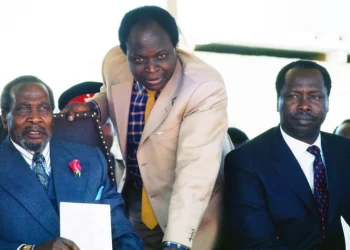
In 1964, the newly independent Republic of Kenya embarked on a journey to shape its future through the establishment of the National Youth Service (NYS). This visionary institution aimed to instill discipline, patriotism, and valuable skills in the youth, contributing to the nation-building process. The foundation of NYS was closely associated with Kenya’s first President, Jomo Kenyatta, who was keen to mold a disciplined and skilled generation to drive the country’s development. The role of Waruhiu Itote, also known as General China, a leader of the Mau Mau uprising, was pivotal in the early stages of the NYS, marking a significant chapter in Kenya’s post-independence history.
Jomo Kenyatta’s Inspection of the NYS in October 1964
On an October day in 1964, Jomo Kenyatta, accompanied by Waruhiu Itote, inspected the newly formed National Youth Service. This marked a symbolic moment in Kenya’s history, with Kenyatta reaffirming his commitment to empowering the youth and preparing them for the challenges of nation-building. As Kenya’s first President, Kenyatta’s endorsement of the NYS represented his desire to bring together the ideals of independence and the energy of youth for the greater good of the nation.
Waruhiu Itote: A Symbol of Leadership and Unity
Waruhiu Itote, better known as General China, was a leader of the Mau Mau rebellion, a critical force in Kenya’s struggle for independence. After the country gained its freedom in 1963, Itote transitioned from a freedom fighter to a key figure in the development of Kenya’s institutions. In 1964, Kenyatta appointed him as the Deputy Commandant of the National Youth Service, underscoring Itote’s stature and his crucial role in the national efforts to forge a disciplined and skilled young generation.
Itote’s involvement in the NYS was a significant recognition of his military leadership during the Mau Mau uprising, which had been a critical part of Kenya’s fight for independence. His appointment was also seen as a gesture of national reconciliation, with a former freedom fighter now playing a central role in shaping Kenya’s future leaders.
Establishment and Growth of the National Youth Service
The National Youth Service was officially established in 1964 as a means to provide young Kenyans with an opportunity to contribute to the nation’s development. The initial vision for NYS was to create a disciplined, skillful, and patriotic youth corps that would serve the country through a variety of roles, ranging from agricultural projects to infrastructural development.
By 1965, just one year after its inception, the NYS had grown to 3,000 young men in uniform. This rapid expansion reflected the nation’s eagerness to mobilize the youth to take part in the development of the new republic. The NYS became a cornerstone of Kenya’s youth empowerment strategy, providing training in a wide range of fields, including agriculture, engineering, and public service.
The Role of the NYS in Nation-Building
The creation of the National Youth Service was more than just a military or paramilitary endeavor—it was a strategic move to ensure that Kenya’s youth were prepared to contribute to the country’s development. The NYS not only provided a space for youth to learn important life skills but also served as a tool for instilling national values such as discipline, responsibility, and service to the nation.
Kenyatta’s government saw the NYS as an essential institution to unify Kenya’s diverse youth and bring them together under a shared vision of nationhood. The NYS became an integral part of Kenya’s post-independence strategy, contributing significantly to national infrastructure projects, as well as fostering a sense of unity and pride among young Kenyans.
The Legacy of Jomo Kenyatta and Waruhiu Itote
Jomo Kenyatta’s vision for the National Youth Service has left an enduring legacy in Kenya’s political and social landscape. The NYS continues to serve as a vital institution, shaping the lives of thousands of Kenyan youth every year, and its roots can be traced directly to Kenyatta’s 1964 decision to establish the service.
Waruhiu Itote’s role in the NYS, transitioning from Mau Mau general to a key leader in the new republic, exemplified the complex process of national reconciliation and unity. His leadership in the NYS remains a symbol of the transformation from resistance to reconstruction, where former fighters were tasked with helping build the nation they had fought for.
Conclusion: The Enduring Impact of the NYS
The National Youth Service, founded under the leadership of Jomo Kenyatta with Waruhiu Itote’s support, remains a key institution in Kenya’s development. It is a testament to the foresight of Kenya’s leaders in recognizing the power of youth as an instrument for change. Through the NYS, Kenyatta not only shaped the future of Kenya’s youth but also built a foundation for national unity and progress. Today, as Kenya continues to evolve, the NYS stands as a proud legacy of those who envisioned a strong, skilled, and disciplined youth ready to take on the challenges of the future.