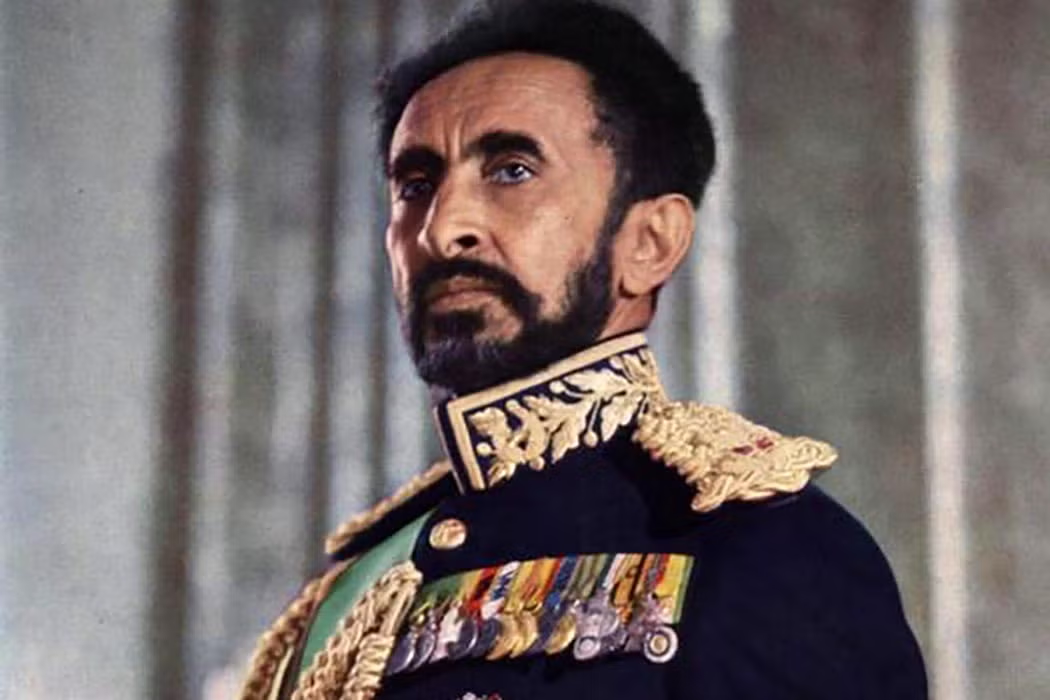
On August 27, 1975, Haile Selassie, the last emperor of Ethiopia, passed away at the age of 83. A monarch whose reign spanned over half a century, he ruled Ethiopia with great influence but also faced numerous challenges that ultimately led to his deposition in 1974. His death, which came only a year after his overthrow by a military coup, marked the end of an era in Ethiopian history and left a profound impact on both his country and the broader African continent.
The End of an Era
Haile Selassie’s death was reported by the military government in Addis Ababa, the capital of Ethiopia. The announcement was made during a routine radio broadcast at 7:00 AM, revealing that the former emperor had been found dead in his bed by a servant. The cause of death was attributed to complications arising from a prostate operation he had undergone two months prior. However, controversy surrounded his passing. Crown Prince Asfa Wossen, who had been living abroad since the monarchy was abolished, publicly disputed the official cause of death, calling for an independent autopsy to determine the true reasons behind the Emperor’s demise.
The military government that succeeded Haile Selassie maintained strict privacy regarding the burial, in accordance with Ethiopian custom, which demands that burials occur within 24 hours of death. The burial was conducted in utmost secrecy, with little public fanfare.
Haile Selassie’s Fall from Power
Haile Selassie’s reign was one of contradictions, blending periods of reform with authoritarian control. His leadership was marked by ambitious efforts to modernize Ethiopia, but his autocratic style eventually led to growing discontent, particularly within the military and the lower classes. His troubles began in 1973, when a devastating drought caused widespread famine in northern Ethiopia, leading to the death of over 100,000 people. The government’s failure to respond effectively to the crisis sparked unrest, especially among the peasant population and the military.
In 1974, a series of mutinies broke out, and in February, soldiers and officers rebelled over low wages and inadequate equipment, as well as the ongoing war in Eritrea. Riots erupted in the capital, and the Emperor’s absolute power began to wane. Despite his early initiatives to introduce reforms, such as modernizing the education system and trying to address the country’s land tenure system, Haile Selassie failed to adapt to the changing political landscape. By the time of the coup in September 1974, his reign was already faltering.
The military coup, which saw Haile Selassie deposed, was a dramatic and humiliating event. The Emperor, who had once been accustomed to a life of opulence and regal power, was forcibly removed from his palace and taken to a military camp in a blue Volkswagen. The former Emperor, who had ruled as a medieval autocrat, was now treated with contempt by the very military officers he had once commanded.
Legacy and Accomplishments
Haile Selassie’s reign, though ultimately marred by his downfall, had significant lasting impacts on Ethiopia and Africa. As a ruler, he endeavored to modernize Ethiopia’s economy, education, and infrastructure, though these efforts were often slow and inefficient. His support for African unity was perhaps his most enduring legacy. In 1963, Haile Selassie helped establish the Organization of African Unity (OAU), with its headquarters in Addis Ababa. The Emperor was an advocate for the independence of African nations and played a key role in rallying support for anticolonial movements across the continent.
Despite facing intense political opposition and criticism, Selassie’s status as an African icon grew over time. To his admirers, he was the “Lion of Judah,” a symbol of African dignity and independence. His image was especially revered by Rastafarians, who regarded him as a messianic figure. His death was met with mixed emotions across the world—mourning from his supporters and indifference from those who had opposed his regime.
Haile Selassie’s Early Life and Rise to Power
Haile Selassie was born on July 23, 1892, in the rural town of Ejarsa Gora, in a mud-and-wattle house. He was named Lij Tafari Makonnen and was the son of Ras Makonnen, a governor of Harar, and a cousin of Emperor Menelik II. After his father’s death in 1906, the young Tafari was brought to the court of Menelik II, where he received an education in both governance and the political intrigues of the royal family.
Tafari’s rise to power was not without difficulty. After the death of Menelik II in 1913, Tafari was initially passed over in favor of Menelik’s grandson, Lij Yasu. However, Tafari’s political acumen allowed him to outmaneuver his rivals, and by 1916, he was made the heir presumptive and regent to Empress Zauditu. His power was solidified in 1930, when he was crowned Emperor Haile Selassie I. His coronation was a grand affair, attended by international dignitaries, and marked the beginning of his long and transformative reign.
Challenges and Criticisms of His Rule
Haile Selassie’s reign, though marked by progress in certain areas, was also fraught with challenges. His failure to implement meaningful land reform and his slow pace of modernization left large segments of the population disillusioned. By the time of his deposition, Ethiopia’s economy remained heavily dependent on agriculture, and many rural Ethiopians still lived in poverty.
Moreover, the Emperor’s autocratic style of governance and his concentration of power in his own hands led to growing dissatisfaction, particularly among the military and intellectuals. His attempts at modernization were perceived as inadequate by the educated elite, who began to call for more rapid social and economic reforms.
Conclusion
Haile Selassie’s death marked the end of an era in Ethiopian history. A monarch who had once been celebrated as the “Conquering Lion of the Tribe of Judah,” he left behind a complicated legacy. His contributions to African unity and his efforts to modernize Ethiopia were significant, but his inability to adapt to the changing political climate ultimately led to his downfall. Nevertheless, Haile Selassie remains an enduring figure in both Ethiopian and African history, remembered as a symbol of resilience and leadership in the face of immense challenges.