Austronesians settled Fiji around 1000 B.C., followed by successive waves of Melanesians starting around the first century A.D. Fijians traded with Polynesian groups in Samoa and Tonga, and by about 900, much of Fiji was in the Tu’i Tongan Empire’s sphere of influence. The Tongan influence declined significantly by 1200, while Melanesian seafarers continued to periodically arrive in Fiji, further mixing Melanesian and Polynesian cultural traditions. The first European spotted Fiji in 1643 and by the 1800s, European merchants, missionaries, traders, and whalers frequented the islands. Rival kings and chiefs competed for power, at times aided by Europeans, and in 1865, Seru Epenisa CAKOBAU united many groups into the Confederacy of Independent Kingdoms of Viti. The arrangement proved weak, however, and in 1871 CAKOBAU formed the Kingdom of Fiji in an attempt to centralize power. Fearing a hostile takeover by a foreign power as the kingdom’s economy began to falter, CAKOBAU ceded Fiji to the UK in 1874.
The first British governor set up a plantation-style economy and brought in more than 60,000 Indians as indentured laborers, most of whom chose to stay in Fiji rather than return to India when their contracts expired. In the early 1900s, society was divided along ethnic lines, with iTaukei (indigenous Fijians), Europeans, and Indo-Fijians living in separate areas and maintaining their own languages and traditions. ITaukei fears of an Indo-Fijian takeover of government delayed independence through the 1960s; Fiji achieved independence in 1970 with agreements to allocate parliamentary seats by ethnic groups. After two coups in 1987, a new constitution in 1990 cemented iTaukei control of politics, leading thousands of Indo-Fijians to leave. A reformed constitution in 1997 was more equitable and led to the election of an Indo-Fijian prime minister in 1999, who was ousted in a coup the following year. In 2005, the new prime minister put forward a bill that would grant pardons to the coup perpetrators, leading Josaia Voreqe “Frank” BAINIMARAMA to launch a coup in 2006. BAINIMARAMA appointed himself prime minister in 2007 and retained the position after elections in 2014 and 2018 that international observers deemed credible. BAINIMARAMA’s party lost control of the prime minister position after elections in 2022 with former opposition leader Sitiveni Ligamamada RABUKA winning the office by a narrow margin.
Geography
Location
Oceania, island group in the South Pacific Ocean, about two-thirds of the way from Hawaii to New Zealand

Geographic coordinates
18 00 S, 175 00 E
Map references
Oceania
Area
total : 18,274 sq km
land: 18,274 sq km
water: 0 sq km
comparison ranking: total 156
Area – comparative
slightly smaller than New Jersey
Land boundaries
total: 0 km
Coastline
1,129 km
Maritime claims
territorial sea: 12 nm
contiguous zone: 24 nm
exclusive economic zone: 200 nm
continental shelf: 200-m depth or to the depth of exploitation
measured from claimed archipelagic straight baselines
Climate
tropical marine; only slight seasonal temperature variation
Terrain
mostly mountains of volcanic origin
Elevation
highest point: Tomanivi 1,324 m
lowest point: Pacific Ocean 0 m
Natural resources
timber, fish, gold, copper, offshore oil potential, hydropower
Land use
agricultural land: 17.1% (2022 est.)
arable land: 4.2% (2022 est.)
permanent crops: 3.4% (2022 est.)
permanent pasture: 9.5% (2022 est.)
forest: 63.1% (2022 est.)
other: 19.8% (2022 est.)
Irrigated land
40 sq km (2012)
Population distribution
approximately 70% of the population lives on the island of Viti Levu; roughly half of the population lives in urban areas
Natural hazards
cyclonic storms can occur from November to January
Geography – note
consists of 332 islands, approximately 110 of which are inhabited, and more than 500 islets
People and Society
Population
total: 951,611 (2024 est.)
male: 482,304
female: 469,307
comparison rankings: total 163; female 163; male 162
Nationality
noun: Fijian(s)
adjective: Fijian
Ethnic groups
iTaukei 56.8% (predominantly Melanesian with a Polynesian admixture), Indo-Fijian 37.5%, Rotuman 1.2%, other 4.5% (European, part European, other Pacific Islanders, Chinese) (2007 est.)
note: a 2010 law replaces ‘Fijian’ with ‘iTaukei’ when referring to the original and native settlers of Fiji
Languages
English (official), iTaukei (official), Fiji Hindi (official)
Religions
Protestant 45% (Methodist 34.6%, Assembly of God 5.7%, Seventh Day Adventist 3.9%, and Anglican 0.8%), Hindu 27.9%, other Christian 10.4%, Roman Catholic 9.1%, Muslim 6.3%, Sikh 0.3%, other 0.3%, none 0.8% (2007 est.)
Age structure
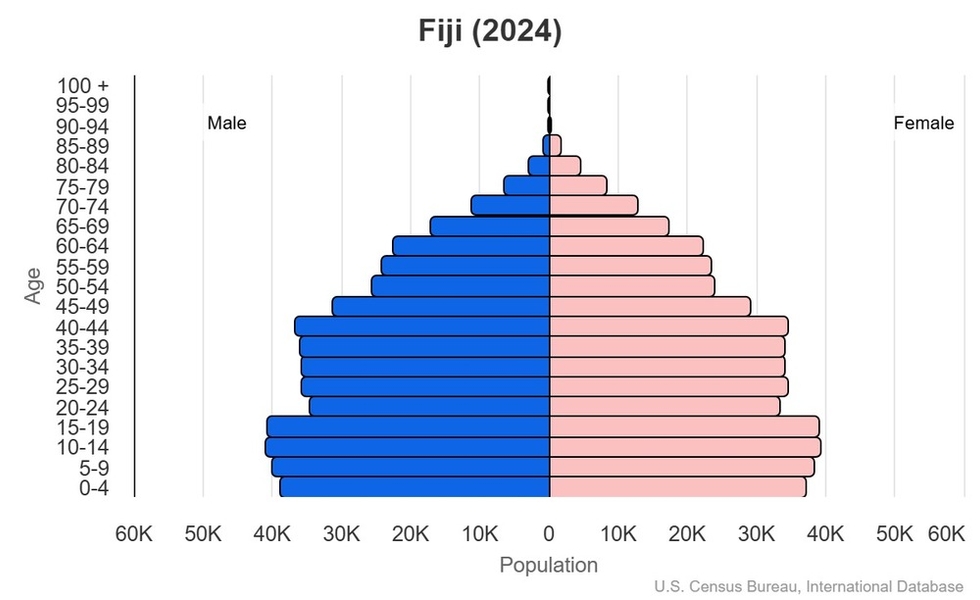
0-14 years: 24.7% (male 119,910/female 114,904)
15-64 years: 66.4% (male 323,339/female 308,921)
65 years and over: 8.9% (2024 est.) (male 39,055/female 45,482)
2024 population pyramid:
Dependency ratios
total dependency ratio: 50.5 (2024 est.)
youth dependency ratio: 37.1 (2024 est.)
elderly dependency ratio: 13.4 (2024 est.)
potential support ratio: 7.5 (2024 est.)
Median age
total: 31.6 years (2024 est.)
male: 31.4 years
female: 31.8 years
comparison ranking: total 124
Population growth rate
0.4% (2024 est.)
comparison ranking: 157
Birth rate
15.9 births/1,000 population (2024 est.)
comparison ranking: 99
Death rate
6.5 deaths/1,000 population (2024 est.)
comparison ranking: 135
Net migration rate
-5.5 migrant(s)/1,000 population (2024 est.)
comparison ranking: 206
Population distribution
approximately 70% of the population lives on the island of Viti Levu; roughly half of the population lives in urban areas
Urbanization
urban population: 58.7% of total population (2023)
rate of urbanization: 1.37% annual rate of change (2020-25 est.)
Major urban areas – population
178,000 SUVA (capital) (2018)
Sex ratio
at birth: 1.05 male(s)/female
0-14 years: 1.04 male(s)/female
15-64 years: 1.05 male(s)/female
65 years and over: 0.86 male(s)/female
total population: 1.03 male(s)/female (2024 est.)
Maternal mortality ratio
38 deaths/100,000 live births (2020 est.)
comparison ranking: 107
Infant mortality rate
total: 9.7 deaths/1,000 live births (2024 est.)
male: 11.1 deaths/1,000 live births
female: 8.1 deaths/1,000 live births
comparison ranking: total 133
Life expectancy at birth
total population: 74.8 years (2024 est.)
male: 72.2 years
female: 77.6 years
comparison ranking: total population 136
Total fertility rate
2.21 children born/woman (2024 est.)
comparison ranking: 84
Gross reproduction rate
1.08 (2024 est.)
Contraceptive prevalence rate
35.5% (2021)
Drinking water source
improved:
urban: 98.2% of population
rural: 89.1% of population
total: 94.3% of population
unimproved:
urban: 1.8% of population
rural: 10.9% of population
total: 5.7% of population (2020 est.)
Health expenditure
5.4% of GDP (2021)
10.3% of national budget (2022 est.)
Physician density
0.81 physicians/1,000 population (2015)
Hospital bed density
1.9 beds/1,000 population (2017 est.)
Sanitation facility access
improved:
urban: 100% of population
rural: 100% of population
total: 100% of population
unimproved:
urban: 0% of population
rural: 0% of population
total: 0% of population (2020 est.)
Obesity – adult prevalence rate
30.2% (2016)
comparison ranking: 24
Alcohol consumption per capita
total: 2.71 liters of pure alcohol (2019 est.)
beer: 1.64 liters of pure alcohol (2019 est.)
wine: 0.29 liters of pure alcohol (2019 est.)
spirits: 0.79 liters of pure alcohol (2019 est.)
other alcohols: 0 liters of pure alcohol (2019 est.)
comparison ranking: total 120
Tobacco use
total: 26.8% (2025 est.)
male: 40.8% (2025 est.)
female: 12.9% (2025 est.)
comparison ranking: total 31
Children under the age of 5 years underweight
4.6% (2021)
comparison ranking: 68
Currently married women (ages 15-49)
58.8% (2023 est.)
Child marriage
women married by age 15: 0.2% (2021)
women married by age 18: 4% (2021)
men married by age 18: 1.7% (2021)
Education expenditure
4.2% of GDP (2023 est.)
11.6% national budget (2024 est.)
comparison ranking: Education expenditure (% GDP) 95
Literacy
total population: 99.1%
male: 99.1%
female: 92.4% (2021 est.)
Environment
Environment – current issues
air pollution from waste incineration and vehicle emissions; deforestation and soil erosion; soil erosion from clearing land by bush burning
Environment – international agreements
party to: Biodiversity, Climate Change, Climate Change-Kyoto Protocol, Climate Change-Paris Agreement, Comprehensive Nuclear Test Ban, Desertification, Endangered Species, Law of the Sea, Marine Life Conservation, Nuclear Test Ban, Ozone Layer Protection, Ship Pollution, Tropical Timber 2006, Wetlands
signed, but not ratified: none of the selected agreements
Climate
tropical marine; only slight seasonal temperature variation
Land use
agricultural land: 17.1% (2022 est.)
arable land: 4.2% (2022 est.)
permanent crops: 3.4% (2022 est.)
permanent pasture: 9.5% (2022 est.)
forest: 63.1% (2022 est.)
other: 19.8% (2022 est.)
Urbanization
urban population: 58.7% of total population (2023)
rate of urbanization: 1.37% annual rate of change (2020-25 est.)
Air pollutants
particulate matter emissions: 7.36 micrograms per cubic meter (2019 est.)
carbon dioxide emissions: 2.05 megatons (2016 est.)
methane emissions: 0.95 megatons (2020 est.)
Waste and recycling
municipal solid waste generated annually: 189,390 tons (2011 est.)
municipal solid waste recycled annually: 10,322 tons (2013 est.)
percent of municipal solid waste recycled: 5.5% (2013 est.)
Total water withdrawal
municipal: 30 million cubic meters (2020 est.)
industrial: 10 million cubic meters (2020 est.)
agricultural: 50 million cubic meters (2020 est.)
Total renewable water resources
28.55 billion cubic meters (2020 est.)
Government
Country name
conventional long form: Republic of Fiji
conventional short form: Fiji
local long form: Republic of Fiji (English)/ Matanitu ko Viti (Fijian)
local short form: Fiji (English)/ Viti (Fijian)
etymology: the Fijians called their home Viti, but the neighboring Tongans called it Fisi; in the Anglicized spelling of the Tongan pronunciation — promulgated by explorer Captain James COOK — the designation became Fiji
Government type
parliamentary republic
Capital
name: Suva (on Viti Levu)
geographic coordinates: 18 08 S, 178 25 E
time difference: UTC+12 (17 hours ahead of Washington, DC, during Standard Time)
etymology: the name means “little hill” in the native Fijian language and may refer to a mound where a temple once stood
Administrative divisions
14 provinces and 1 dependency*; Ba, Bua, Cakaudrove, Kadavu, Lau, Lomaiviti, Macuata, Nadroga and Navosa, Naitasiri, Namosi, Ra, Rewa, Rotuma*, Serua, Tailevu
Legal system
common law system based on the English model
Constitution
history: several previous; latest signed into law 6 September 2013
amendment process: proposed as a bill by Parliament and supported by at least three quarters of its members, followed by referral to the president and then to the Electoral Commission, which conducts a referendum; passage requires approval by at least three-quarters of registered voters and assent by the president
International law organization participation
has not submitted an ICJ jurisdiction declaration; accepts ICCt jurisdiction
Citizenship
citizenship by birth: no
citizenship by descent only: at least one parent must be a citizen of Fiji
dual citizenship recognized: yes
residency requirement for naturalization: at least 5 years residency out of the 10 years preceding application
Suffrage
18 years of age; universal
Executive branch
chief of state: President Ratu Naiqama LALABALAVU (since 12 November 2024)
head of government: Prime Minister Sitiveni Ligamamada RABUKA (since 24 December 2022)
cabinet: Cabinet appointed by the prime minister from among members of Parliament and is responsible to Parliament
elections/appointments: president elected by Parliament for a 3-year term (eligible for a second term); election last held on 31 October 2024 (next to be held in 2027); prime minister endorsed by the president
election results:
2024: Ratu Naiqama LALABALAVU elected president (People’s Alliance) 35 votes, Meli Tora TAVAIQIA (Fiji First) 14 votes
2021: Ratu Wiliame KATONIVERE elected president; Wiliame KATONIVERE (People’s Alliance) 28 votes, Teimumu KEPA (SODELPA) 23 votes
Legislative branch
legislature name: Parliament
legislative structure: unicameral
number of seats: 55 (all directly elected)
electoral system: proportional representation
scope of elections: full renewal
term in office: 4 years
most recent election date: 12/14/2022
parties elected and seats per party: FijiFirst (26); People’s Alliance (21); National Federation Party (NFP) (5); Social Democratic Liberal Party (Soldelpa) (3)
percentage of women in chamber: 9.1%
expected date of next election: December 2026
Judicial branch
highest court(s): Supreme Court (consists of the chief justice, all justices of the Court of Appeal, and judges appointed specifically as Supreme Court judges); Court of Appeal (consists of the court president, all puisne judges of the High Court, and judges specifically appointed to the Court of Appeal); High Court (chaired by the chief justice and includes a minimum of 10 puisne judges; High Court organized into civil, criminal, family, employment, and tax divisions)
judge selection and term of office: chief justice appointed by the president of Fiji on the advice of the prime minister following consultation with the parliamentary leader of the opposition; judges of the Supreme Court, the president of the Court of Appeal, the justices of the Court of Appeal, and puisne judges of the High Court appointed by the president of Fiji on the nomination of the Judicial Service Commission after consulting with the cabinet minister and the House of Representatives committee responsible for the administration of justice; the chief justice, Supreme Court judges, and justices of Appeal generally required to retire at age 70, but this requirement may be waived for one or more sessions of the court; puisne judges appointed for not less than 4 years or more than 7 years, with mandatory retirement at age 65
subordinate courts: Magistrates’ Court (organized into civil, criminal, juvenile, and small claims divisions)
Political parties
Fiji First
Fiji Labor Party or FLP
Freedom Alliance (formerly Fiji United Freedom Party or FUFP)
National Federation Party or NFP
People’s Alliance
Peoples Democratic Party or PDP
Social Democratic Liberal Party or SODELPA
Unity Fiji
Diplomatic representation in the US
chief of mission: Ambassador Ilisoni VUIDREKETI (since 17 June 2024)
chancery: 1707 L Street NW, Suite 200, Washington, DC 20036
telephone: [1] (917) 208-4560
FAX: [1] (202) 466-8325
email address and website:
[email protected]
https://www.fijiembassydc.com/
Diplomatic representation from the US
chief of mission: Ambassador Marie DAMOUR (since 24 November 2022); note – also accredited to Kiribati, Nauru, Tonga, and Tuvalu
embassy: 158 Princes Road, Tamavua, Suva
mailing address: 4290 Suva Place, Washington DC 20521-4290
telephone: [679] 331-4466
FAX: [679] 330-2267
email address and website:
[email protected]
https://fj.usembassy.gov/
International organization participation
ACP, ADB, AOSIS, C, CP, FAO, G-77, IAEA, IBRD, ICAO, ICCt, ICRM, IDA, IFAD, IFC, IFRCS, IHO, ILO, IMF, IMO, Interpol, IOC, IOM, ISO, ITSO, ITU, ITUC (NGOs), MIGA, OPCW, PCA, PIF, Sparteca (suspended), SPC, UN, UNCTAD, UNDOF, UNESCO, UNIDO, UNISFA, UNMISS, UNWTO, UPU, WCO, WFTU (NGOs), WHO, WIPO, WMO, WTO
Independence
10 October 1970 (from the UK)
National holiday
Fiji (Independence) Day, 10 October (1970)
Flag description
light blue with the UK flag in the upper hoist-side quadrant and the Fijian shield centered on the outer half of the flag; blue symbolizes the Pacific Ocean; the shield is taken from Fiji’s coat of arms and shows a yellow lion holding a coconut above a white field quartered by the cross of Saint George; the four quarters depict sugarcane, a palm tree, a banana bunch, and a white dove
National symbol(s)
Fijian canoe
National colors
light blue
National anthem
name: “God Bless Fiji”
lyrics/music: Michael Francis Alexander PRESCOTT/C. Austin MILES (adapted by Michael Francis Alexander PRESCOTT)
note: adopted 1970; known in Fijian as “Meda Dau Doka” (Let Us Show Pride); adapted from the hymn, “Dwelling in Beulah Land,” the anthem’s English lyrics are generally sung, although they differ in meaning from the official Fijian lyrics
National heritage
total World Heritage Sites: 1 (cultural)
selected World Heritage Site locales: Levuka Historical Port Town
Economy
Economic overview
upper-middle income, tourism-based Pacific island economy; susceptible to ocean rises; key energy and infrastructure investments; post-pandemic tourism resurgence; improved debt standing; limited workforce
Real GDP (purchasing power parity)
$12.617 billion (2023 est.)
$11.734 billion (2022 est.)
$9.795 billion (2021 est.)
note: data in 2021 dollars
comparison ranking: 161
Real GDP growth rate
7.52% (2023 est.)
19.79% (2022 est.)
-4.88% (2021 est.)
note: annual GDP % growth based on constant local currency
comparison ranking: 15
Real GDP per capita
$13,700 (2023 est.)
$12,800 (2022 est.)
$10,700 (2021 est.)
note: data in 2021 dollars
comparison ranking: 129
GDP (official exchange rate)
$5.442 billion (2023 est.)
note: data in current dollars at official exchange rate
Inflation rate (consumer prices)
2.1% (2023 est.)
4.5% (2022 est.)
0.2% (2021 est.)
note: annual % change based on consumer prices
comparison ranking: 61
GDP – composition, by sector of origin
agriculture: 11.7% (2023 est.)
industry: 14.2% (2023 est.)
services: 55.1% (2023 est.)
note: figures may not total 100% due to non-allocated consumption not captured in sector-reported data
comparison rankings: services 124; industry 173; agriculture 68
GDP – composition, by end use
household consumption: 82.4% (2022 est.)
government consumption: 20.5% (2022 est.)
investment in fixed capital: 17.8% (2022 est.)
investment in inventories: 0.7% (2022 est.)
exports of goods and services: 48.2% (2022 est.)
imports of goods and services: -69.3% (2022 est.)
note: figures may not total 100% due to rounding or gaps in data collection
Agricultural products
sugarcane, cassava, taro, vegetables, chicken, coconuts, eggs, ginger, milk, sweet potatoes (2023)
note: top ten agricultural products based on tonnage
Industries
tourism, sugar processing, clothing, copra, gold, silver, lumber
Industrial production growth rate
-4.86% (2023 est.)
note: annual % change in industrial value added based on constant local currency
comparison ranking: 197
Labor force
387,800 (2024 est.)
note: number of people ages 15 or older who are employed or seeking work
comparison ranking: 164
Unemployment rate
4.3% (2024 est.)
4.3% (2023 est.)
4.4% (2022 est.)
note: % of labor force seeking employment
comparison ranking: 77
Youth unemployment rate (ages 15-24)
total: 15.5% (2024 est.)
male: 11.8% (2024 est.)
female: 22.5% (2024 est.)
note: % of labor force ages 15-24 seeking employment
comparison ranking: total 85
Population below poverty line
24.1% (2019 est.)
note: % of population with income below national poverty line
Gini Index coefficient – distribution of family income
30.7 (2019 est.)
note: index (0-100) of income distribution; higher values represent greater inequality
comparison ranking: 120
Household income or consumption by percentage share
lowest 10%: 3.5% (2019 est.)
highest 10%: 24.2% (2019 est.)
note: % share of income accruing to lowest and highest 10% of population
Remittances
9.19% of GDP (2023 est.)
9.23% of GDP (2022 est.)
9.14% of GDP (2021 est.)
note: personal transfers and compensation between resident and non-resident individuals/households/entities
Budget
revenues: $1.019 billion (2021 est.)
expenditures: $1.488 billion (2021 est.)
note: central government revenues and expenses (excluding grants/extrabudgetary units/social security funds) converted to US dollars at average official exchange rate for year indicated
Public debt
48.9% of GDP (2017 est.)
comparison ranking: 110
Taxes and other revenues
20.7% (of GDP) (2023 est.)
note: central government tax revenue as a % of GDP
comparison ranking: 79
Current account balance
-$865.665 million (2022 est.)
-$686.577 million (2021 est.)
-$614.13 million (2020 est.)
note: balance of payments – net trade and primary/secondary income in current dollars
comparison ranking: 136
Exports
$2.376 billion (2022 est.)
$1.171 billion (2021 est.)
$1.23 billion (2020 est.)
note: balance of payments – exports of goods and services in current dollars
comparison ranking: 159
Exports – partners
USA 32%, Australia 12%, Tonga 6%, NZ 6%, Samoa 4% (2023)
note: top five export partners based on percentage share of exports
Exports – commodities
water, fish, raw sugar, refined petroleum, garments (2023)
note: top five export commodities based on value in dollars
Imports
$3.434 billion (2022 est.)
$2.344 billion (2021 est.)
$1.977 billion (2020 est.)
note: balance of payments – imports of goods and services in current dollars
comparison ranking: 161
Imports – partners
Singapore 25%, China 16%, Australia 15%, NZ 14%, USA 5% (2023)
note: top five import partners based on percentage share of imports
Imports – commodities
refined petroleum, medical instruments, cars, broadcasting equipment, plastics (2023)
note: top five import commodities based on value in dollars
Reserves of foreign exchange and gold
$1.597 billion (2024 est.)
$1.548 billion (2023 est.)
$1.557 billion (2022 est.)
note: holdings of gold (year-end prices)/foreign exchange/special drawing rights in current dollars
comparison ranking: 136
Debt – external
$1.397 billion (2023 est.)
note: present value of external debt in current US dollars
comparison ranking: 100
Exchange rates
Fijian dollars (FJD) per US dollar –
Exchange rates:
2.268 (2024 est.)
2.25 (2023 est.)
2.201 (2022 est.)
2.071 (2021 est.)
2.169 (2020 est.)
Energy
Electricity access
electrification – total population: 92% (2022 est.)
electrification – urban areas: 97.6%
electrification – rural areas: 86.8%
Electricity
installed generating capacity: 427,000 kW (2023 est.)
consumption: 1.048 billion kWh (2023 est.)
transmission/distribution losses: 102.047 million kWh (2023 est.)
comparison rankings: transmission/distribution losses 46; consumption 160; installed generating capacity 154
Electricity generation sources
fossil fuels: 36.3% of total installed capacity (2023 est.)
solar: 1.1% of total installed capacity (2023 est.)
wind: 0.2% of total installed capacity (2023 est.)
hydroelectricity: 52.3% of total installed capacity (2023 est.)
biomass and waste: 10% of total installed capacity (2023 est.)
Coal
consumption: 6 metric tons (2023 est.)
imports: 2 metric tons (2022 est.)
Petroleum
refined petroleum consumption: 10,000 bbl/day (2023 est.)
Carbon dioxide emissions
1.432 million metric tonnes of CO2 (2023 est.)
from coal and metallurgical coke: 12 metric tonnes of CO2 (2023 est.)
from petroleum and other liquids: 1.432 million metric tonnes of CO2 (2023 est.)
comparison ranking: total emissions 165
Energy consumption per capita
25.375 million Btu/person (2023 est.)
comparison ranking: 123
Communications
Telephones – fixed lines
total subscriptions: 49,000 (2021 est.)
subscriptions per 100 inhabitants: 4 (2022 est.)
comparison ranking: total subscriptions 155
Telephones – mobile cellular
total subscriptions: 992,000 (2021 est.)
subscriptions per 100 inhabitants: 107 (2021 est.)
comparison ranking: total subscriptions 163
Broadcast media
Fiji TV, a publicly traded company, operates a free-to-air channel; Digicel Fiji operates the Sky Fiji and Sky Pacific multi-channel pay-TV services; state-owned commercial company, Fiji Broadcasting Corporation, Ltd, operates 6 radio stations, including 2 public broadcasters and 4 commercial broadcasters with multiple repeaters; 5 radio stations with repeaters operated by Communications Fiji, Ltd; transmissions of multiple international broadcasters are available
Internet country code
.fj
Internet users
percent of population: 79% (2023 est.)
Broadband – fixed subscriptions
total: 23,000 (2022 est.)
subscriptions per 100 inhabitants: 3 (2022 est.)
comparison ranking: total 166
Transportation
Civil aircraft registration country code prefix
DQ
Airports
26 (2025)
comparison ranking: 128
Heliports
2 (2025)
comparison ranking: 138
Railways
total: 597 km (2008)
narrow gauge: 597 km (2008) 0.600-m gauge
note: belongs to the government-owned Fiji Sugar Corporation; used to haul sugarcane during the harvest season, which runs from May to December
Merchant marine
total: 74 (2023)
by type: general cargo 21, oil tanker 4, other 49
comparison ranking: total 105
Ports
total ports: 5 (2024)
large: 0
medium: 0
small: 2
very small: 3
ports with oil terminals: 4
key ports: Lautoka Harbor, Levuka, Malai, Savusavu Bay, Suva Harbor
Military and Security
Military and security forces
Republic of Fiji Military Forces (RFMF): Land Force, Republic of Fiji Navy (2025)
Military expenditures
1.4% of GDP (2024 est.)
1.1% of GDP (2023 est.)
1.2% of GDP (2022 est.)
1.5% of GDP (2021 est.)
1.4% of GDP (2020 est.)
Military and security service personnel strengths
approximately 4,000 active Republic of Fiji Military Forces (2025)
Military equipment inventories and acquisitions
the RFMF is lightly armed and equipped; Australia has provided patrol boats and a few armored personnel carriers; it also provides logistical support for RFMF regional or UN operations; in recent years, China and the US have provided small amounts of equipment (2024)
Military service age and obligation
18-25 years of age for voluntary military service for men and women (2024)
note: as of 2024, women comprised approximately 8% of the Fiji Military Forces
Military deployments
170 Egypt (MFO); 160 Iraq (UNAMI); 150 Golan Heights (UNDOF) (2024)
Military – note
established in 1920, the RFMF is a small and lightly-armed force with a history of intervening in the country’s politics, including coups in 1987 and 2006, and a mutiny in 2000, and it continues to have significant political power; the RFMF is responsible for external security but can be assigned some domestic security responsibilities in specific circumstances; it also has a tradition of participating in UN peacekeeping operations, having sent troops on nearly 20 such missions since first deploying personnel to South Lebanon in 1978; these deployments have offered experience and a source of financial support; the RFMF has an infantry regiment and a small naval element comprised of patrol boats
Fiji has a “shiprider” agreement with the US, which allows local maritime law enforcement officers to embark on US Coast Guard (USCG) and US Navy (USN) vessels, including to board and search vessels suspected of violating laws or regulations within Fiji’s designated exclusive economic zone (EEZ) or on the high seas; “shiprider” agreements also enable USCG personnel and USN vessels with embarked USCG law enforcement personnel to work with host nations to protect critical regional resources (2025)
Transnational Issues
Trafficking in persons
tier rating: Tier 2 Watch List — the government did not demonstrate overall increasing efforts to eliminate trafficking compared with the previous reporting period, therefore Fiji was downgraded to Tier 2 Watch List; for more details, go to: https://www.state.gov/reports/2024-trafficking-in-persons-report/fiji/