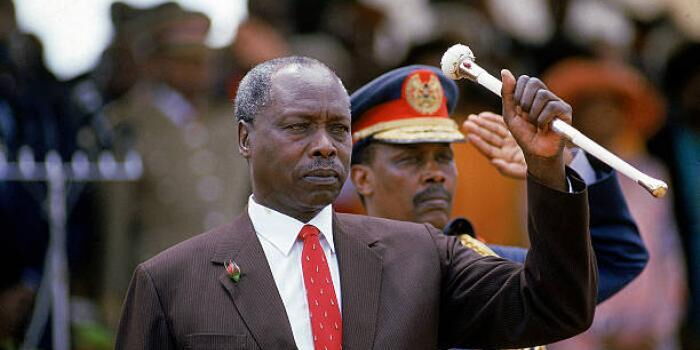
Daniel arap Moi was Kenya’s second president and one of the country’s longest-serving leaders. He ruled Kenya from 22 August 1978 until 30 December 2002, serving for 24 years after the death of the country’s founding president, Jomo Kenyatta.
Moi became one of the most influential political figures in Kenya’s post-independence history, overseeing the country during periods of one-party rule, economic challenges, political transition, and the eventual return of multiparty democracy.
Read Also: List of people who served as Ministers in Jomo Kenyatta’s Regime
Early Life and Education
Daniel Toroitich arap Moi ( 2 September 1924 – 4 February 2020) was a Kenyan politician who served as the second president of Kenya from 1978 to 2002. He is the country’s longest-serving president to date. Moi previously served as the third vice president of Kenya from 1967 to 1978 under President Jomo Kenyatta, becoming the president following the latter’s death.
He attended:
- African Inland Mission School
- Tambach Teachers Training College (TTC)
Before joining politics, Moi worked as a teacher, which later contributed to his calm and disciplined public image.
Entry Into Politics
Moi entered politics during the final years of British colonial rule and became associated with:
- KADU
KADU mainly represented minority communities that feared domination by larger ethnic groups after independence.
Following the dissolution of KADU in 1964, Moi joined:
- KANU
This move helped consolidate Kenya into a de facto single-party state.
Political Offices Held
Member of Parliament (1963–2002)
Moi served continuously as a Member of Parliament from December 1963 until December 2002.
Constituencies Represented
- Baringo North (1963–1967)
- Baringo Central (1967–2002)
After his retirement from politics, he was succeeded in Parliament by his son:
- Gideon Moi
Minister for Home Affairs (1964–1978)
Under President Jomo Kenyatta, Moi served as Minister for Home Affairs from 1964 to 1978.
This powerful ministry gave him national visibility and helped position him for future leadership.
Vice President of Kenya (1967–1978)
Moi became Kenya’s third Vice President on 5 January 1967 after:
- Joseph Murumbi
resigned from office.
During this period, Moi developed strong political networks across the country while remaining publicly loyal to Kenyatta.
Presidency of Kenya (1978–2002)
Becoming President
Following Jomo Kenyatta’s death on 22 August 1978, Moi automatically assumed office as Acting President before formally becoming President on 14 October 1978.
Vice Presidents During Moi’s Presidency
After Kenya gained independence on 12 December 1963, Kenyatta convinced Moi that KADU and KANU should merge to complete the process of decolonisation. Accordingly, KADU dissolved and joined KANU in 1964. The only real challenge to KANU’s dominance came from the Kenya People’s Union, starting in 1966. That party was banned in 1969, and from that point onward Kenya was a de facto one-party state dominated by the Kĩkũyũ–Luo alliance. However, with an eye on the fertile lands of the Rift Valley populated by members of Moi’s Kalenjin tribe, Kenyatta secured their support by first promoting Moi to Minister for Home Affairs in 1964, and then to Vice-President in 1967. As a member of a minority tribe Moi was also an acceptable compromise for the major tribes. Moi was elected to the Kenyan parliament in 1963 from Baringo North. From 1966 until his retirement in 2002, he served as the MP for Baringo Central in addition to his various other offices
- Mwai Kibaki
- Josephat Karanja
- George Saitoti
- Musalia Mudavadi
However, Moi faced opposition from the tribe Kikuyu elite known as the Kiambu Mafia, who would have preferred one of their own to accede to the presidency. This resulted in an attempt by the constitutional drafting group to change the constitution to prevent the vice-president automatically assuming power in the event of the president’s death.[17] However, many senior Kikuyu politicians, including Mwai Kibaki and Charles Njonjo, as well as Kenyatta himself, opposed such a change to the order of succession, fearing it might lead to political instability if Kenyatta died, given his advanced age and perennial illnesses. Thus, Moi’s position as successor to Kenyatta was safeguarded.
One-Party Rule and KANU Dominance
Much of Moi’s presidency was characterized by:
- One-party rule under KANU
- Strong centralized government
- Frequent cabinet reshuffles
- Tight political control
During the 1980s, Kenya officially became a one-party state under Section 2A of the Constitution.
Return of Multiparty Politics
Domestic pressure and international calls for political reforms eventually forced Moi’s government to reintroduce multiparty democracy in 1991.
Moi later won:
- The 1992 presidential election
- The 1997 presidential election
despite growing opposition pressure.
Chairperson of the OAU
Moi also served as Chairperson of the:
- Organization of African Unity
from June 1981 to June 1983.
During his tenure, he played diplomatic roles in regional peace and African political affairs.
Family and Personal Life
Moi married:
- Lena Moi
in 1950 before they later separated in 1974.
He had eight children, including:
- Gideon Moi
- Jonathan Toroitich
His family remained influential in Kenyan politics and business long after his retirement.
Leadership Style
Moi became known for:
- Authoritarian political control
- Emphasis on loyalty
- Strong provincial administration
- Rural political mobilization
His famous philosophy of:
- “Nyayo” (footsteps)
symbolized continuity with Kenyatta’s leadership.
Death and Legacy
Daniel arap Moi died on 4 February 2020 in Nairobi at the age of 95.
His death marked the end of one of the most influential political eras in Kenyan history.
Legacy
Supporters credit Moi for:
- Maintaining national stability
- Expanding education
- Infrastructure development
- African diplomacy
Critics point to:
- Human rights abuses
- Corruption
- Political repression
- Suppression of opposition
Despite differing opinions, Moi remains one of the most consequential figures in Kenya’s post-independence political history.
Awards and Recognition
Among his honors was the:
- Silver World Award (1981)
recognizing his international diplomatic contributions.
Read Also: Joshua Kulei: From Warder to Billionaire
| 2nd President of Kenya | |
|---|---|
| In office 22 August 1978 – 30 December 2002 Acting to 14 October 1978 | |
| Vice President | Mwai KibakiJosephat KaranjaGeorge SaitotiMusalia Mudavadi |
| Preceded by | Jomo Kenyatta |
| Succeeded by | Mwai Kibaki |
| Chairperson of the OAU | |
| In office 24 June 1981 – 6 June 1983 | |
| Preceded by | Siaka Stevens |
| Succeeded by | Mengistu Haile Mariam |
| 3rd Vice President of Kenya | |
| In office 5 January 1967 – 22 August 1978 | |
| President | Jomo Kenyatta |
| Preceded by | Joseph Murumbi |
| Succeeded by | Mwai Kibaki |
| Minister for Home Affairs | |
| In office 28 December 1964 – 9 April 1978 | |
| President | Jomo Kenyatta |
| Member of Parliament | |
| In office 5 December 1963 – 20 December 2002 | |
| Succeeded by | Gideon Moi |
| Constituency | Baringo North (1963–1967)Baringo Central (1967–2002) |
| Personal details | |
| Born | Toroitich Arap Moi 2 September 1924 Sacho, Baringo, Kenya Colony |
| Died | 4 February 2020 (aged 95) Nairobi, Kenya |
| Party | KANUKADU (1960–1964) |
| Spouse | Lena Bomett(m. 1950; sep. 1974)[1] |
| Children | 8, including Jonathan Toroitich and Gideon |
| Alma mater | Tambach TTC |
| Profession | Teacher |
| Awards | Silver World Award (1981) |