First inhabited by Arawak and later by Carib Indians, the Virgin Islands were settled by the Dutch in 1648 and then annexed by the English in 1672. The islands were part of the British colony of the Leeward Islands (1872-1960); they were granted autonomy in 1967. The economy is closely tied to the larger and more populous US Virgin Islands to the west, and the US dollar is the legal currency. In 2017, Hurricane Irma devastated the island of Tortola. An estimated 80% of residential and business structures were destroyed or damaged, communications disrupted, and local roads rendered impassable.
Geography
Location
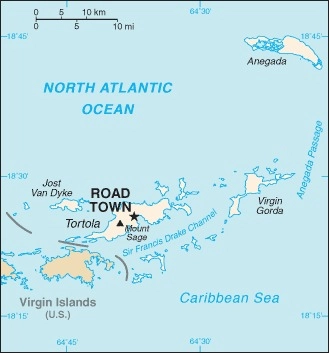
Caribbean, between the Caribbean Sea and the North Atlantic Ocean, east of Puerto Rico
Geographic coordinates
18 30 N, 64 30 W
Map references
Central America and the Caribbean
Area
total : 151 sq km
land: 151 sq km
water: 0 sq km
note: comprised of 16 inhabited and more than 20 uninhabited islands; includes the islands of Tortola, Anegada, Virgin Gorda, Jost van Dyke
comparison ranking: total 220
Area – comparative
about 0.9 times the size of Washington, D.C.
Land boundaries
total: 0 km
Coastline
80 km
Maritime claims
territorial sea: 12 nm
exclusive fishing zone: 200 nm
Climate
subtropical; humid; temperatures moderated by trade winds
Terrain
coral islands relatively flat; volcanic islands steep, hilly
Elevation
highest point: Mount Sage 521 m
lowest point: Caribbean Sea 0 m
Natural resources
NEGL; pleasant climate, beaches foster tourism
Land use
agricultural land: 46.7% (2022 est.)
arable land: 6.7% (2022 est.)
permanent crops: 6.7% (2022 est.)
permanent pasture: 33.3% (2022 est.)
forest: 24.1% (2022 est.)
other: 29.2% (2022 est.)
Irrigated land
NA
Population distribution
a fairly even distribution throughout the inhabited islands, with the largest islands of Tortola, Anegada, Virgin Gorda, and Jost Van Dyke having the largest populations
Natural hazards
hurricanes and tropical storms (July to October)
Geography – note
strong ties to nearby US Virgin Islands and Puerto Rico
People and Society
Population
total: 40,102 (2024 est.)
male: 19,042
female: 21,060
comparison rankings: total 213; female 212; male 213
Nationality
noun: British Virgin Islander(s)
adjective: British Virgin Islander
Ethnic groups
African/Black 76.3%, Latino 5.5%, White 5.4%, mixed 5.3%, Indian 2.1%, East Indian 1.6%, other 3%, unspecified 0.8% (2010 est.)
Languages
English (official), Virgin Islands Creole
Religions
Protestant 70.2% (Methodist 17.6%, Church of God 10.4%, Anglican 9.5%, Seventh Day Adventist 9.0%, Pentecostal 8.2%, Baptist 7.4%, New Testament Church of God 6.9%, other Protestant 1.2%), Roman Catholic 8.9%, Jehovah’s Witness 2.5%, Hindu 1.9%, other 6.2%, none 7.9%, unspecified 2.4% (2010 est.)
Age structure
0-14 years: 16.6% (male 3,298/female 3,351)
15-64 years: 71.3% (male 13,455/female 15,152)
65 years and over: 12.1% (2024 est.) (male 2,289/female 2,557)
2024 population pyramid:

Dependency ratios
total dependency ratio: 40.2 (2024 est.)
youth dependency ratio: 23.2 (2024 est.)
elderly dependency ratio: 16.9 (2024 est.)
potential support ratio: 5.9 (2024 est.)
Median age
total: 38.5 years (2024 est.)
male: 38.1 years
female: 38.9 years
comparison ranking: total 74
Population growth rate
1.82% (2024 est.)
comparison ranking: 47
Birth rate
10.9 births/1,000 population (2024 est.)
comparison ranking: 168
Death rate
5.5 deaths/1,000 population (2024 est.)
comparison ranking: 183
Net migration rate
12.9 migrant(s)/1,000 population (2024 est.)
comparison ranking: 4
Population distribution
a fairly even distribution throughout the inhabited islands, with the largest islands of Tortola, Anegada, Virgin Gorda, and Jost Van Dyke having the largest populations
Urbanization
urban population: 49.7% of total population (2023)
rate of urbanization: 1.73% annual rate of change (2020-25 est.)
Major urban areas – population
15,000 ROAD TOWN (capital) (2018)
Sex ratio
at birth: 1.05 male(s)/female
0-14 years: 0.98 male(s)/female
15-64 years: 0.89 male(s)/female
65 years and over: 0.9 male(s)/female
total population: 0.9 male(s)/female (2024 est.)
Infant mortality rate
total: 13.4 deaths/1,000 live births (2024 est.)
male: 16 deaths/1,000 live births
female: 10.7 deaths/1,000 live births
comparison ranking: total 105
Life expectancy at birth
total population: 80.1 years (2024 est.)
male: 78.6 years
female: 81.7 years
comparison ranking: total population 57
Total fertility rate
1.38 children born/woman (2024 est.)
comparison ranking: 213
Gross reproduction rate
0.67 (2024 est.)
Contraceptive prevalence rate
NA
Drinking water source
improved:
total: 99.9% of population
unimproved:
total: 0.1% of population (2020 est.)
Sanitation facility access
improved:
urban: 97.5% of population
rural: 97.5% of population
total: 97.5% of population
unimproved:
urban: 2.5% of population
rural: 2.5% of population
total: 2.5% of population (2015 est.)
Currently married women (ages 15-49)
46.6% (2023 est.)
Education expenditure
2.5% of GDP (2022 est.)
13.6% national budget (2025 est.)
comparison ranking: Education expenditure (% GDP) 172
Literacy
total population: NA
male: NA
female: NA
School life expectancy (primary to tertiary education)
total: 12 years
male: 12 years
female: 12 years (2018)
Environment
Environment – current issues
limited natural freshwater resources; water pollution from sewage and mining/industry waste; coral reef preservation
Climate
subtropical; humid; temperatures moderated by trade winds
Land use
agricultural land: 46.7% (2022 est.)
arable land: 6.7% (2022 est.)
permanent crops: 6.7% (2022 est.)
permanent pasture: 33.3% (2022 est.)
forest: 24.1% (2022 est.)
other: 29.2% (2022 est.)
Urbanization
urban population: 49.7% of total population (2023)
rate of urbanization: 1.73% annual rate of change (2020-25 est.)
Air pollutants
carbon dioxide emissions: 0.21 megatons (2016 est.)
Waste and recycling
municipal solid waste generated annually: 21,099 tons (2000 est.)
Government
Country name
conventional long form: none
conventional short form: British Virgin Islands
abbreviation: BVI
etymology: the islets, cays, and rocks surrounding the major islands reminded explorer Christopher COLUMBUS in 1493 of Saint Ursula and her 11,000 virgin followers (Santa Ursula y las Once Mil Virgenes), which over time was shortened to the Virgins (las Virgenes)
Government type
Overseas Territory of the UK with limited self-government; parliamentary democracy
Dependency status
overseas territory of the UK; internal self-governing
Capital
name: Road Town
geographic coordinates: 18 25 N, 64 37 W
time difference: UTC-4 (1 hour ahead of Washington, DC, during Standard Time)
etymology: name refers to the nautical term “roadstead” or “roads,” a body of water less sheltered than a harbor but where ships can still lie at anchor
Administrative divisions
none (overseas territory of the UK)
Legal system
English common law
Constitution
history: several previous; latest effective 15 June 2007 (The Virgin Islands Constitution Order 2007)
amendment process: initiated by any elected member of the House of Assembly; passage requires simple majority vote by the elected members of the Assembly and assent by the governor on behalf of the monarch
Citizenship
see United Kingdom
Suffrage
18 years of age; universal
Executive branch
chief of state: King CHARLES III (since 8 September 2022); represented by Governor Daniel PRUCE (since 29 January 2024)
head of government: Premier Dr. Natalio WHEATLEY (since 5 May 2022)
cabinet: Executive Council appointed by the governor from members of the House of Assembly
elections/appointments: the monarchy is hereditary; governor appointed by the monarch; following legislative elections, the leader of the majority party or majority coalition usually appointed premier by the governor
note: on 5 May 2022, Premier Andrew FAHIE was removed from office by a no-confidence vote in the House of Assembly after his arrest on drug-trafficking and money-laundering charges; Premier Dr. Natalio WHEATLEY was sworn in as premier on 5 May 2022
Legislative branch
legislature name: House of Assembly
legislative structure: unicameral
number of seats: 15 (directly elected and appointed)
scope of elections: full renewal
term in office: 4 years
most recent election date: 4/24/2023
parties elected and seats per party: VIP (6); NDP (3); PVIM (3); PU (1)
expected date of next election: 2027
Judicial branch
highest court(s): the Eastern Caribbean Supreme Court (ECSC) is the superior court of the Organization of Eastern Caribbean States; the ECSC is headquartered on St. Lucia and consists of the Court of Appeal — headed by the chief justice and 4 judges — and the High Court with 18 judges; the Court of Appeal travels to member states on a schedule to hear appeals from the High Court and subordinate courts
judge selection and term of office: Eastern Caribbean Supreme Court chief justice appointed by the British monarch; other justices and judges appointed by the Judicial and Legal Services Commission; Court of Appeal justices appointed for life with mandatory retirement at age 65; High Court judges appointed for life with mandatory retirement at age 62
subordinate courts: Magistrates’ Courts
Political parties
National Democratic Party or NDP
Progressive Virgin Islands Movement or PVIM
Progressives United or PU
Virgin Islands Party or VIP
Diplomatic representation in the US
none (overseas territory of the UK)
Diplomatic representation from the US
embassy: none (overseas territory of the UK)
International organization participation
ACS (associate), Caricom (associate), CDB, Interpol (subbureau), IOC, OECS, UNESCO (associate), UPU
Independence
none (overseas territory of the UK)
National holiday
Territory Day, 1 July (1956)
Flag description
blue with the UK flag in the upper hoist-side quadrant and the Virgin Islander coat of arms centered in the outer half of the flag; the coat of arms depicts a woman flanked by vertical columns of six oil lamps above a scroll bearing the Latin word VIGILATE (Be Watchful); Christopher COLUMBUS named the islands in 1493 in honor of Saint Ursula and her virgin followers, and the figure holding a lamp represents the saint, with the other lamps symbolizing her followers
National symbol(s)
zenaida dove, white cedar flower
National colors
yellow, green, red, white, blue
National anthem
note: as an overseas territory of the United Kingdom, “God Save the King” is official (see United Kingdom)
Economy
Economic overview
British Caribbean island territorial economy; strong tourism and services industries; vulnerable to hurricanes; navigating public debt insolvency since 2008 Crisis; considered a tax haven; high electrification costs; major rum exporter
Real GDP (purchasing power parity)
$500 million (2017 est.)
$490.2 million (2016 est.)
$481.1 million (2015 est.)
comparison ranking: 213
Real GDP growth rate
2% (2017 est.)
1.9% (2016 est.)
1.8% (2015 est.)
comparison ranking: 141
Real GDP per capita
$34,200 (2017 est.)
comparison ranking: 71
GDP (official exchange rate)
$1.38 billion (2018 est.)
Inflation rate (consumer prices)
4.2% (2022 est.)
2.8% (2021 est.)
0.4% (2020 est.)
comparison ranking: 132
GDP – composition, by sector of origin
agriculture: 0.2% (2017 est.)
industry: 6.8% (2017 est.)
services: 93.1% (2017 est.)
comparison rankings: services 1; industry 208; agriculture 208
GDP – composition, by end use
household consumption: 25.1% (2017 est.)
government consumption: 7.5% (2017 est.)
investment in fixed capital: 21.7% (2017 est.)
investment in inventories: 20.4% (2017 est.)
exports of goods and services: 94.7% (2017 est.)
imports of goods and services: -69.4% (2017 est.)
Agricultural products
fruits, vegetables; livestock, poultry; fish
Industries
tourism, light industry, construction, rum, concrete block, offshore banking center
Industrial production growth rate
1.1% (2017 est.)
comparison ranking: 128
Budget
revenues: $400 million (2017 est.)
expenditures: $400 million (2017 est.)
Taxes and other revenues
38.9% (of GDP) (2017 est.)
comparison ranking: 12
Exports
$23 million (2017 est.)
$23 million (2015 est.)
note: Data are in current year dollars and do not include illicit exports or re-exports.
comparison ranking: 216
Exports – partners
Malta 33%, Guyana 22%, Greece 11%, Germany 7%, Indonesia 4% (2023)
Exports – commodities
ships, refined petroleum, aircraft, molasses, precious stones (2023)
Imports
$300 million (2017 est.)
$210 million (2016 est.)
comparison ranking: 209
Imports – partners
USA 34%, Italy 10%, France 9%, China 8%, Luxembourg 5% (2023)
Imports – commodities
ships, refined petroleum, aircraft, railway cargo containers, jewelry (2023)
Exchange rates
the US dollar is used
Energy
Electricity access
electrification – total population: 100% (2022 est.)
Electricity
installed generating capacity: 63,000 kW (2023 est.)
consumption: 163.82 million kWh (2023 est.)
transmission/distribution losses: 10.18 million kWh (2023 est.)
comparison rankings: transmission/distribution losses 18; consumption 191; installed generating capacity 190
Electricity generation sources
fossil fuels: 97.7% of total installed capacity (2023 est.)
solar: 1.1% of total installed capacity (2023 est.)
wind: 1.1% of total installed capacity (2023 est.)
Coal
imports: 20 metric tons (2023 est.)
Petroleum
refined petroleum consumption: 1,000 bbl/day (2023 est.)
Carbon dioxide emissions
188,000 metric tonnes of CO2 (2023 est.)
from petroleum and other liquids: 188,000 metric tonnes of CO2 (2023 est.)
comparison ranking: total emissions 203
Energy consumption per capita
66.998 million Btu/person (2023 est.)
comparison ranking: 74
Communications
Telephones – fixed lines
total subscriptions: 23,000 (2021 est.)
subscriptions per 100 inhabitants: 17 (2022 est.)
comparison ranking: total subscriptions 171
Telephones – mobile cellular
total subscriptions: 38,000 (2021 est.)
subscriptions per 100 inhabitants: 121 (2021 est.)
comparison ranking: total subscriptions 210
Broadcast media
1 private TV station; multi-channel TV is available from cable and satellite subscription services; about a half-dozen private radio stations
Internet country code
.vg
Internet users
percent of population: 78% (2017 est.)
Broadband – fixed subscriptions
total: 7,000 (2022 est.)
subscriptions per 100 inhabitants: 18 (2022 est.)
comparison ranking: total 190
Transportation
Civil aircraft registration country code prefix
VP-L
Airports
3 (2025)
comparison ranking: 194
Heliports
2 (2025)
comparison ranking: 127
Merchant marine
total: 29 (2023)
by type: general cargo 3, other 26
comparison ranking: total 137
Ports
total ports: 1 (2024)
large: 0
medium: 1
small: 0
very small: 0
ports with oil terminals: 1
key ports: Road Harbor
Military and Security
Military – note
defense is the responsibility of the UK
Transnational Issues
Illicit drugs
transshipment point for South American narcotics destined for the US and Europe; large offshore financial center makes it vulnerable to money laundering