Belize was the site of several Mayan city states until their decline at the end of the first millennium A.D. The British and Spanish disputed the region in the 17th and 18th centuries; it formally became the colony of British Honduras in 1862. Territorial disputes between the UK and Guatemala delayed the independence of Belize until 1981. Guatemala refused to recognize the new nation until 1992, and the two countries are still involved in an ongoing border dispute. Tourism has become the mainstay of the economy. Current concerns include the country’s heavy foreign debt burden, high crime rates, high unemployment combined with a majority youth population, growing involvement in the Mexican and South American drug trade, and one of the highest HIV/AIDS prevalence rates in Central America.
Geography
Location
Central America, bordering the Caribbean Sea, between Guatemala and Mexico
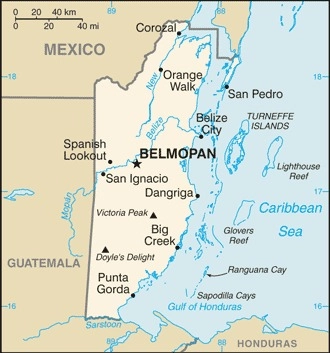
Geographic coordinates
17 15 N, 88 45 W
Map references
Central America and the Caribbean
Area
total : 22,966 sq km
land: 22,806 sq km
water: 160 sq km
comparison ranking: total 151
Area – comparative
slightly smaller than Massachusetts
Land boundaries
total: 542 km
border countries (2): Guatemala 266 km; Mexico 276 km
Coastline
386 km
Maritime claims
territorial sea: 12 nm in the north, 3 nm in the south; note – from the mouth of the Sarstoon River to Ranguana Cay, Belize’s territorial sea is 3 nm; according to Belize’s Maritime Areas Act, 1992, the purpose of this limitation is to provide a framework for negotiating a definitive agreement on territorial differences with Guatemala
exclusive economic zone: 200 nm
Climate
tropical; very hot and humid; rainy season (May to November); dry season (February to May)
Terrain
flat, swampy coastal plain; low mountains in south
Elevation
highest point: Doyle’s Delight 1,124 m
lowest point: Caribbean Sea 0 m
mean elevation: 173 m
Natural resources
arable land potential, timber, fish, hydropower
Land use
agricultural land: 8% (2022 est.)
arable land: 4.4% (2022 est.)
permanent crops: 1.4% (2022 est.)
permanent pasture: 2.2% (2022 est.)
forest: 55% (2022 est.)
other: 37% (2022 est.)
Irrigated land
35 sq km (2012)
Population distribution
approximately 25% to 30% of the population lives in the former capital, Belize City; over half of the overall population is rural; population density is slightly higher in the north and east
Natural hazards
frequent, devastating hurricanes (June to November) and coastal flooding (especially in south)
Geography – note
only country in Central America without a coastline on the North Pacific Ocean
People and Society
Population
total: 415,789 (2024 est.)
male: 205,895
female: 209,894
comparison rankings: total 175; female 176; male 175
Nationality
noun: Belizean(s)
adjective: Belizean
Ethnic groups
Mestizo 52.9%, Creole 25.9%, Maya 11.3%, Garifuna 6.1%, East Indian 3.9%, Mennonite 3.6%, White 1.2%, Asian 1%, other 1.2%, unknown 0.3% (2010 est.)
note: percentages add up to more than 100% because respondents were able to identify more than one ethnic origin
Languages
English 62.9% (official), Spanish 56.6%, Creole 44.6%, Maya 10.5%, German 3.2%, Garifuna 2.9%, other 1.8%, unknown 0.5% (2010 est.)
major-language sample(s):
The World Factbook, the indispensable source for basic information. (English)
La Libreta Informativa del Mundo, la fuente indispensable de información básica. (Spanish)
note: shares sum to more than 100% because some respondents gave more than one answer on the census
Spanish audio sample:
Religions
Roman Catholic 40.1%, Protestant 31.5% (includes Pentecostal 8.4%, Seventh Day Adventist 5.4%, Anglican 4.7%, Mennonite 3.7%, Baptist 3.6%, Methodist 2.9%, Nazarene 2.8%), Jehovah’s Witness 1.7%, other 10.5% (includes Baha’i, Buddhist, Hindu, Church of Jesus Christ, Muslim, Rastafarian, Salvation Army), unspecified 0.6%, none 15.5% (2010 est.)
Age structure
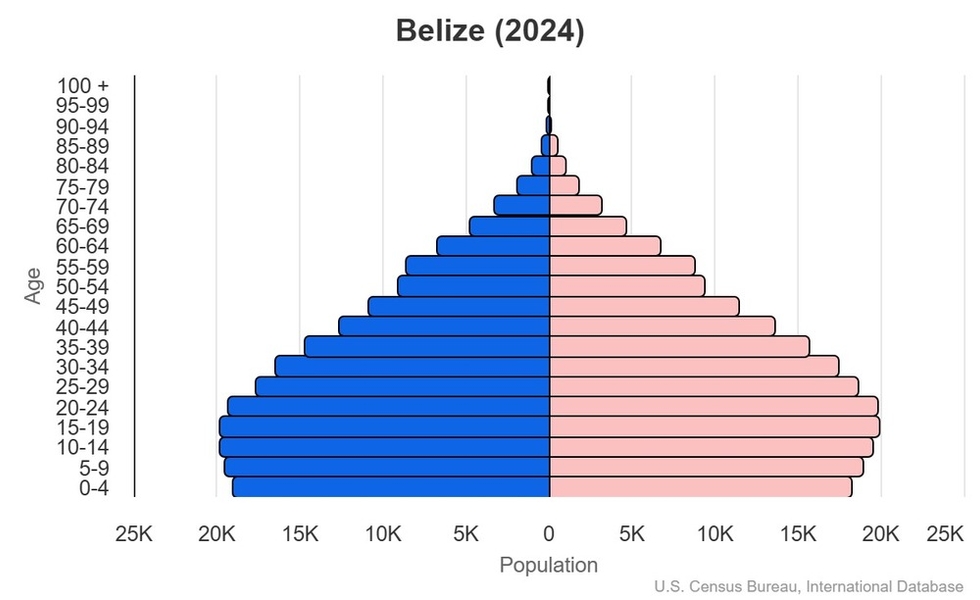
0-14 years: 27.7% (male 58,529/female 56,811)
15-64 years: 66.7% (male 135,903/female 141,503)
65 years and over: 5.5% (2024 est.) (male 11,463/female 11,580)
2024 population pyramid:
Dependency ratios
total dependency ratio: 49.9 (2024 est.)
youth dependency ratio: 41.6 (2024 est.)
elderly dependency ratio: 8.3 (2024 est.)
potential support ratio: 12 (2024 est.)
Median age
total: 26.8 years (2024 est.)
male: 26.4 years
female: 27.2 years
comparison ranking: total 162
Population growth rate
1.47% (2024 est.)
comparison ranking: 67
Birth rate
17.7 births/1,000 population (2024 est.)
comparison ranking: 81
Death rate
5 deaths/1,000 population (2024 est.)
comparison ranking: 194
Net migration rate
2 migrant(s)/1,000 population (2024 est.)
comparison ranking: 50
Population distribution
approximately 25% to 30% of the population lives in the former capital, Belize City; over half of the overall population is rural; population density is slightly higher in the north and east
Urbanization
urban population: 46.6% of total population (2023)
rate of urbanization: 2.3% annual rate of change (2020-25 est.)
Major urban areas – population
23,000 BELMOPAN (capital) (2018)
Sex ratio
at birth: 1.05 male(s)/female
0-14 years: 1.03 male(s)/female
15-64 years: 0.96 male(s)/female
65 years and over: 0.99 male(s)/female
total population: 0.98 male(s)/female (2024 est.)
Maternal mortality ratio
130 deaths/100,000 live births (2020 est.)
comparison ranking: 57
Infant mortality rate
total: 11.3 deaths/1,000 live births (2024 est.)
male: 12.4 deaths/1,000 live births
female: 10.1 deaths/1,000 live births
comparison ranking: total 120
Life expectancy at birth
total population: 74.3 years (2024 est.)
male: 72.6 years
female: 76.1 years
comparison ranking: total population 143
Total fertility rate
2.05 children born/woman (2024 est.)
comparison ranking: 100
Gross reproduction rate
1 (2024 est.)
Contraceptive prevalence rate
51.4% (2015/16)
Drinking water source
improved:
urban: 100% of population
rural: 99.4% of population
total: 99.7% of population
unimproved:
urban: 0% of population
rural: 0.6% of population
total: 0.3% of population (2020 est.)
Health expenditure
5% of GDP (2021)
11.5% of national budget (2022 est.)
Physician density
1.09 physicians/1,000 population (2018)
Hospital bed density
1 beds/1,000 population (2018 est.)
Sanitation facility access
improved:
urban: 99.1% of population
rural: 95.7% of population
total: 97.3% of population
unimproved:
urban: 0.9% of population
rural: 4.3% of population
total: 2.7% of population (2020 est.)
Obesity – adult prevalence rate
24.1% (2016)
comparison ranking: 60
Alcohol consumption per capita
total: 5.93 liters of pure alcohol (2019 est.)
beer: 3.88 liters of pure alcohol (2019 est.)
wine: 0.68 liters of pure alcohol (2019 est.)
spirits: 1.19 liters of pure alcohol (2019 est.)
other alcohols: 0.17 liters of pure alcohol (2019 est.)
comparison ranking: total 72
Tobacco use
total: 8.3% (2025 est.)
male: 14.8% (2025 est.)
female: 1.8% (2025 est.)
comparison ranking: total 141
Children under the age of 5 years underweight
4.6% (2015/16)
comparison ranking: 67
Currently married women (ages 15-49)
64.3% (2023 est.)
Child marriage
women married by age 15: 6.3% (2016)
women married by age 18: 33.5% (2016)
men married by age 18: 22.2% (2016)
Education expenditure
4.6% of GDP (2024 est.)
18.9% national budget (2024 est.)
comparison ranking: Education expenditure (% GDP) 81
Literacy
total population: 90.9% (2015 est.) NA
male: 90.2% (2015 est.) NA
female: 91.6% (2015 est.) NA
School life expectancy (primary to tertiary education)
total: 13 years
male: 12 years
female: 13 years (2021)
Environment
Environment – current issues
deforestation; water pollution from sewage, industrial effluents, agricultural runoff; inability to properly dispose of solid waste
Environment – international agreements
party to: Biodiversity, Climate Change, Climate Change-Kyoto Protocol, Climate Change-Paris Agreement, Comprehensive Nuclear Test Ban, Desertification, Endangered Species, Hazardous Wastes, Law of the Sea, Ozone Layer Protection, Ship Pollution, Wetlands, Whaling
signed, but not ratified: none of the selected agreements
Climate
tropical; very hot and humid; rainy season (May to November); dry season (February to May)
Land use
agricultural land: 8% (2022 est.)
arable land: 4.4% (2022 est.)
permanent crops: 1.4% (2022 est.)
permanent pasture: 2.2% (2022 est.)
forest: 55% (2022 est.)
other: 37% (2022 est.)
Urbanization
urban population: 46.6% of total population (2023)
rate of urbanization: 2.3% annual rate of change (2020-25 est.)
Air pollutants
particulate matter emissions: 10.51 micrograms per cubic meter (2019 est.)
carbon dioxide emissions: 0.57 megatons (2016 est.)
methane emissions: 0.55 megatons (2020 est.)
Waste and recycling
municipal solid waste generated annually: 101,379 tons (2015 est.)
Total water withdrawal
municipal: 10 million cubic meters (2020 est.)
industrial: 20 million cubic meters (2020 est.)
agricultural: 70 million cubic meters (2020 est.)
Total renewable water resources
21.73 billion cubic meters (2020 est.)
Government
Country name
conventional long form: none
conventional short form: Belize
former: British Honduras
etymology: traditionally believed to be derived from the Spanish pronunciation of the last name of Scottish explorer Peter Wallace, who settled in the area in 1638; alternatively, may be named for the Belize River, whose name possibly derives from the Maya word “belix,” meaning “muddy-watered”
Government type
parliamentary democracy (National Assembly) under a constitutional monarchy; a Commonwealth realm
Capital
name: Belmopan
geographic coordinates: 17 15 N, 88 46 W
time difference: UTC-6 (1 hour behind Washington, DC, during Standard Time)
etymology: the name is formed from two words: “Belize,” the name of the longest river in the country, and “Mopan,” one of the rivers in the area that empties into the Belize River
Administrative divisions
6 districts; Belize, Cayo, Corozal, Orange Walk, Stann Creek, Toledo
Legal system
English common law
Constitution
history: previous 1954, 1963 (pre-independence); latest signed and entered into force 21 September 1981
amendment process: proposed and adopted by two-thirds majority vote of the National Assembly House of Representatives except for amendments relating to rights and freedoms, changes to the Assembly, and to elections and judiciary matters, which require at least three-quarters majority vote of the House; both types of amendments require assent of the governor general
International law organization participation
has not submitted an ICJ jurisdiction declaration; accepts ICCt jurisdiction
Citizenship
citizenship by birth: yes
citizenship by descent only: yes
dual citizenship recognized: yes
residency requirement for naturalization: 5 years
Suffrage
18 years of age; universal
Executive branch
chief of state: King CHARLES III (since 8 September 2022); represented by Governor-General Froyla TZALAM (since 27 May 2021)
head of government: Prime Minister John BRICEÑO (since 12 November 2020)
cabinet: Cabinet appointed by the governor general on the advice of the prime minister from among members of the National Assembly
elections/appointments: the monarchy is hereditary; governor-general appointed by the monarch; following legislative elections, the leader of the majority party or majority coalition usually appointed prime minister by the governor-general; prime minister recommends the deputy prime minister
Legislative branch
legislature name: National Assembly
legislative structure: bicameral
Legislative branch – lower chamber
chamber name: House of Representatives
number of seats: 32 (all directly elected)
electoral system: plurality/majority
scope of elections: full renewal
term in office: 5 years
most recent election date: 3/12/2025
parties elected and seats per party: People’s United Party (PUP) (26); United Democratic Party (UDP) (5)
percentage of women in chamber: 12.5%
expected date of next election: March 2030
Legislative branch – upper chamber
chamber name: Senate
number of seats: 13 (all appointed)
scope of elections: full renewal
term in office: 5 years
most recent election date: 5/9/2025
percentage of women in chamber: 35.7%
expected date of next election: May 2030
Judicial branch
highest court(s): Supreme Court of Judicature (consists of the Court of Appeal with the court president and 3 justices, and the Supreme Court with the chief justice and 10 justices); the Caribbean Court of Justice is the final court of appeal
judge selection and term of office: Court of Appeal president and justices appointed by the governor-general upon advice of the prime minister after consultation with the National Assembly opposition leader; justices’ tenures vary by terms of appointment; Supreme Court chief justice appointed by the governor-general upon the advice of the prime minister and the National Assembly opposition leader; other judges appointed by the governor-general upon the advice of the Judicial and Legal Services Section of the Public Services Commission and with the concurrence of the prime minister after consultation with the National Assembly opposition leader; judges can be appointed beyond age 65 but must retire by age 75
subordinate courts: Magistrates’ Courts; Family Court
Political parties
Belize People’s Front or BPF
Belize Progressive Party or BPP (formed in 2015 from a merger of the People’s National Party, elements of the Vision Inspired by the People, and other smaller political groups)
People’s United Party or PUP
United Democratic Party or UDP
Vision Inspired by the People or VIP
Diplomatic representation in the US
chief of mission: Ambassador Lynn Raymond YOUNG (since 7 July 2021)
chancery: 2535 Massachusetts Avenue NW, Washington, DC 20008-2826
telephone: [1] (202) 332-9636
FAX: [1] (202) 332-6888
email address and website:
[email protected]
https://www.belizeembassyusa.mfa.gov.bz/
consulate(s) general: Chicago, Los Angeles, Miami, New York
Diplomatic representation from the US
chief of mission: Ambassador (vacant); Chargé d’Affaires David HODGE (since January 2025)
embassy: 4 Floral Park Road, Belmopan, Cayo
mailing address: 3050 Belmopan Place, Washington DC 20521-3050
telephone: (501) 822-4011
FAX: (501) 822-4012
email address and website:
[email protected]
https://bz.usembassy.gov/
International organization participation
ACP, ACS, AOSIS, C, Caricom, CD, CDB, CELAC, FAO, G-77, IADB, IAEA, IBRD, ICAO, ICC (NGOs), ICRM, IDA, IFAD, IFC, IFRCS, ILO, IMF, IMO, Interpol, IOC, IOM, ITU, LAES, MIGA, NAM, OAS, OPANAL, OPCW, PCA, Petrocaribe, SICA, UN, UNCTAD, UNESCO, UNIDO, UPU, WCO, WHO, WIPO, WMO, WTO
Independence
21 September 1981 (from the UK)
National holiday
Battle of St. George’s Caye Day (National Day), 10 September (1798); Independence Day, 21 September (1981)
Flag description
royal blue with a narrow red stripe along the top and the bottom edges; a large white disk bears the coat of arms at the center, which features a shield flanked by two workers in front of a mahogany tree with the motto SUB UMBRA FLOREO (I Flourish in the Shade) on a scroll at the bottom, all encircled by a green garland of 50 mahogany leaves; the figures, the tools, the mahogany tree, and the garland refer to the logging industry that led to British settlement of Belize; blue and red are the colors of the two main political parties
note: Belize has the only national flag that depicts humans; the flags of two British overseas territories, Montserrat and the British Virgin Islands, also depict humans
National symbol(s)
Baird’s tapir (a large forest-dwelling mammal), keel-billed toucan, black orchid
National colors
red, blue
National anthem
name: Land of the Free
lyrics/music: Samuel Alfred HAYNES/Selwyn Walford YOUNG
note: adopted 1981; as a Commonwealth country, in addition to the national anthem, “God Save the King” serves as the royal anthem (see United Kingdom)
National heritage
total World Heritage Sites: 1 (natural)
selected World Heritage Site locales: Belize Barrier Reef Reserve System
Economy
Economic overview
tourism- and agriculture-driven economy; strong post-pandemic rebound; innovative and ecological bond restructuring that significantly lowered public debt and expanded marine protections; central bank offering USD-denominated treasury notes; high mobility across borders
Real GDP (purchasing power parity)
$5.12 billion (2023 est.)
$5.062 billion (2022 est.)
$4.617 billion (2021 est.)
note: data in 2021 dollars
comparison ranking: 185
Real GDP growth rate
1.15% (2023 est.)
9.65% (2022 est.)
17.86% (2021 est.)
note: annual GDP % growth based on constant local currency
comparison ranking: 163
Real GDP per capita
$12,500 (2023 est.)
$12,600 (2022 est.)
$11,700 (2021 est.)
note: data in 2021 dollars
comparison ranking: 136
GDP (official exchange rate)
$3.067 billion (2023 est.)
note: data in current dollars at official exchange rate
Inflation rate (consumer prices)
3.3% (2024 est.)
4.4% (2023 est.)
6.3% (2022 est.)
note: annual % change based on consumer prices
comparison ranking: 111
GDP – composition, by sector of origin
agriculture: 8.1% (2023 est.)
industry: 14.3% (2023 est.)
services: 62.4% (2023 est.)
note: figures may not total 100% due to non-allocated consumption not captured in sector-reported data
comparison rankings: services 74; industry 171; agriculture 88
GDP – composition, by end use
household consumption: 62.9% (2023 est.)
government consumption: 15.7% (2023 est.)
investment in fixed capital: 20.6% (2023 est.)
investment in inventories: -2.3% (2023 est.)
exports of goods and services: 55.3% (2023 est.)
imports of goods and services: -51.2% (2023 est.)
note: figures may not total 100% due to rounding or gaps in data collection
Agricultural products
sugarcane, maize, bananas, sorghum, soybeans, chicken, rice, oranges, fruits, plantains (2023)
note: top ten agricultural products based on tonnage
Industries
garment production, food processing, tourism, construction, oil
Industrial production growth rate
-2.48% (2023 est.)
note: annual % change in industrial value added based on constant local currency
comparison ranking: 185
Labor force
190,000 (2024 est.)
note: number of people ages 15 or older who are employed or seeking work
comparison ranking: 178
Unemployment rate
7% (2024 est.)
8.3% (2023 est.)
8.8% (2022 est.)
note: % of labor force seeking employment
comparison ranking: 131
Youth unemployment rate (ages 15-24)
total: 16.3% (2024 est.)
male: 10.6% (2024 est.)
female: 25.6% (2024 est.)
note: % of labor force ages 15-24 seeking employment
comparison ranking: total 80
Remittances
4.88% of GDP (2023 est.)
5% of GDP (2022 est.)
5.59% of GDP (2021 est.)
note: personal transfers and compensation between resident and non-resident individuals/households/entities
Budget
revenues: $554.405 million (2017 est.)
expenditures: $506.316 million (2017 est.)
note: central government revenues and expenses (excluding grants/extrabudgetary units/social security funds) converted to US dollars at average official exchange rate for year indicated
Public debt
99% of GDP (2017 est.)
note: central government debt as a % of GDP
comparison ranking: 22
Taxes and other revenues
21.3% (of GDP) (2017 est.)
note: central government tax revenue as a % of GDP
comparison ranking: 76
Current account balance
-$51.762 million (2024 est.)
-$19.761 million (2023 est.)
-$235.566 million (2022 est.)
note: balance of payments – net trade and primary/secondary income in current dollars
comparison ranking: 95
Exports
$1.64 billion (2024 est.)
$1.536 billion (2023 est.)
$1.369 billion (2022 est.)
note: balance of payments – exports of goods and services in current dollars
comparison ranking: 168
Exports – partners
USA 22%, UK 14%, Spain 9%, Guatemala 7%, Portugal 5% (2023)
note: top five export partners based on percentage share of exports
Exports – commodities
raw sugar, bananas, fish, shellfish, refined petroleum (2023)
note: top five export commodities based on value in dollars
Imports
$1.724 billion (2024 est.)
$1.573 billion (2023 est.)
$1.574 billion (2022 est.)
note: balance of payments – imports of goods and services in current dollars
comparison ranking: 181
Imports – partners
USA 37%, China 17%, Guatemala 10%, Mexico 8%, Costa Rica 6% (2023)
note: top five import partners based on percentage share of imports
Imports – commodities
refined petroleum, orthopedic appliances, ships, garments, tobacco (2023)
note: top five import commodities based on value in dollars
Reserves of foreign exchange and gold
$498.087 million (2024 est.)
$473.729 million (2023 est.)
$482.146 million (2022 est.)
note: holdings of gold (year-end prices)/foreign exchange/special drawing rights in current dollars
comparison ranking: 167
Debt – external
$1.235 billion (2023 est.)
note: present value of external debt in current US dollars
comparison ranking: 103
Exchange rates
Belizean dollars (BZD) per US dollar –
Exchange rates:
2 (2024 est.)
2 (2023 est.)
2 (2022 est.)
2 (2021 est.)
2 (2020 est.)
Energy
Electricity access
electrification – total population: 98.6% (2022 est.)
electrification – urban areas: 98.4%
electrification – rural areas: 97.1%
Electricity
installed generating capacity: 220,000 kW (2023 est.)
consumption: 595.389 million kWh (2023 est.)
imports: 283.8 million kWh (2023 est.)
transmission/distribution losses: 140.519 million kWh (2023 est.)
comparison rankings: transmission/distribution losses 53; imports 103; consumption 170; installed generating capacity 170
Electricity generation sources
fossil fuels: 12% of total installed capacity (2023 est.)
solar: 2.4% of total installed capacity (2023 est.)
hydroelectricity: 52.9% of total installed capacity (2023 est.)
biomass and waste: 32.7% of total installed capacity (2023 est.)
Coal
imports: 32 metric tons (2023 est.)
Petroleum
total petroleum production: 800 bbl/day (2023 est.)
refined petroleum consumption: 5,000 bbl/day (2023 est.)
crude oil estimated reserves: 6.7 million barrels (2021 est.)
Carbon dioxide emissions
662,000 metric tonnes of CO2 (2023 est.)
from coal and metallurgical coke: 3 metric tonnes of CO2 (2023 est.)
from petroleum and other liquids: 662,000 metric tonnes of CO2 (2023 est.)
comparison ranking: total emissions 184
Energy consumption per capita
30.752 million Btu/person (2023 est.)
comparison ranking: 115
Communications
Telephones – fixed lines
total subscriptions: 19,000 (2021 est.)
subscriptions per 100 inhabitants: 4 (2022 est.)
comparison ranking: total subscriptions 173
Telephones – mobile cellular
total subscriptions: 264,000 (2021 est.)
subscriptions per 100 inhabitants: 66 (2021 est.)
comparison ranking: total subscriptions 180
Broadcast media
8 privately owned TV stations; multi-channel cable TV provides access to foreign stations; about 25 radio stations broadcasting on roughly 50 different frequencies; state-run radio was privatized in 1998 (2019)
Internet country code
.bz
Internet users
percent of population: 72% (2023 est.)
Broadband – fixed subscriptions
total: 39,000 (2022 est.)
subscriptions per 100 inhabitants: 10 (2022 est.)
comparison ranking: total 152
Transportation
Civil aircraft registration country code prefix
V3
Airports
27 (2025)
comparison ranking: 124
Heliports
5 (2025)
comparison ranking: 99
Merchant marine
total: 774 (2023)
by type: bulk carrier 49, general cargo 410, oil tanker 64, other 251
comparison ranking: total 31
Ports
total ports: 2 (2024)
large: 0
medium: 0
small: 1
very small: 0
size unknown: 1
ports with oil terminals: 1
key ports: Belize City, Big Creek
Military and Security
Military and security forces
Belize Defense Force (BDF): Army, Air Wing; Belize Coast Guard (BCG) (2025)
note: the Ministry of National Defense and Border Security is responsible for oversight of the BDF and the Coast Guard, while the Ministry of Home Affairs and New Growth Industries has responsibility for the Belize Police Department (BPD) and prisons
Military expenditures
1% of GDP (2024 est.)
0.9% of GDP (2023 est.)
1.1% of GDP (2022 est.)
1.3% of GDP (2021 est.)
1.5% of GDP (2020 est.)
Military and security service personnel strengths
approximately 1,500 BDF personnel (2025)
Military equipment inventories and acquisitions
the military has a small inventory consisting mostly of UK- and US-origin equipment (2024)
Military service age and obligation
18-23 years of age for voluntary military service; laws allow for conscription only if volunteers are insufficient, but conscription has never been implemented; initial service obligation is 12 years (2024)
Military – note
the Belize Defense Force (BDF) is responsible for external security but also provides some support to civilian authorities; it has limited powers of arrest within land and shoreline areas, while the Coast Guard has arrest powers and jurisdiction within coastal and maritime areas; the BDF traces its history back to the Prince Regent Royal Honduras Militia, a volunteer force established in 1817; the BDF was established in 1978 from the disbanded Police Special Force and the Belize Volunteer Guard to assist the resident British forces with the defense of Belize against Guatemala
the British Army has maintained a presence in Belize since its independence; the presence consists of a small training support unit that provides jungle training to troops from the UK and international partners (2025)
Transnational Issues
Illicit drugs
a significant drug trafficking and transit point between countries in South America and the United States; primary domestic use of narcotics is marijuana and some crack cocaine; a major source of precursor or essential chemicals used in the production of illicit narcotics