


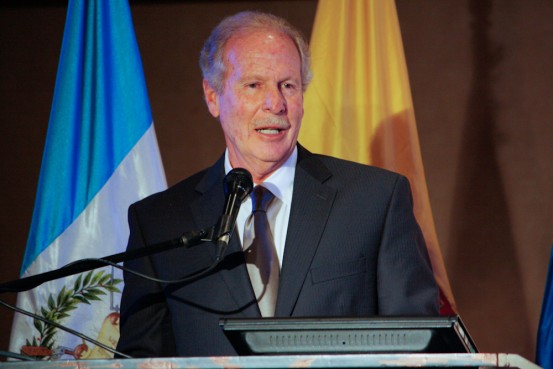
Álvaro Enrique Arzú Irigoyen (born March 14, 1946, Guatemala City—died April 27, 2018, Guatemala City) was a Guatemalan businessman, reformist politician, and president (1996–2000) best remembered for ending the country’s 36-year civil war through historic peace accords.
Arzú descended from Basque immigrants and was part of Guatemala’s small but powerful European elite. A charismatic young man, he explored pursuits such as boxing and bullfighting, but his true success came in business and politics. He earned a degree in social and legal sciences from Rafael Landívar University, positioning himself as both a pragmatic businessman and future statesman.
In 1978 he became director of the Guatemalan Tourist Institute, marking his first major entry into public service.
Rise in Politics
Arzú was elected mayor of Guatemala City in 1982 as a member of the Christian Democratic Party (PDCG) but was prevented from assuming office by a military coup. Undeterred, he ran again in 1985 under the Civic Committee Plan for National Advancement, a coalition that included the PDCG, and decisively won. From 1986 to 1990, he modernized city governance and infrastructure.
In 1989 the Civic Committee transformed into the National Advancement Party (PAN), which became his political base. Arzú made his first presidential run in 1990, losing narrowly, but remained influential. By 1991 he briefly served as foreign minister, resigning later that year to become PAN’s secretary-general.
Presidency (1996–2000): Architect of Peace
In the 1995 elections, Arzú won the presidency in a January 1996 runoff, backed strongly by Guatemala City voters. His presidency is most remembered for ending Guatemala’s civil war, which had begun in 1960 and claimed over 200,000 lives.
- In March 1996, he negotiated a temporary cease-fire with the Guatemalan National Revolutionary Unity (URNG).
- On December 4, 1996, a permanent cease-fire was signed in Oslo, Norway.
- On December 29, 1996, in Guatemala City, Arzú presided over the signing of the Accord for a Firm and Lasting Peace, officially ending the conflict.
His government also promoted reforms, including:
- Reducing the armed forces and transferring policing duties to civilian control.
- Expanding rights for indigenous peoples.
- Improving infrastructure, education, and health services.
Arzú faced challenges in implementing the accords, but he is credited with laying the foundation for Guatemala’s democratic recovery.
Later Career and Long Mayoralty
Constitutionally barred from reelection, Arzú left the presidency in 2000 but soon returned to local politics. In 2002, after breaking with PAN, he founded the Unionist Party (PU).
In 2003, he was elected mayor of Guatemala City again, beginning a new era of municipal leadership. He was reelected multiple times (2007, 2011, 2015) and served continuously until his death in 2018. His mayoralty focused on urban development, security, and modernization, making him one of the most enduring political figures in Guatemala.
Death and Legacy
On April 27, 2018, Álvaro Arzú suffered a fatal heart attack while playing golf in Guatemala City. He was still serving as mayor at the time.
Arzú is remembered as a transformative president, whose leadership brought peace to Guatemala after decades of civil war. Though his legacy is not without controversy, particularly in later years over corruption investigations, he is widely honored as a key architect of Guatemala’s peace process.
Key Facts at a Glance
| Year | Event | Outcome |
|---|---|---|
| 1946 | Born in Guatemala City | Member of elite Basque-descended family |
| 1978 | Director, Tourist Institute | Entry into public administration |
| 1982 | Elected mayor of Guatemala City | Prevented from serving by coup |
| 1986–90 | Mayor of Guatemala City | Modernized urban administration |
| 1991 | Minister of Foreign Affairs | Brief tenure, later PAN leader |
| 1996 | Elected president of Guatemala | Won runoff on Jan. 7 |
| 1996 (Dec. 29) | Peace Accords signed | Ended 36-year civil war |
| 2003–18 | Mayor of Guatemala City | Repeatedly reelected until death |
| 2018 | Died of heart attack | Age 72, still in office as mayor |




