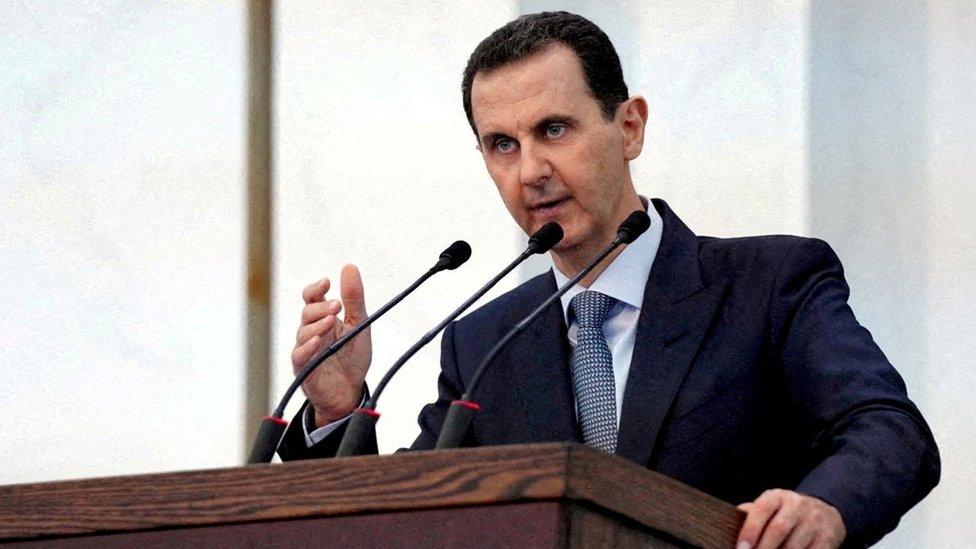
Bashar al-Assad (born September 11, 1965, Damascus, Syria) was the third child of Hafez al-Assad, Syria’s president from 1971 to 2000. The Assad family belonged to the Alawite minority, which represented roughly 10 percent of Syria’s population but held disproportionate political power.
Initially, Bashar showed little interest in politics. He studied medicine at the University of Damascus, graduating as an ophthalmologist in 1988. He later pursued postgraduate training in London in 1992. His path to power changed suddenly in 1994, when his elder brother and heir apparent, Basil al-Assad, died in a car crash. Bashar was recalled to Syria, where he trained at a military academy and rose to the rank of colonel in the Republican Guard, preparing to succeed his father. He also gained visibility by leading an anticorruption campaign and chairing the Syrian Computer Society, presenting himself as a modernizer.
Rise to Power and Early Presidency
Following Hafez al-Assad’s death on June 10, 2000, Syria’s legislature swiftly amended the constitution, lowering the presidential age requirement from 40 to 34, Bashar’s age at the time. On July 10, 2000, he was elected president, running unopposed.
At first, there was optimism. Bashar al-Assad’s Western education and youth suggested the possibility of reform. He initiated limited changes: easing press restrictions, releasing political prisoners, and permitting public debate in what became known as the “Damascus Spring.” However, the openness was short-lived. Within months, his government cracked down on dissent, and his political reforms were largely symbolic.
His economic liberalization programs benefited a small elite connected to the regime but did little to alleviate unemployment and poverty among the wider population.
Foreign Policy and Regional Role
Bashar al-Assad maintained a hard-line stance against Israel, demanding the return of the Golan Heights and supporting groups such as Hezbollah and Hamas. He positioned Syria as a pillar of the Axis of Resistance alongside Iran.
Relations with the United States deteriorated after he opposed the 2003 U.S. invasion of Iraq. In 2005, the assassination of former Lebanese prime minister Rafic al-Hariri led to widespread suspicion of Syrian involvement, though no conclusive evidence tied Assad’s regime directly to the killing. Under international pressure, Syrian troops withdrew from Lebanon, ending a nearly 30-year presence.
The Arab Spring and Syrian Civil War
In March 2011, mass protests erupted in Syria as part of the Arab Spring. Assad initially promised reforms, such as ending the long-standing emergency law, but his security forces cracked down violently on demonstrators. The brutal response fueled anger, leading to the outbreak of the Syrian Civil War.
By 2012, opposition groups had taken up arms, and the conflict escalated into a devastating war. Assad’s forces were accused of committing massacres, using barrel bombs, and deploying chemical weapons, including the infamous 2013 sarin gas attack near Damascus, which killed hundreds. While Western governments blamed Assad, he denied responsibility and, with Russian and Iranian backing, avoided foreign military intervention by agreeing to surrender Syria’s chemical arsenal.
The rise of ISIS in 2013 shifted international priorities, with the U.S. and its allies focusing on defeating the extremist group rather than removing Assad. In 2015, Russia launched a major military intervention in Syria, enabling Assad to regain control over key cities such as Aleppo and Homs.
Decline and Fall
Despite reclaiming much territory, Assad’s regime faced international isolation and an economy shattered by war. The controversial Law 10 allowed the state to confiscate properties abandoned by refugees, fueling accusations of demographic engineering.
In 2024, Assad’s position collapsed. Russia, weakened by its war in Ukraine, scaled back its support, while Iran and Hezbollah were distracted by conflict with Israel. Rebel group Hayat Tahrir al-Sham (HTS) launched a rapid offensive from Idlib, capturing Aleppo and Hama, and advancing on Damascus. By December 8, 2024, Assad was ousted from power after rebels entered the capital. His fall marked the end of 24 years of Assad family rule in Syria.
Legacy
Bashar al-Assad’s presidency is one of the most consequential in modern Middle Eastern history. His early promises of modernization gave way to entrenched authoritarianism. The Syrian Civil War (2011–24) devastated the country, leaving hundreds of thousands dead and millions displaced.
Internationally, Assad is remembered as both a survivor of global and regional isolation and as a leader whose reliance on brutal repression and foreign allies ultimately led to the downfall of his regime. His legacy remains deeply divisive—viewed by some as a defender of Syrian sovereignty and by others as a symbol of tyranny and destruction.
Key Facts at a Glance
| Year | Event | Outcome |
|---|---|---|
| 1965 | Born in Damascus, Syria | Son of Pres. Hafez al-Assad |
| 1988 | Graduated as ophthalmologist, University of Damascus | Began medical career |
| 1994 | Death of brother Basil al-Assad | Bashar recalled to Syria, groomed for leadership |
| 2000 | Became president of Syria | Succeeded his father Hafez al-Assad |
| 2000–01 | “Damascus Spring” | Short-lived period of political openness |
| 2003 | Opposed U.S. invasion of Iraq | Relations with U.S. worsened |
| 2011 | Arab Spring protests begin | Crackdown leads to Syrian Civil War |
| 2013 | Chemical weapons attack near Damascus | International outrage, Assad denies responsibility |
| 2015 | Russian military intervention | Assad regains control of key cities |
| 2024 | Rebel offensive topples Assad regime | End of his presidency after 24 years of Assad family rule |