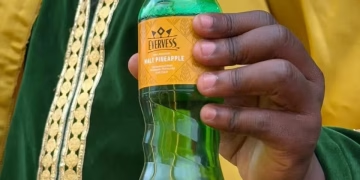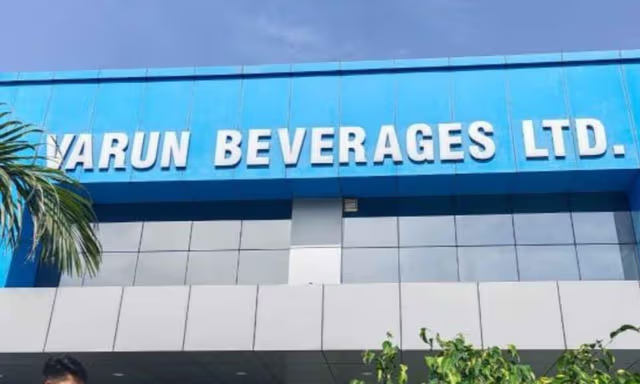
Varun Beverages Kenya has moved from market ambition to physical manufacturing presence after the Indian beverage group agreed to acquire Devyani Food Industries Kenya’s value-added dairy beverages, juices and packaged drinking water business in a transaction valued at US$32 million, or about KSh4.1 billion.
The acquisition will be executed through VBL Industries Kenya Limited, a wholly owned subsidiary of Varun Beverages Limited. The deal gives the company control of Devyani Food Industries Kenya’s operating business on a going-concern basis, including associated assets and the Daima brand. Varun disclosed the transaction to the National Stock Exchange of India and BSE on July 6, 2026, under India’s listed-company disclosure rules.
The agreement gives Varun a ready manufacturing base in Nakuru, one of Kenya’s most important agricultural and logistics regions. The facility sits on 52 acres and has a built-up area of about 17,500 square metres, with utilities including a reverse osmosis plant, boiler, effluent treatment plant, diesel generator set and air compressor. The plant is also accredited under Food Safety System Certification 22000 and ISO 9001:2015.
For Kenya’s consumer-goods market, the deal is significant because Varun Beverages is one of PepsiCo’s largest franchise partners outside the United States, manufacturing and distributing carbonated soft drinks, non-carbonated beverages and packaged drinking water across multiple territories.
The transaction is not simply a dairy and juice acquisition. It is a platform deal. Varun says the acquisition will support deeper penetration in Kenya and the wider East African market by using Devyani’s manufacturing infrastructure and distribution capabilities, while VBL Kenya prepares to launch a carbonated soft drinks range.
Varun Beverages Kenya Deal Gives PepsiCo Bottler a Local Base
The Varun Beverages Kenya entry gives the Indian-listed beverage group something it would have taken time to build from scratch: an operating plant, a local production footprint, utilities, certifications, distribution links and a consumer-facing brand platform.
Varun’s stock-exchange filing says VBL Industries Kenya Limited has entered into a Business Transfer Agreement to acquire the value-added dairy beverages, juices and packaged drinking water business of Devyani Food Industries Kenya. The purchase consideration is US$32 million, equivalent to about INR3.05 billion using the company’s stated exchange rate of INR95.30 to the dollar.
The deal is expected to be completed on or before August 1, 2026, subject to agreed conditions. The filing also describes Devyani Food Industries Kenya as a promoter group company and states that the transaction is being conducted on an arm’s-length basis.
That related-party detail is important for investors because Varun Beverages is a listed company in India. Transactions involving promoter group entities usually attract closer scrutiny from shareholders, regulators and market analysts. The company’s disclosure gives the structure, commercial purpose, consideration, relationship between the parties and expected completion timeline.
Strategically, the deal gives Varun an immediate foothold in Kenya’s formal beverage manufacturing sector. Rather than entering the market only through imports, distribution agreements or a greenfield project, the company is acquiring an existing operating business.
This can shorten market-entry timelines. It can also reduce execution risk because the business already has manufacturing infrastructure, utilities and product categories that are familiar to Kenyan consumers.
The bigger question is what Varun does next. Its disclosure states that VBL Kenya is preparing to launch carbonated soft drinks. That suggests the acquired Devyani platform may become more than a dairy, juice and water business. It could become the base for a broader PepsiCo-linked beverage portfolio in Kenya and potentially the wider region.
Background: Why This Story Matters
Kenya is one of East Africa’s most competitive consumer markets. It has a growing urban population, a large informal retail network, a formal supermarket and wholesale channel, a strong agriculture base and a central location for regional distribution.
For global and regional beverage companies, Kenya offers three advantages. First, it has a sizeable domestic consumer market. Second, it has established manufacturing and distribution corridors linking Nairobi, Nakuru, Mombasa and western Kenya. Third, it can serve as a gateway into neighbouring markets when supply chains, regulatory approvals and distribution partnerships are properly aligned.
The acquisition also lands in a dairy sector that remains central to Kenya’s food economy. Invest Kenya’s dairy sector investment pack says the dairy industry accounts for about 14% of agricultural GDP and around 4% of total GDP. It also estimates total milk production at 5.76 billion litres, with smallholder farmers contributing more than 80% of milk production.
That makes the transaction relevant beyond corporate deal-making. Dairy, juice and bottled water are linked to farmers, processors, packaging suppliers, logistics firms, retailers and consumers. A stronger formal processing business can influence demand for raw materials, quality standards, cold-chain investment and product innovation.
The value-added dairy category is especially important. Fresh milk remains a core product, but urban demand has been moving toward yoghurt, flavoured milk, fermented products and convenient packaged beverages. Invest Kenya notes that value-added dairy products are gaining popularity because of urban demand and shifting consumer preferences.
Varun’s entry also reflects a wider African expansion strategy. The company already has beverage interests across several African markets, and its official profile describes it as one of PepsiCo’s largest franchisees outside the United States.
For Kenya, the deal is another signal that international consumer-goods companies see East Africa as a growth market worth building around local manufacturing, not only distribution.
Key Details From the Development
The transaction has several layers: the buyer, the seller, the assets, the location, the product categories and the future soft-drink strategy.
Together, they make the deal more strategic than a simple acquisition of production equipment.
What Varun Beverages Is Buying
Varun is buying Devyani Food Industries Kenya’s value-added dairy beverages, juices and packaged drinking water business.
The deal includes all assets associated with that business on a going-concern basis. In commercial terms, that means the buyer is taking over an operating business rather than only isolated assets. It can include production operations, equipment, business infrastructure and other assets connected to the acquired unit, depending on the final agreement.
The acquired business includes the Daima brand, according to the transaction notes supplied. Daima is a recognised Kenyan dairy and beverage name, giving Varun access to a consumer-facing platform that already exists in the market.
That matters because brands are difficult to build from zero. In food and beverages, consumer trust is built through repeat purchases, availability, product quality and price familiarity. An existing brand gives a new entrant a faster route into consumer shelves, kiosks, supermarkets and wholesale networks.
For Varun, the acquisition also offers diversification. The company’s global identity is closely linked to carbonated soft drinks and PepsiCo beverages, but the Kenyan asset base includes dairy beverages, juices and packaged water. These categories can complement carbonated soft drinks because they use overlapping distribution channels, retail relationships and manufacturing capabilities.
The Nakuru Facility Is a Strategic Manufacturing Asset
The Nakuru plant is one of the most important parts of the transaction.
Varun’s disclosure says the manufacturing facility sits on a 52-acre parcel on a national highway in Nakuru, with a built-up area of 17,500 square metres. The plant manufactures value-added dairy beverages, juices and packaged drinking water.
Location matters in manufacturing. Nakuru sits along a key transport corridor, giving producers access to central Kenya, western Kenya, Nairobi and regional routes. For beverage distribution, road access is critical because products move in high volumes and often require fast replenishment across many small outlets.
The size of the land parcel also gives the buyer room to think beyond the existing product mix. While Varun has not announced detailed expansion plans for the facility beyond the soft-drinks preparation disclosed, a 52-acre site offers flexibility that a smaller urban plant may not provide.
The utilities listed in the filing are also important. A reverse osmosis plant is relevant for water treatment and beverage quality. A boiler supports processing needs. An effluent treatment plant supports waste management and environmental compliance. A diesel generator set helps with backup power, while an air compressor supports industrial operations.
In beverage manufacturing, these utilities are not minor details. They determine whether a plant can operate reliably, meet quality standards and scale production.
Certifications Strengthen the Quality Case
The plant’s certifications add another layer to the deal.
Varun’s transaction overview says the facility is accredited under Food Safety System Certification 22000 and ISO 9001:2015.
These certifications matter for three reasons.
First, they support consumer confidence. Food and beverage products depend heavily on safety, hygiene and consistency. Certification does not eliminate all operational risk, but it signals that the plant has been operating under recognised management and food-safety systems.
Second, certification can help with institutional customers, modern retail chains and regional trade. Larger buyers often require evidence of quality systems before onboarding suppliers.
Third, certifications may reduce the time Varun needs to prepare the facility for additional product lines. A plant that already operates under recognised safety and quality standards can be easier to integrate into a multinational supply and compliance system.
For Kenya’s formal manufacturing sector, this is also important. International buyers and investors increasingly assess production assets through quality, environmental and governance standards. Plants that meet global certification benchmarks are more attractive acquisition targets.
The Deal Is Linked to a Soft-Drinks Launch
The transaction disclosure clearly states that VBL Kenya is preparing to launch a carbonated soft drinks range.
That line is central to understanding the acquisition.
If Varun only wanted to operate a dairy and juice business, the deal would be one type of consumer-goods acquisition. But if the company uses the Devyani platform to support a broader carbonated soft-drinks rollout, the transaction becomes a market-entry bridge.
Carbonated soft drinks require strong distribution, outlet visibility, cold-chain support, brand marketing, packaging supply and consistent manufacturing. These are areas where Varun has deep experience in other markets through its PepsiCo franchise relationship.
The Kenyan market already has strong beverage competition. Local and multinational brands compete across sodas, juices, bottled water, energy drinks, flavoured milk and yoghurt drinks. Varun will therefore need not only production capacity, but also route-to-market strength.
The acquisition gives it a starting point. It does not guarantee market share. Execution will depend on pricing, product availability, retail relationships, marketing, packaging, consumer taste and the company’s ability to manage supply-chain costs.
The Transaction Reflects Varun’s Africa Expansion Logic
Varun Beverages has built its business around scale, territories and distribution execution.
Its official company profile says it manufactures, distributes and sells carbonated soft drinks and non-carbonated beverages, including packaged drinking water sold under PepsiCo-owned trademarks. It also lists PepsiCo brands produced and sold by the company, including Pepsi, Pepsi Black, Mountain Dew, Sting, Seven-Up, Mirinda, Tropicana products, Gatorade and Aquafina.
The Kenya deal fits that model. Varun is not entering a market as a small distributor. It is buying manufacturing infrastructure and preparing for product launch.
That approach gives the company more control over production, quality, inventory and route-to-market strategy. It may also help manage costs because locally manufactured beverages can avoid some import-related expenses, though local production still depends on inputs, packaging, utilities and logistics.
The company’s Africa presence already includes several markets. Its official materials and public disclosures show a long-running strategy of acquiring or building beverage platforms outside India.
Kenya adds another important East African node to that footprint.
Impact on Kenya’s Manufacturing, Consumers and Dairy Value Chain
The deal could affect Kenya in several ways, though the scale of impact will depend on Varun’s post-acquisition investment, hiring, sourcing and product strategy.
For manufacturing, the immediate benefit is continuity of an existing operating asset. A going-concern transfer means the business is being acquired as an active operation, not as a distressed asset being dismantled. If Varun expands production, upgrades equipment or launches new lines, the Nakuru facility could become more important within Kenya’s formal beverage manufacturing sector.
For consumers, the deal could increase product variety. Varun’s existing global relationship with PepsiCo and its preparation for a carbonated soft-drinks launch suggest more branded beverage options may enter the Kenyan market. That can intensify competition, which may improve availability and pricing discipline, though consumer prices will still depend on input costs, taxes, distribution margins and currency conditions.
For retailers and distributors, the deal may bring new commercial relationships. Beverage companies compete heavily for shelf space, refrigerators, route coverage and outlet loyalty. If Varun brings stronger distribution systems, retail outlets could see more competition among suppliers.
For dairy farmers, the impact is less direct and should be stated carefully. The acquired business includes value-added dairy beverages, so any expansion in dairy production could increase demand for milk inputs. However, the company has not disclosed detailed sourcing plans, farmer contract models or expansion volumes. It would be premature to claim a guaranteed boost for farmers.
Still, the broader sector context is relevant. Kenya’s dairy sector supports an estimated 1.8 million smallholder households and employs hundreds of thousands of people directly and indirectly, according to Invest Kenya’s dairy sector pack.
If formal processors expand responsibly, they can support better quality control, farmer linkages and value addition. But this depends on procurement policy, payment terms, chilling infrastructure and farmer support.
For Nakuru, the transaction reinforces the county’s role as a manufacturing and agribusiness hub. A large beverage plant on a national highway can support jobs, logistics activity, packaging demand and supplier networks. Again, the actual impact will depend on investment decisions after completion.
Market, Policy or Industry Context
The transaction comes at a time when Kenya is trying to attract more manufacturing investment and deepen agro-processing.
Consumer-goods manufacturing is important because it sits close to everyday demand. Unlike some capital-intensive sectors that depend heavily on government contracts or export markets, beverages rely on household consumption, retail networks and brand loyalty.
Kenya’s beverage sector is also linked to urbanisation. As more consumers buy packaged drinks through supermarkets, mini-marts, restaurants, kiosks and petrol-station retail, producers need wider distribution and consistent product quality.
Dairy is a particularly strategic category. Kenya produces large volumes of milk, but a significant share still moves through informal channels. Invest Kenya estimates that only about 15% of milk production was handled by the formal sector in 2024, while the informal sector accounted for about 85%.
That gap creates both an opportunity and a challenge. Formal processors can improve food safety, packaging, shelf life and value addition. However, they must compete with informal raw-milk channels that are often cheaper and deeply embedded in local consumption habits.
Juices and packaged water are also competitive categories. Consumers are price-sensitive, and distribution is expensive because beverages are bulky. Success depends on operational efficiency as much as branding.
The Kenya deal also has a regional angle. Varun says the acquisition will help deepen penetration in Kenya and the broader East African region.
That statement points to Kenya’s role as a regional commercial base. From Nairobi and Nakuru, manufacturers can serve domestic demand while exploring exports or cross-border distribution, subject to regulatory requirements, product standards and logistics economics.
For policymakers, the deal supports the argument that predictable investment rules, industrial land, infrastructure, food-safety systems and regional market access can attract strategic manufacturing investors.
What Comes Next
The first item to watch is completion of the transaction. Varun’s disclosure says the deal is expected to close on or before August 1, 2026, subject to agreed conditions.
After completion, attention will shift to integration. Varun will need to absorb the Devyani Kenya business into its operating structure, align quality systems, manage staff transition issues, stabilise supply chains and prepare for any new product launches.
The second item to watch is the carbonated soft-drinks rollout. The company has said VBL Kenya is preparing to launch a carbonated soft drinks range, but it has not disclosed detailed timing, product list, pricing or distribution strategy.
The third issue is capital expenditure. The acquired plant already has manufacturing infrastructure, but launching new beverage lines may require equipment changes, packaging investments, warehousing adjustments, cold-chain support and distribution expansion.
The fourth issue is competition. Kenya’s beverage shelves are already contested. Varun will need to differentiate through brand strength, pricing, outlet reach, pack sizes and product consistency.
The fifth issue is local sourcing. For dairy beverages, milk procurement will be important. For juices, fruit sourcing, concentrates and packaging inputs may shape cost structures. For water and soft drinks, water treatment, sugar, sweeteners, carbon dioxide, bottles, labels and logistics will matter.
The sixth issue is regulatory and quality compliance. Beverages are tightly linked to food safety, labelling, environmental management and consumer protection. The Nakuru plant’s existing certifications are useful, but compliance will remain an ongoing operational requirement.
Expert Analysis
The logic of the transaction is straightforward: Varun Beverages is buying speed.
A new entrant can build a factory, recruit teams, set up utilities, obtain certifications, establish distribution and then begin selling. That route can work, but it takes time and carries execution risk.
By acquiring Devyani Food Industries Kenya’s operating business, Varun gets an immediate platform. It gains a plant, product categories, production infrastructure and a local market base. That gives it a stronger starting position as it prepares to enter carbonated soft drinks in Kenya.
The transaction also shows how multinational consumer-goods expansion increasingly happens through adjacencies. Varun is known primarily as a PepsiCo bottling partner, but the acquired Kenyan business includes dairy beverages, juices and packaged water. These categories may help it build broader retailer relationships before or alongside a soft-drinks rollout.
For Kenya, the deal is positive because it brings a major international beverage operator into local manufacturing. It also validates the country’s role as a regional consumer market. Investors do not buy manufacturing assets unless they believe there is room to grow.
However, the transaction should not be overstated. A KSh4.1 billion deal is significant, but its economic impact will depend on what follows. The country will benefit most if Varun expands production, sources locally where viable, maintains quality standards, creates jobs, invests in distribution and builds supplier relationships.
There is also a competitive question. New investment can strengthen consumer choice, but it can also pressure smaller local processors. Kenyan dairy and beverage firms may need to improve efficiency, packaging, route-to-market execution and brand positioning.
The deal also gives Varun exposure to Kenya’s operating challenges. These may include power reliability, input costs, packaging costs, tax administration, road logistics, consumer price sensitivity and competition from informal channels. The company’s scale can help, but scale does not remove local complexity.
The most important signal is that Varun is not treating Kenya as a marginal export destination. It is entering with a production asset. That is a stronger commitment than simply shipping finished products into the market.
Frequently Asked Questions
What is the main issue?
The main issue is that Varun Beverages Limited, through its wholly owned Kenyan subsidiary, has agreed to acquire Devyani Food Industries Kenya’s value-added dairy beverages, juices and packaged drinking water business for US$32 million, or about KSh4.1 billion.
Why does the Varun Beverages Kenya deal matter?
The Varun Beverages Kenya deal matters because it gives one of PepsiCo’s largest bottling partners outside the United States a local manufacturing base in Kenya. It also positions the company to deepen its presence in East Africa and prepare for a carbonated soft-drinks launch.
What assets are included in the acquisition?
The acquisition includes Devyani Food Industries Kenya’s value-added dairy beverages, juices and packaged drinking water business, together with associated assets on a going-concern basis. The assets include a manufacturing facility in Nakuru on 52 acres with a built-up area of about 17,500 square metres.
Where is the manufacturing facility located?
The manufacturing facility is located in Nakuru, Kenya, on a national highway. The site includes utilities such as a reverse osmosis plant, boiler, effluent treatment plant, diesel generator set and air compressor.
Does the deal mean PepsiCo itself is buying Devyani Kenya?
No. The buyer is VBL Industries Kenya Limited, a wholly owned subsidiary of Varun Beverages Limited. Varun Beverages is a PepsiCo franchise and bottling partner, but the disclosed acquisition is by Varun’s Kenyan subsidiary, not directly by PepsiCo.
When is the transaction expected to close?
The transaction is expected to be completed on or before August 1, 2026, subject to agreed conditions.
What happens next?
The next steps are completion of the transaction, integration of the acquired business and preparation for Varun’s planned carbonated soft-drinks launch in Kenya. Investors and industry players will also watch whether the company expands production, distribution and local sourcing after taking control of the asset.
Conclusion
Varun Beverages’ KSh4.1 billion entry into Kenya is a strategic manufacturing move with implications for the country’s beverage, dairy and consumer-goods sectors.
The company is not entering the market from a standing start. Through the Devyani Food Industries Kenya acquisition, it gains an operating platform in Nakuru, a recognised beverage and dairy business, certified production infrastructure and a base from which to prepare a carbonated soft-drinks launch.
For Kenya, the transaction adds another international player to the formal manufacturing sector and reinforces the country’s role as an East African consumer market. It could support product variety, stronger competition and potential investment in processing and distribution.
For Varun, the deal offers speed, infrastructure and regional positioning. The company’s experience as a major PepsiCo franchise partner gives it scale and technical depth, but the Kenyan market will still require disciplined execution.
The biggest test will come after completion. If Varun uses the acquisition to expand production, improve distribution, maintain quality standards and build local supply-chain linkages, the deal could become one of the more important consumer-goods investments in Kenya’s manufacturing sector this year.
For now, the message is clear: Kenya’s beverage market has attracted a serious new entrant, and Nakuru is set to become the launchpad for Varun Beverages’ next phase in East Africa.
Read Also: MPs Protect Kenya Sovereign Wealth Fund From Debt