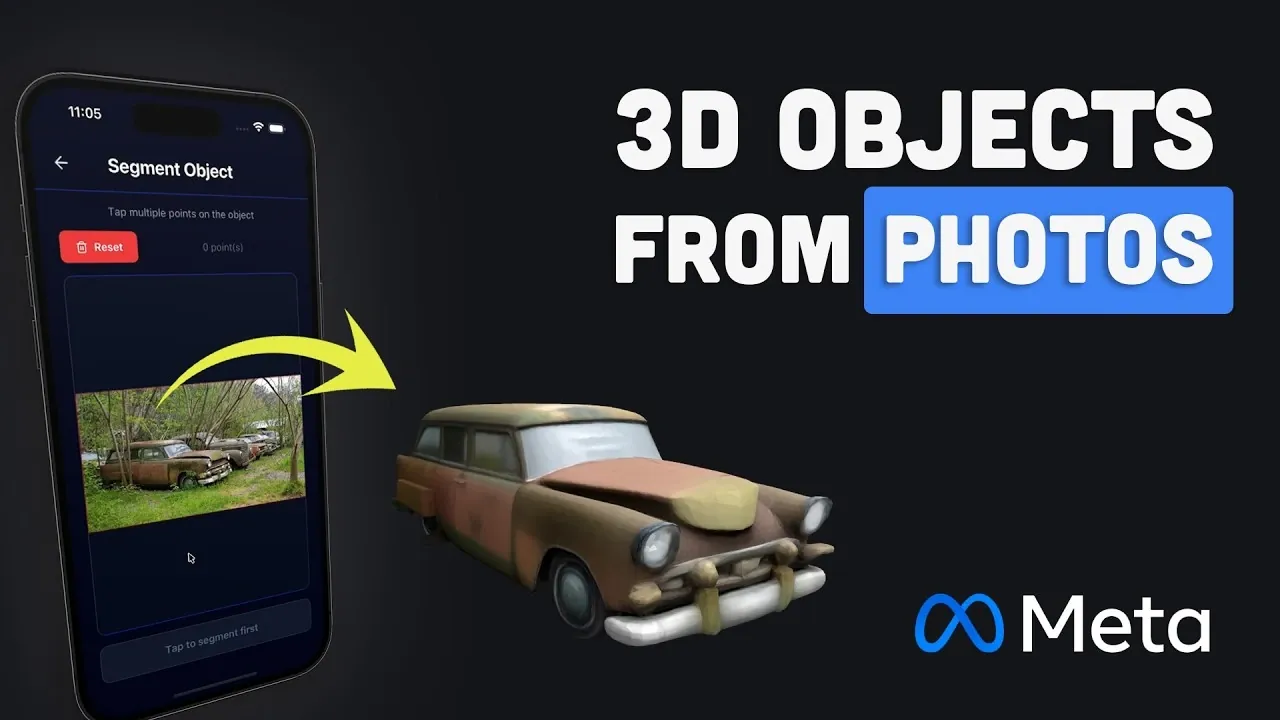
Imagine snapping a picture of your favorite object and transforming it into a lifelike 3D model. Thanks to Meta’s SAM 3D, this concept is no longer a futuristic dream. Whether you’re a designer building virtual worlds, a hobbyist trying out 3D printing, or a developer crafting the next game, SAM 3D makes 3D modeling more accessible than ever before. This AI-driven tool uses advanced techniques like image segmentation and depth analysis to convert 2D photos into interactive 3D objects. In this article, we’ll explore how SAM 3D works, its potential uses, and the challenges it presents.
How SAM 3D Works: Transforming Photos into 3D Models
SAM 3D is a cutting-edge AI tool that generates realistic 3D models from simple 2D images. It uses a three-step process to create highly detailed 3D objects:
- Vision Encoding: The system identifies key features in the image, such as edges, contours, and object boundaries.
- Depth and Geometry Analysis: Using a flow-based transformer, SAM 3D infers depth and geometry, creating a foundational understanding of the object’s structure.
- 3D Point Cloud Generation: The system uses Gaussian splatting to generate a point cloud, which is then refined into a solid mesh with detailed textures.
This process ensures realistic results, even for partially obscured objects. It’s a powerful tool for a range of creative projects, including gaming, VR, 3D modeling, and more.
Specialized Variants of SAM 3D
SAM 3D comes with two specialized variants designed to cater to different applications:
- SAM 3D Objects: This variant is optimized for general objects like vehicles, pets, and everyday items. It’s perfect for gaming, VR modeling, and 3D printing.
- SAM 3D Body: Specifically tailored for human body shapes and poses, this variant offers greater accuracy for applications such as animation, virtual avatars, and healthcare modeling.
These specialized variants make SAM 3D a versatile tool, whether you’re creating assets for a game, designing virtual spaces, or generating realistic human models for interactive media.
SAM 3D Mobile App: Simplifying 3D Model Creation
Meta also offers a mobile app for SAM 3D that streamlines the process of capturing images and generating 3D models. Built with the Expo framework, the app is user-friendly, making it easy to create 3D models even if you have minimal technical expertise.
Key features of the SAM 3D mobile app include:
- Photo Capture: Take or upload images directly within the app for quick 3D creation.
- Segmentation: The app isolates objects in the photo, preparing them for 3D reconstruction.
- Real-Time 3D Visualization: View and interact with the generated 3D models instantly.
The app also has an open-source codebase, which is available on GitHub, allowing developers to customize and enhance the app’s features to suit their needs.
Performance and Real-World Applications
SAM 3D excels in real-world applications like gaming, architecture, and virtual reality (VR). Its ability to generate accurate 3D models from photos enhances immersive experiences across various industries. However, it does face challenges when dealing with intricate patterns or fine details. Here are some practical uses for SAM 3D:
- Gaming: Create low-poly assets for game environments that look realistic and are optimized for gameplay.
- 3D Modeling: Design VR and AR objects, helping expand possibilities for digital experiences.
- Architectural Visualization: Produce detailed models of buildings and interiors for use in planning, presentation, and design.
- E-commerce: Enable businesses to create 3D product images for their online stores, offering a more engaging shopping experience.
SAM 3D’s flexibility allows professionals in various fields to leverage its power for creative and technical applications, while the open-source code encourages innovation.
Strengths and Challenges
While SAM 3D offers immense potential, it does come with some limitations:
Strengths:
- Effective Occlusion Handling: Can reconstruct objects even when parts are obscured.
- Versatility: Ideal for a wide range of creative and technical tasks.
- Realistic Outputs: Produces detailed 3D meshes with accurate geometry and textures.
Challenges:
- Input Quality Dependency: The output quality heavily depends on the clarity of the input image.
- Hardware Requirements: The system requires a powerful GPU for efficient processing, which may limit accessibility for some users.
- Detail Limitations: SAM 3D may struggle with intricate details or complex patterns, leading to the need for refinement.
Despite these challenges, SAM 3D remains a game-changer for professionals and creatives, providing reliable and high-quality 3D models for a variety of applications.
Conclusion: The Future of 3D Modeling
Meta’s SAM 3D technology is revolutionizing 3D modeling by turning simple 2D photos into interactive 3D objects. Its advanced AI-driven approach makes it accessible to both professionals and hobbyists, offering a fast and efficient way to create detailed 3D models without requiring extensive technical knowledge. As this technology continues to evolve, we can expect even greater innovations that push the boundaries of creativity and productivity.
Whether you’re working in gaming, architecture, VR, or e-commerce, SAM 3D’s potential is limitless. With its user-friendly mobile app and open-source framework, SAM 3D is making 3D modeling easier, more accessible, and affordable for everyone.