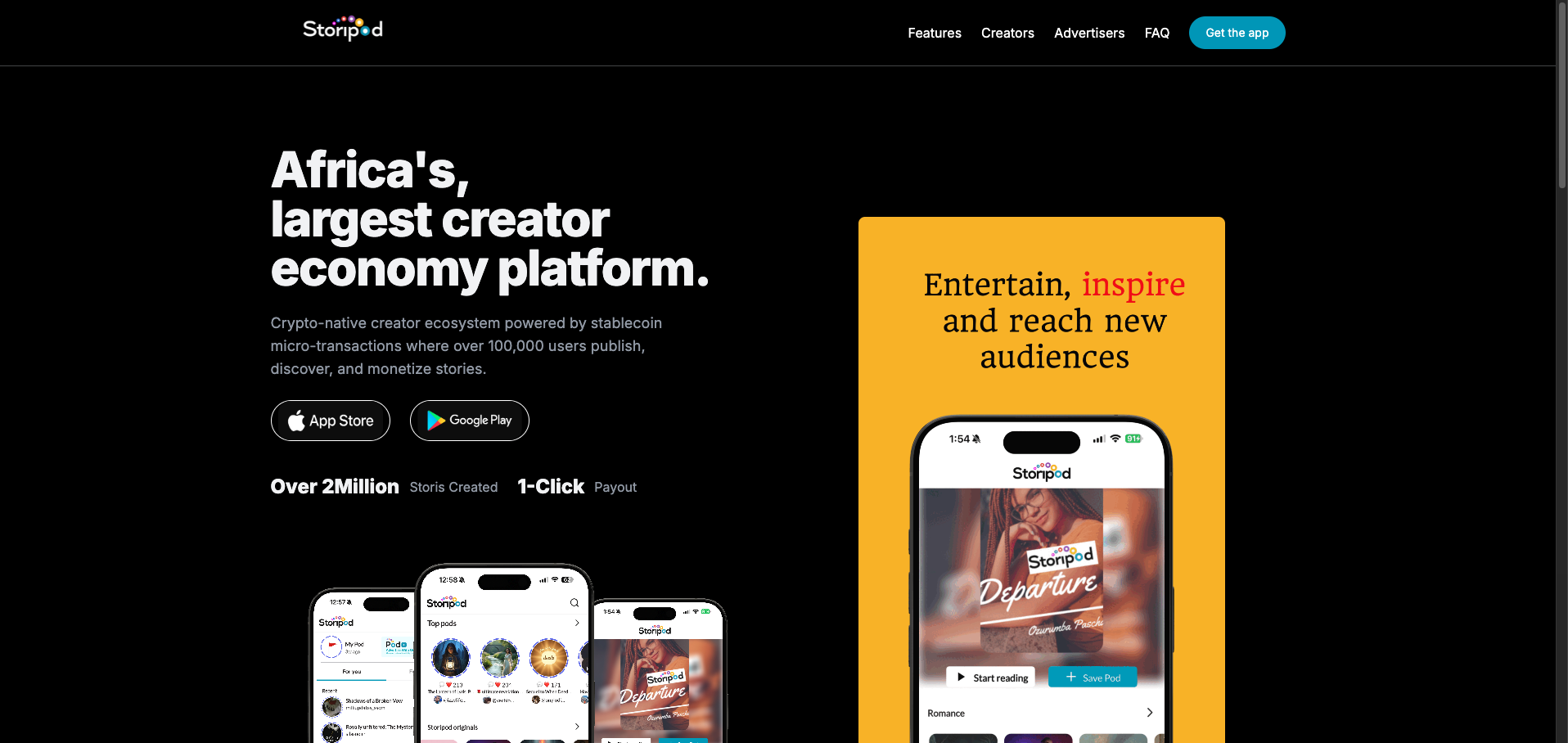
For African writers, finding a platform to share and get paid for their work has always been an immense challenge. While many African startups have been working to solve this issue, Storipod takes a unique approach: serializing stories in the format of social media stories.
This bold strategy aims to capitalize on the growing trend of shorter attention spans in the digital age. Here is the journey of Storipod from Day 1 to Day 1000.
Day 1: The End of Blog Posts
James Nelson has always had a passion for writing. Back in 2019, while working at Interswitch, he would publish blog posts weekly, sharing them on every platform he could. “Come read my blog. Come click. Come to my blog,” he recalls. After a while, he realized he was just spamming people.
The change came when Nelson started using WhatsApp Status. He posted the same content in a different format, breaking it up into slides. By the fifth slide, people were engaging with his content: “Oh, I don’t think that should have happened.” “I actually think this makes sense.” Instant feedback and conversation.
“People consume things in tiny bits,” Nelson explains. “That’s how we read now—WhatsApp Status, Instagram Stories, tweets. So why not use the same approach for actual storytelling?”

The insight was simple but profound. Music has Spotify and Apple Music, allowing artists to make money from their recordings. Movies have YouTube and Netflix, enabling filmmakers to earn from their work. But when it comes to writing? Nothing. Medium doesn’t pay. Substack doesn’t pay African writers. Twitter’s monetization requires subscriptions, but no platform has truly allowed writers to earn influencer money.
“Writers deserve better,” Nelson says.
In 2022, while still head of product at Shuttlers, a startup focused on digitizing shared commutes, Nelson secured the Storipod.com domain. The name came from the phrase ‘peas in a pod,’ representing writers sharing stories together. The ‘Storypod’ domain was already taken, so Nelson chose ‘Storipod’ instead. “We’ll out-market them,” he thought.
By December 2022, Nelson left Shuttlers and made a bold move: buying a Mac and an iPhone. “If I have these two, I will not be jobless,” he told himself.
“I realized the difference between most Nigerian founders and me is that they’ve raised money and I haven’t. That’s it.” After a short stint at Edukoya in 2023, Nelson made the decision: “We’re going to do Storipod, or we’ll die trying.”
Day 500: 15 Developers and a Prayer
Building a social media app is no easy feat. The expectations are sky-high. Users demand the polish of Instagram from just a few developers. They don’t want lag, and they certainly don’t want it to feel like a “Nigerian app.” They want an international product.
According to Nelson, Nigerian developers are great at fixing problems within a company, but they struggle with building scalable systems from scratch.
Storipod burned through 15 mobile developers. Nelson spent his last savings on an Indian developer who introduced bugs. However, by December 2023, Storipod finally launched on the Android store.
Then came the iOS challenge. Twenty-two builds were rejected. Nelson persisted. On February 6, 2024, he received the email he had been waiting for: “Welcome to the App Store.”
“I read it twice,” Nelson recalls. “That’s the most powerful email I’ve ever received.”
But the money was gone, and the team was down to Nelson and his co-founders, Caleb Chinga and Prince Ita. No mobile engineer. No way forward.
“At some point, I thought this was the end,” Nelson admits.
Determined, Nelson turned to LinkedIn, cold-messaging Flutter developers. “We have bugs. Can you help us? We don’t have money, but this thing can blow.”
Most ignored him, but one developer, Daniel, requested to see the documentation. After reviewing the code and fixing a few bugs, Daniel agreed to keep helping for free as he was between jobs. This helped Storipod survive its first crash.
Then Nelson found Taiwo Farinu, a brilliant coder working from a beer parlour with a broken laptop. When Farinu needed ₦20,000 ($13) for an emergency, Nelson sent it immediately, even though he was broke himself. Farinu solved complex problems like making stories remember where readers had stopped, much like WhatsApp Status.
Incredible support came in the form of a free Microsoft Azure 150,000 credits, and a designer created Storipod’s web interface during late-night NHS shifts.
However, the team still wasn’t getting paid. Nelson was burning out, and his co-founders were juggling day jobs with Storipod. “I see what they’re going through,” Nelson says. “I’m like, ‘Guys, how far? We need to fix this one. Let’s push.’” Every night, Nelson would pray, “God, let this succeed, not for me, for these guys.”
Day 1,000: 150,000 Users, Zero Payroll
In January 2024, a Canadian contact on LinkedIn saw what Storipod was doing and asked how much Nelson needed. He signed Storipod’s first angel cheque: $5,000. Nelson shared part of the funds with the team, and people cried. “I never knew ₦200K ($138) meant more to them than millions,” Nelson recalls. That’s when he realized they had something real—more than just a product, but a mission that people believed in.
In 2024, Storipod launched monetization. Writers could lock their stories, allowing readers to pay for access. They could also tip their favourite writers. Storipod took a 30% commission on earnings. Unlike other platforms, the payouts were real.
A user named Grace made an organic TikTok video, sharing how she made money on Storipod. Her video went viral, and Nelson rewarded her with ₦30,000 ($20). Storipod also ran ads on the video, which became their key marketing tool.
Another user, Winnie Baby, began writing on Storipod, then joined the team as a newsletter writer. Nelson made her the face of the brand, turning ‘Winnie Baby from Storipod’ into a recognizable name.
By mid-2025, Storipod reached 50,000 users. Then 150,000. Payments were shifted to on-chain stablecoins, making it easier for users across Africa to withdraw funds, no longer relying on country-specific payment integrations.
The team grew to 20 people, yet they still used Zoho’s free tier and built their own email campaign manager. No one on the team got paid. “When I tell people we run at zero cost, they don’t believe me,” Nelson says.
But somehow, they’re making it work.
The Exit Nobody’s Pricing In
Nelson doesn’t think like a typical founder. He isn’t focused on chasing a VC unicorn path. Instead, he’s closely watching global trends in the creator economy.
With platforms like Farcaster gaining traction, Nelson believes Storipod could become the go-to platform for African writers, especially when they reach 1 million users. That’s when ads will go live, and the business will become real.
Right now, Storipod has 150,000 creators, and they’ve yet to launch ads. Nelson is working long hours, sleeping at 4 a.m. and waking at noon. Farinu is still coding from a beer parlour. The UX designer is still sketching at 3 a.m. between NHS shifts. New people keep joining the team.
“People don’t resign at Storipod,” Nelson says. “Everyone’s a founding member. Even the cleaners. They believe this is theirs.”
It’s hard to believe, but Storipod is still running, with zero payroll, a team of 20, and 150,000 users.
Nelson leans back in his chair. “Where there’s a will, there’s a way.”