Slovakia traces its roots to the 9th century state of Great Moravia. The Slovaks then became part of the Hungarian Kingdom, where they remained for the next 1,000 years. After the formation of the dual Austro-Hungarian monarchy in 1867, language and education policies favoring the use of Hungarian (known as “Magyarization”) led to a public backlash that boosted Slovak nationalism and strengthened Slovak cultural ties with the closely related Czechs, who fell administratively under the Austrian half of the empire. When the Austro-Hungarian Empire dissolved at the end of World War I, the Slovaks joined the Czechs to form Czechoslovakia. During the interwar period, Slovak nationalist leaders pushed for autonomy within Czechoslovakia, and in 1939, in the wake of Germany’s annexation of the Sudetenland, the newly established Slovak Republic became a German client state for the remainder of World War II.
After World War II, Czechoslovakia was reconstituted and came under communist rule within Soviet-dominated Eastern Europe. In 1968, Warsaw Pact troops invaded and ended the efforts of Czechoslovakia’s leaders to liberalize communist rule and create “socialism with a human face,” ushering in a period of repression known as “normalization.” The peaceful Velvet Revolution swept the Communist Party from power at the end of 1989 and inaugurated a return to democratic rule and a market economy. On 1 January 1993, Czechoslovakia underwent a nonviolent “velvet divorce” into its two national components, Slovakia and the Czech Republic. Slovakia joined both NATO and the EU in 2004 and the euro zone in 2009.
Geography
Location
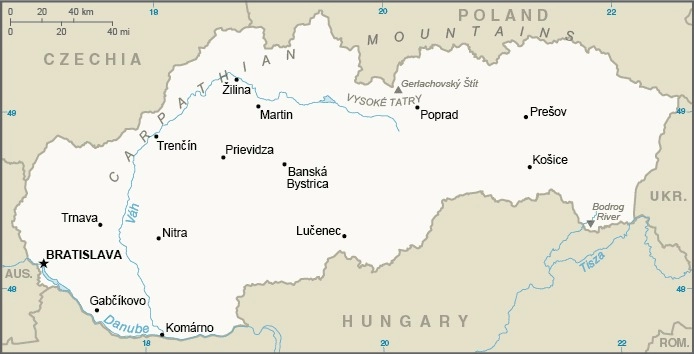
Central Europe, south of Poland
Geographic coordinates
48 40 N, 19 30 E
Map references
Europe
Area
total : 49,035 sq km
land: 48,105 sq km
water: 930 sq km
comparison ranking: total 130
Area – comparative
about one and a half times the size of Maryland; about twice the size of New Hampshire
Area comparison map:

Land boundaries
total: 1,587 km
border countries (5): Austria 105 km; Czechia 241 km; Hungary 627 km; Poland 517 km; Ukraine 97 km
Coastline
0 km (landlocked)
Maritime claims
none (landlocked)
Climate
temperate; cool summers; cold, cloudy, humid winters
Terrain
rugged mountains in the central and northern part and lowlands in the south
Elevation
highest point: Gerlachovsky Stit 2,655 m
lowest point: Bodrok River 94 m
mean elevation: 458 m
Natural resources
lignite, small amounts of iron ore, copper and manganese ore; salt; arable land
Land use
agricultural land: 38.8% (2022 est.)
arable land: 27.9% (2022 est.)
permanent crops: 0.4% (2022 est.)
permanent pasture: 10.6% (2022 est.)
forest: 40.1% (2022 est.)
other: 21.1% (2022 est.)
Irrigated land
259 sq km (2022)
Major rivers (by length in km)
Dunaj (Danube) (shared with Germany [s], Austria, Hungary, Croatia, Serbia, Bulgaria, Ukraine, Moldova, and Romania [m]) – 2,888 km
note – [s] after country name indicates river source; [m] after country name indicates river mouth
Major watersheds (area sq km)
Atlantic Ocean drainage: (Black Sea) Danube (795,656 sq km)
Population distribution
a fairly even distribution throughout most of the country; slightly larger concentration in the west in proximity to the Czech border
Natural hazards
flooding
Geography – note
landlocked; most of the country is rugged and mountainous; the Tatra Mountains in the north are interspersed with many scenic lakes and valleys
People and Society
Population
total: 5,563,649 (2024 est.)
male: 2,684,747
female: 2,878,902
comparison rankings: total 119; female 117; male 121
Nationality
noun: Slovak(s)
adjective: Slovak
Ethnic groups
Slovak 83.8%, Hungarian 7.8%, Romani 1.2%, other 1.8% (includes Czech, Ruthenian, Ukrainian, Russian, German, Polish), unspecified 5.4% (2021 est.)
note: data represent population by nationality; Romani populations are usually underestimated in official statistics and may represent 7–11% of Slovakia’s population
Languages
Slovak (official) 81.8%, Hungarian 8.5%, Roma 1.8%, other 2.2%, unspecified 5.7% (2021 est.)
major-language sample(s):
Svetova Kniha Faktov, nenahraditelny zdroj zakladnej informacie. (Slovak)
The World Factbook, the indispensable source for basic information.
Slovakian audio sample:
Religions
Roman Catholic 55.8%, Evangelical Church of the Augsburg Confession 5.3%, Greek Catholic 4%, Reformed Christian 1.6%, other 3%, none 23.8%, unspecified 6.5% (2021 est.)
Age structure
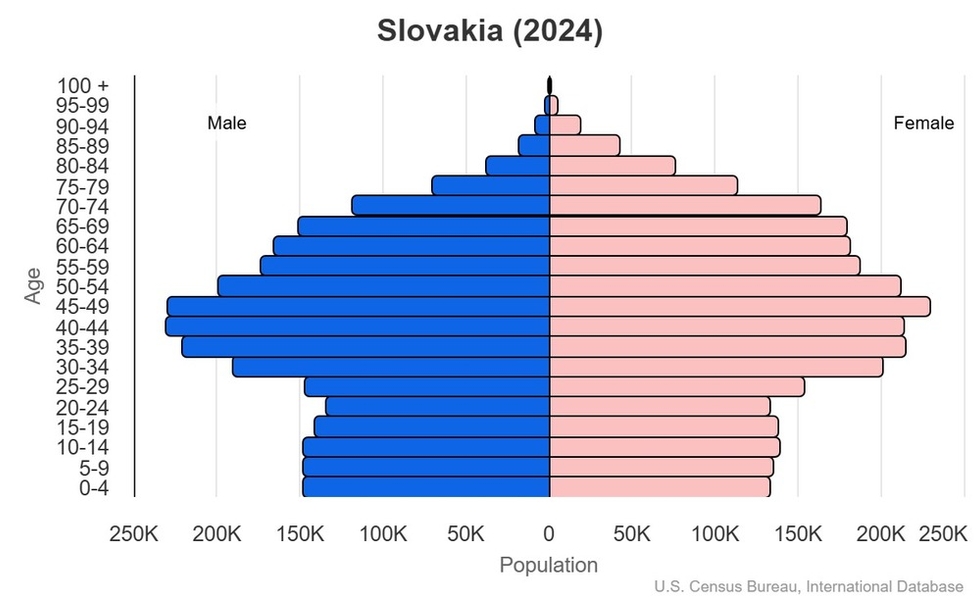
0-14 years: 15.3% (male 444,033/female 408,902)
15-64 years: 66.5% (male 1,834,359/female 1,867,158)
65 years and over: 18.1% (2024 est.) (male 406,355/female 602,842)
2024 population pyramid:
Dependency ratios
total dependency ratio: 50.3 (2024 est.)
youth dependency ratio: 23 (2024 est.)
elderly dependency ratio: 27.3 (2024 est.)
potential support ratio: 3.7 (2024 est.)
Median age
total: 42.8 years (2024 est.)
male: 41.3 years
female: 44.4 years
comparison ranking: total 39
Population growth rate
-0.08% (2024 est.)
comparison ranking: 202
Birth rate
10 births/1,000 population (2024 est.)
comparison ranking: 187
Death rate
11.2 deaths/1,000 population (2024 est.)
comparison ranking: 24
Net migration rate
0.4 migrant(s)/1,000 population (2024 est.)
comparison ranking: 73
Population distribution
a fairly even distribution throughout most of the country; slightly larger concentration in the west in proximity to the Czech border
Urbanization
urban population: 54% of total population (2023)
rate of urbanization: 0.17% annual rate of change (2020-25 est.)
Major urban areas – population
441,000 BRATISLAVA (capital) (2023)
Sex ratio
at birth: 1.07 male(s)/female
0-14 years: 1.09 male(s)/female
15-64 years: 0.98 male(s)/female
65 years and over: 0.67 male(s)/female
total population: 0.93 male(s)/female (2024 est.)
Mother’s mean age at first birth
27.2 years (2020 est.)
Maternal mortality ratio
5 deaths/100,000 live births (2020 est.)
comparison ranking: 171
Infant mortality rate
total: 5.1 deaths/1,000 live births (2024 est.)
male: 5.7 deaths/1,000 live births
female: 4.5 deaths/1,000 live births
comparison ranking: total 174
Life expectancy at birth
total population: 77.2 years (2024 est.)
male: 73.7 years
female: 81 years
comparison ranking: total population 94
Total fertility rate
1.6 children born/woman (2024 est.)
comparison ranking: 184
Gross reproduction rate
0.77 (2024 est.)
Contraceptive prevalence rate
NA
Drinking water source
improved:
urban: 100% of population
rural: 100% of population
total: 100% of population
unimproved:
urban: 0% of population
rural: 0% of population
total: 0% of population (2020 est.)
Health expenditure
7.8% of GDP (2021)
14.6% of national budget (2022 est.)
Physician density
3.7 physicians/1,000 population (2022)
Hospital bed density
5.7 beds/1,000 population (2020 est.)
Sanitation facility access
improved:
urban: 99.9% of population
rural: 100% of population
total: 100% of population
unimproved:
urban: 0.1% of population
rural: 0% of population
total: 0% of population (2020 est.)
Obesity – adult prevalence rate
20.5% (2016)
comparison ranking: 98
Alcohol consumption per capita
total: 10.3 liters of pure alcohol (2019 est.)
beer: 4.14 liters of pure alcohol (2019 est.)
wine: 2.01 liters of pure alcohol (2019 est.)
spirits: 4.14 liters of pure alcohol (2019 est.)
other alcohols: 0 liters of pure alcohol (2019 est.)
comparison ranking: total 21
Tobacco use
total: 30.3% (2025 est.)
male: 34.5% (2025 est.)
female: 26.3% (2025 est.)
comparison ranking: total 20
Currently married women (ages 15-49)
47.9% (2023 est.)
Education expenditure
4.5% of GDP (2022 est.)
10.7% national budget (2022 est.)
comparison ranking: Education expenditure (% GDP) 82
Literacy
total population: NA
male: NA
female: NA
School life expectancy (primary to tertiary education)
total: 15 years
male: 14 years
female: 15 years (2020)
Environment
Environment – current issues
air pollution and acid rain; land erosion from agricultural and mining practices; water pollution
Environment – international agreements
party to: Air Pollution, Air Pollution-Heavy Metals, Air Pollution-Multi-effect Protocol, Air Pollution-Nitrogen Oxides, Air Pollution-Persistent Organic Pollutants, Air Pollution-Sulphur 85, Air Pollution-Sulphur 94, Air Pollution-Volatile Organic Compounds, Antarctic Treaty, Biodiversity, Climate Change, Climate Change-Kyoto Protocol, Climate Change-Paris Agreement, Comprehensive Nuclear Test Ban, Desertification, Endangered Species, Environmental Modification, Hazardous Wastes, Law of the Sea, Nuclear Test Ban, Ozone Layer Protection, Ship Pollution, Tropical Timber 2006, Wetlands, Whaling
signed, but not ratified: Antarctic-Environmental Protection
Climate
temperate; cool summers; cold, cloudy, humid winters
Land use
agricultural land: 38.8% (2022 est.)
arable land: 27.9% (2022 est.)
permanent crops: 0.4% (2022 est.)
permanent pasture: 10.6% (2022 est.)
forest: 40.1% (2022 est.)
other: 21.1% (2022 est.)
Urbanization
urban population: 54% of total population (2023)
rate of urbanization: 0.17% annual rate of change (2020-25 est.)
Air pollutants
particulate matter emissions: 15.89 micrograms per cubic meter (2019 est.)
carbon dioxide emissions: 32.42 megatons (2016 est.)
methane emissions: 4.43 megatons (2020 est.)
Waste and recycling
municipal solid waste generated annually: 1.784 million tons (2015 est.)
municipal solid waste recycled annually: 135,941 tons (2015 est.)
percent of municipal solid waste recycled: 7.6% (2015 est.)
Major rivers (by length in km)
Dunaj (Danube) (shared with Germany [s], Austria, Hungary, Croatia, Serbia, Bulgaria, Ukraine, Moldova, and Romania [m]) – 2,888 km
note – [s] after country name indicates river source; [m] after country name indicates river mouth
Major watersheds (area sq km)
Atlantic Ocean drainage: (Black Sea) Danube (795,656 sq km)
Total water withdrawal
municipal: 290 million cubic meters (2020 est.)
industrial: 230 million cubic meters (2020 est.)
agricultural: 30 million cubic meters (2020 est.)
Total renewable water resources
50.1 billion cubic meters (2020 est.)
Geoparks
total global geoparks and regional networks: 1
global geoparks and regional networks: Novohrad-Nógrád (includes Hungary) (2023)
Government
Country name
conventional long form: Slovak Republic
conventional short form: Slovakia
local long form: Slovenska republika
local short form: Slovensko
etymology: the country takes its name from the local Slav ethnic group; the origin of the group’s name is unclear, although early forms were used in Medieval Latin (Sclavus) and Byzantine Greek (Sklabos)
Government type
parliamentary republic
Capital
name: Bratislava
geographic coordinates: 48 09 N, 17 07 E
time difference: UTC+1 (6 hours ahead of Washington, DC, during Standard Time)
daylight saving time: +1hr, begins last Sunday in March; ends last Sunday in October
etymology: the meaning is unclear but has medieval Slavic origins; the name was adopted in 1919 after Czechoslovakia gained its independence, replacing the name Prešporok
Administrative divisions
8 regions (kraje, singular – kraj); Banska Bystrica, Bratislava, Kosice, Nitra, Presov, Trencin, Trnava, Zilina
Legal system
civil law system based on Austro-Hungarian codes
Constitution
history: several previous (pre-independence); latest passed by the National Council 1 September 1992, signed 3 September 1992, effective 1 October 1992
amendment process: proposed by the National Council; passage requires at least three-fifths majority vote of Council members
International law organization participation
accepts compulsory ICJ jurisdiction with reservations; accepts ICCt jurisdiction
Citizenship
citizenship by birth: no
citizenship by descent only: at least one parent must be a citizen of Slovakia
dual citizenship recognized: no
residency requirement for naturalization: 5 years
Suffrage
18 years of age; universal
Executive branch
chief of state: President Peter PELLEGRINI (since 15 June 2024)
head of government: Prime Minister Robert FICO (since 25 October 2023)
cabinet: Cabinet appointed by the president on the recommendation of the prime minister
elections/appointments: president directly elected by absolute majority popular vote in 2 rounds if needed for a 5-year term (eligible for a second term); election first round held on 23 March 2024 with a runoff on 6 April 2024 (next to be held in 2029); following National Council elections (every 4 years), the president designates a prime minister candidate, usually the leader of the party or coalition that wins the most votes, who must win a vote of confidence in the National Council
election results:
2024: Peter PELLEGRINI elected president in the second round; percent of vote in second round Peter PELLEGRINI 53.1%; Ivan KORCOK 46.9%; percent of vote in first round – Ivan KORCOK (independent) 42.5%; Peter PELLEGRINI (Hlas-SD) 37%; Stefan HARABIN (independent) 11.7%, other 8.8%;
2019: Zuzana CAPUTOVA elected president in second round; percent of vote – Zuzana CAPUTOVA (PS) 58.4%, Maros SEFCOVIC (independent) 41.6%
Legislative branch
legislature name: National Council (Narodna rada Slovenskej republiky)
legislative structure: unicameral
chamber name: National Council (Národná rada)
number of seats: 150 (all directly elected)
electoral system: proportional representation
scope of elections: full renewal
term in office: 4 years
most recent election date: 9/30/2023
parties elected and seats per party: Smer – Social Democracy (Smer-SD) (42); Progressive Slovakia (PS) (32); Hlas (“Voice”) – SD (27); Coalition OĽaNO and Friends, ‘For the People’ and ‘Christian Union’ (16); Christian Democratic Movement (KDH) (12); Freedom and Solidarity (SaS) (11); Slovak National Party (SNS) (10)
percentage of women in chamber: 23.3%
expected date of next election: September 2027
Judicial branch
highest court(s): Supreme Court of the Slovak Republic (consists of the court president, vice president, and approximately 80 judges organized into criminal, civil, commercial, and administrative divisions with 3- and 5-judge panels); Constitutional Court of the Slovak Republic (consists of 13 judges organized into 3-judge panels)
judge selection and term of office: Supreme Court judge candidates nominated by the Judicial Council of the Slovak Republic, an 18-member self-governing body that includes the Supreme Court chief justice and presidential, governmental, parliamentary, and judiciary appointees; judges appointed by the president serve for life, subject to removal by the president at age 65; Constitutional Court judges nominated by the National Council of the Republic and appointed by the president; judges serve 12-year terms
subordinate courts: regional and district civil courts; Special Criminal Court; Higher Military Court; military district courts; Court of Audit
Political parties
Alliance-Szovetseg or A-S
Christian Union or KÚ
Civic Conservative Party or OKS
Democrats
Direction-Social Democracy or Smer-SSD
For the People or Za Ludi
Freedom and Solidarity or SaS
Life National Party or Život–NS (formerly Christian Democracy – Life and Prosperity – Alliance for Slovkia)
New Majority or NOVA
Ordinary People and Independent Personalities – New Majority or OLaNO-NOVA
People’s Party Our Slovakia or LSNS
Progressive Slovakia or PS
Republic
Slovak National Party or SNS
Voice – Social Democracy or Hlas-SD
We Are Family or Sme-Rodina (formerly Party of Citizens of Slovakia)
Diplomatic representation in the US
chief of mission: Ambassador Radovan JAVORČÍK (since 18 January 2021)
chancery: 3523 International Court NW, Washington, DC 20008
telephone: [1] (202) 237-1054
FAX: [1] (202) 237-6438
email address and website:
[email protected]
https://www.mzv.sk/web/washington-en
consulate(s) general: New York
Diplomatic representation from the US
chief of mission: Ambassador Gautam A. RANA (since 28 September 2022)
embassy: P.O. Box 309, 814 99 Bratislava
mailing address: 5840 Bratislava Place, Washington DC 20521-5840
telephone: [421] (2) 5443-3338
FAX: [421] (2) 5441-8861
email address and website:
[email protected]
https://sk.usembassy.gov/
International organization participation
Australia Group, BIS, BSEC (observer), CBSS (observer), CD, CE, CEI, CERN, EAPC, EBRD, ECB, EIB, EMU, EU, FAO, IAEA, IBRD, ICAO, ICC (national committees), ICRM, IDA, IEA, IFC, IFRCS, ILO, IMF, IMO, IMSO, Interpol, IOC, IOM, IPU, ISO, ITU, ITUC (NGOs), MIGA, NATO, NEA, NSG, OAS (observer), OECD, OIF (observer), OPCW, OSCE, PCA, Schengen Convention, SELEC (observer), UN, UNCTAD, UNESCO, UNFICYP, UNIDO, UNTSO, UNWTO, UPU, Wassenaar Arrangement, WCO, WFTU (NGOs), WHO, WIPO, WMO, WTO, ZC
Independence
1 January 1993 (Czechoslovakia split into the Czech Republic and Slovakia)
National holiday
Constitution Day, 1 September (1992)
Flag description
three equal horizontal bands of white (top), blue, and red come from the pan-Slav colors; the national coat of arms (a red shield bordered in white and with a white double-barred cross of St. Cyril and St. Methodius on top of three blue hills) is centered over the bands but offset slightly to the hoist side
note: the pan-Slav colors were inspired by Russia’s flag
National symbol(s)
double-barred cross (Cross of St. Cyril and St. Methodius) over three peaks
National colors
white, blue, red
National anthem
name: “Nad Tatrou sa blyska” (Lightning Over the Tatras)
lyrics/music: Janko MATUSKA/traditional
note: adopted 1993, in use since 1844; music based on the Slovak folk song “Kopala studienku” (She was digging a well)
National heritage
total World Heritage Sites: 8 (6 cultural, 2 natural)
selected World Heritage Site locales: Historic Town of Banská Štiavnica (c); Levoča, Spišský Hrad, and the Associated Cultural Monuments (c); Vlkolínec (c); Caves of Aggtelek Karst and Slovak Karst (n); Bardejov Town (c); Ancient and Primeval Beech Forests of the Carpathians (n); Wooden Churches of the Slovak Carpathians (c); Frontiers of the Roman Empire – The Danube Limes (Western Segment) (c)
Economy
Economic overview
high-income EU and eurozone economy; manufacturing and exports led by automotive sector; growth supported by private consumption and public investment from EU funds, tempered by trade risks; increased taxes and withdrawal of energy subsidies contributing to rising but manageable inflation; strong labor demand and influx of foreign labor offsets aging workforce
Real GDP (purchasing power parity)
$213.219 billion (2023 est.)
$210.32 billion (2022 est.)
$209.379 billion (2021 est.)
note: data in 2021 dollars
comparison ranking: 76
Real GDP growth rate
1.38% (2023 est.)
0.45% (2022 est.)
4.77% (2021 est.)
note: annual GDP % growth based on constant local currency
comparison ranking: 153
Real GDP per capita
$39,300 (2023 est.)
$38,700 (2022 est.)
$38,400 (2021 est.)
note: data in 2021 dollars
comparison ranking: 62
GDP (official exchange rate)
$132.908 billion (2023 est.)
note: data in current dollars at official exchange rate
Inflation rate (consumer prices)
2.8% (2024 est.)
10.5% (2023 est.)
12.8% (2022 est.)
note: annual % change based on consumer prices
comparison ranking: 87
GDP – composition, by sector of origin
agriculture: 2% (2023 est.)
industry: 32.9% (2023 est.)
services: 56.4% (2023 est.)
note: figures may not total 100% due to non-allocated consumption not captured in sector-reported data
comparison rankings: services 116; industry 47; agriculture 156
GDP – composition, by end use
household consumption: 58.9% (2023 est.)
government consumption: 20.1% (2023 est.)
investment in fixed capital: 22.3% (2023 est.)
investment in inventories: -3% (2023 est.)
exports of goods and services: 91.9% (2023 est.)
imports of goods and services: -90.4% (2023 est.)
note: figures may not total 100% due to rounding or gaps in data collection
Agricultural products
wheat, sugar beets, maize, milk, barley, rapeseed, sunflower seeds, potatoes, soybeans, pork (2023)
note: top ten agricultural products based on tonnage
Industries
automobiles; metal and metal products; electricity, gas, coke, oil, nuclear fuel; chemicals, synthetic fibers, wood and paper products; machinery; earthenware and ceramics; textiles; electrical and optical apparatus; rubber products; food and beverages; pharmaceutical
Industrial production growth rate
15.03% (2023 est.)
note: annual % change in industrial value added based on constant local currency
comparison ranking: 3
Labor force
2.769 million (2024 est.)
note: number of people ages 15 or older who are employed or seeking work
comparison ranking: 118
Unemployment rate
5.2% (2024 est.)
5.8% (2023 est.)
6.1% (2022 est.)
note: % of labor force seeking employment
comparison ranking: 101
Youth unemployment rate (ages 15-24)
total: 18.2% (2024 est.)
male: 20.1% (2024 est.)
female: 15% (2024 est.)
note: % of labor force ages 15-24 seeking employment
comparison ranking: total 69
Population below poverty line
13.7% (2021 est.)
note: % of population with income below national poverty line
Gini Index coefficient – distribution of family income
24.1 (2021 est.)
note: index (0-100) of income distribution; higher values represent greater inequality
comparison ranking: 154
Average household expenditures
on food: 19.4% of household expenditures (2023 est.)
on alcohol and tobacco: 4.9% of household expenditures (2023 est.)
Household income or consumption by percentage share
lowest 10%: 3.4% (2021 est.)
highest 10%: 19.1% (2021 est.)
note: % share of income accruing to lowest and highest 10% of population
Remittances
1.8% of GDP (2023 est.)
2% of GDP (2022 est.)
2.01% of GDP (2021 est.)
note: personal transfers and compensation between resident and non-resident individuals/households/entities
Budget
revenues: $43.882 billion (2022 est.)
expenditures: $46.056 billion (2022 est.)
note: central government revenues (excluding grants) and expenses converted to US dollars at average official exchange rate for year indicated
Public debt
64.3% of GDP (2022 est.)
note: central government debt as a % of GDP
comparison ranking: 66
Taxes and other revenues
19.4% (of GDP) (2022 est.)
note: central government tax revenue as a % of GDP
comparison ranking: 91
Current account balance
-$2.23 billion (2023 est.)
-$11.126 billion (2022 est.)
-$5.776 billion (2021 est.)
note: balance of payments – net trade and primary/secondary income in current dollars
comparison ranking: 159
Exports
$121.008 billion (2023 est.)
$114.519 billion (2022 est.)
$109.237 billion (2021 est.)
note: balance of payments – exports of goods and services in current dollars
comparison ranking: 44
Exports – partners
Germany 20%, Czechia 10%, Hungary 7%, USA 6%, Poland 6% (2023)
note: top five export partners based on percentage share of exports
Exports – commodities
cars, vehicle parts/accessories, video displays, broadcasting equipment, refined petroleum (2023)
note: top five export commodities based on value in dollars
Imports
$119.666 billion (2023 est.)
$121.473 billion (2022 est.)
$109.891 billion (2021 est.)
note: balance of payments – imports of goods and services in current dollars
comparison ranking: 44
Imports – partners
Germany 16%, Czechia 14%, Poland 8%, China 7%, Hungary 6% (2023)
note: top five import partners based on percentage share of imports
Imports – commodities
vehicle parts/accessories, broadcasting equipment, cars, plastic products, insulated wire (2023)
note: top five import commodities based on value in dollars
Reserves of foreign exchange and gold
$11.793 billion (2024 est.)
$11.288 billion (2023 est.)
$10.28 billion (2022 est.)
note: holdings of gold (year-end prices)/foreign exchange/special drawing rights in current dollars
comparison ranking: 73
Exchange rates
euros (EUR) per US dollar –
Exchange rates:
0.924 (2024 est.)
0.925 (2023 est.)
0.95 (2022 est.)
0.845 (2021 est.)
0.876 (2020 est.)
Energy
Electricity access
electrification – total population: 100% (2022 est.)
Electricity
installed generating capacity: 8.138 million kW (2023 est.)
consumption: 24.18 billion kWh (2023 est.)
exports: 14.078 billion kWh (2023 est.)
imports: 10.671 billion kWh (2023 est.)
transmission/distribution losses: 1.233 billion kWh (2023 est.)
comparison rankings: transmission/distribution losses 110; imports 24; exports 18; consumption 70; installed generating capacity 73
Electricity generation sources
fossil fuels: 14.4% of total installed capacity (2023 est.)
nuclear: 63.7% of total installed capacity (2023 est.)
solar: 2.1% of total installed capacity (2023 est.)
hydroelectricity: 13.9% of total installed capacity (2023 est.)
biomass and waste: 5.9% of total installed capacity (2023 est.)
Nuclear energy
Number of operational nuclear reactors: 5 (2025)
Number of nuclear reactors under construction: 1 (2025)
Net capacity of operational nuclear reactors: 2.3GW (2025 est.)
Percent of total electricity production: 61.3% (2023 est.)
Number of nuclear reactors permanently shut down: 3 (2025)
Coal
production: 2.315 million metric tons (2023 est.)
consumption: 6.066 million metric tons (2023 est.)
exports: 13,000 metric tons (2023 est.)
imports: 3.658 million metric tons (2023 est.)
proven reserves: 19 million metric tons (2023 est.)
Petroleum
total petroleum production: 7,000 bbl/day (2023 est.)
refined petroleum consumption: 90,000 bbl/day (2024 est.)
crude oil estimated reserves: 9 million barrels (2021 est.)
Natural gas
production: 46.585 million cubic meters (2023 est.)
consumption: 4.277 billion cubic meters (2023 est.)
imports: 4.56 billion cubic meters (2023 est.)
proven reserves: 14.158 billion cubic meters (2021 est.)
Carbon dioxide emissions
30.087 million metric tonnes of CO2 (2023 est.)
from coal and metallurgical coke: 9.607 million metric tonnes of CO2 (2023 est.)
from petroleum and other liquids: 12.112 million metric tonnes of CO2 (2023 est.)
from consumed natural gas: 8.368 million metric tonnes of CO2 (2023 est.)
comparison ranking: total emissions 73
Energy consumption per capita
127.582 million Btu/person (2023 est.)
comparison ranking: 30
Communications
Telephones – fixed lines
total subscriptions: 505,000 (2023 est.)
subscriptions per 100 inhabitants: 9 (2023 est.)
comparison ranking: total subscriptions 92
Telephones – mobile cellular
total subscriptions: 7.63 million (2023 est.)
subscriptions per 100 inhabitants: 132 (2022 est.)
comparison ranking: total subscriptions 107
Broadcast media
state-owned public broadcaster, Radio and Television of Slovakia (RTVS), has 2 national TV stations; roughly 50 privately owned national, regional, and local TV stations; about 40% of households connected to multi-channel cable or satellite TV; multiple RTVS national and regional radio networks; 32 privately owned radio stations
Internet country code
.sk
Internet users
percent of population: 90% (2024 est.)
Broadband – fixed subscriptions
total: 1.83 million (2023 est.)
subscriptions per 100 inhabitants: 33 (2023 est.)
comparison ranking: total 64
Transportation
Civil aircraft registration country code prefix
OM
Airports
116 (2025)
comparison ranking: 47
Heliports
2 (2025)
comparison ranking: 131
Railways
total: 3,627 km (2020) 1,585 km electrified
Military and Security
Military and security forces
Armed Forces of the Slovak Republic (Ozbrojene Sily Slovenskej Republiky): Ground Forces (Slovenské Pozemné Sily), Air Forces (Slovenské Vzdušné Sily), Special Operations Forces (Sily Pre Speciálne Operácie)
Ministry of Interior: Slovak Police Force (SPF or Policajný Zbor) (2025)
note: the SPF has sole responsibility for internal and border security
Military expenditures
2% of GDP (2024 est.)
2.1% of GDP (2023)
1.8% of GDP (2022)
1.7% of GDP (2021)
1.9% of GDP (2020)
Military and security service personnel strengths
approximately 15,000 active-duty Armed Forces (2025)
Military equipment inventories and acquisitions
the military’s inventory consists mostly of Soviet-era platforms; in recent years it has imported limited quantities of more modern, NATO-compatible equipment, particularly from Italy and the US (2024)
Military service age and obligation
18-30 years of age for voluntary military service for men and women; conscription in peacetime suspended in 2004 (2023)
note: as of 2021, women made up nearly 13% of the military’s full-time personnel
Military deployments
240 Cyprus (UNFICYP); up to 150 Latvia (NATO) (2024)
Military – note
the Slovak military was created from the Czechoslovak Army after the dissolution of Czechoslovakia in January 1993; it is responsible for external defense and fulfilling Slovakia’s commitments to European and international security; Slovakia has been a member of both the EU and NATO since 2004; a key focus of the Slovak military is fulfilling the country’s security responsibilities to NATO, including modernizing and acquiring NATO-compatible equipment, participating in training exercises, and providing forces for security missions such as NATO’s Enhanced Forward Presence in the Baltic States; since 2022, Slovakia has hosted a NATO ground force battlegroup comprised of troops from Czechia, Germany, the Netherlands, Poland, Slovakia, Slovenia, and the US as part of the NATO effort to boost the defenses of Eastern Europe since the Russian invasion of Ukraine; Slovakia also contributes to EU and UN peacekeeping missions
the Slovak Air Force has only a handful of fighter aircraft and is assisted by NATO’s air policing mission over Slovakia, which includes fighter aircraft from Czechia and Poland; in 2022, Slovakia signed a defense agreement with the US that allows the US to use two Slovak military air bases (2024)
Transnational Issues
Refugees and internally displaced persons
refugees (country of origin): 117,265 (Ukraine) (as of 14 April 2024)
stateless persons: 2,940 (2022)
Illicit drugs
transshipment point for Southwest Asian heroin bound for Western Europe; producer of synthetic drugs for regional market; consumer of MDMA (ecstasy)