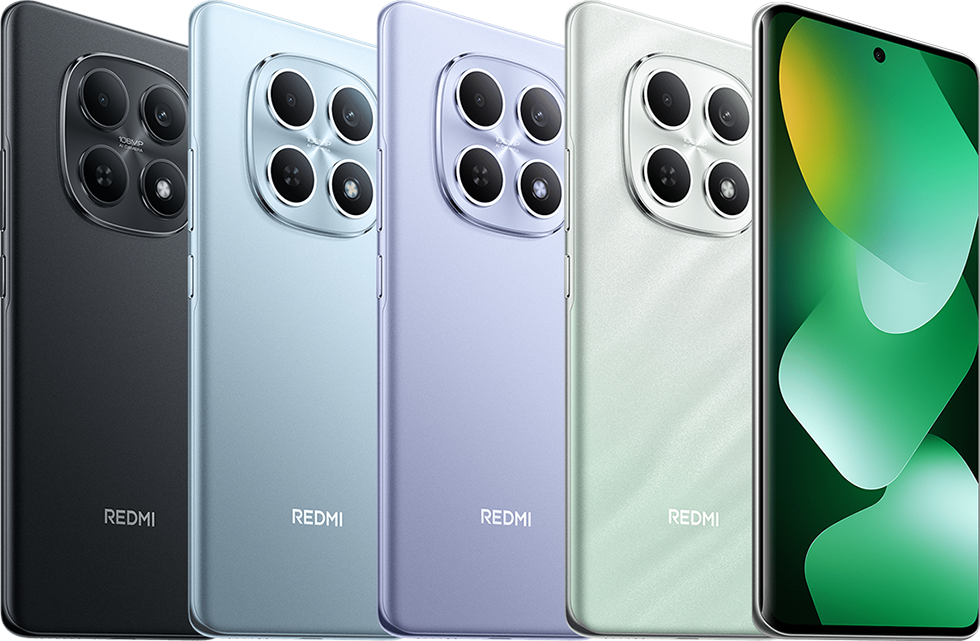
Xiaomi Redmi Note 15 5G DEALS
The Redmi Note 15 sits in the middle of a crowded Xiaomi lineup, but it makes more sense than some of its siblings. The Redmi Note 15 avoids the obvious compromises of the 4G Pro model, keeps the price below the Pro 5G, and focuses on the features that matter most to mainstream buyers: a bright AMOLED screen, solid battery life, stable daily performance, and a dependable main camera.
That gives it a clear market role. This is not a phone for buyers chasing flagship gaming power or camera versatility. Instead, it aims to be a sensible all-rounder for people who want a durable 5G phone with a large display, good endurance, and few serious weaknesses. In that respect, Xiaomi’s formula still works.
Specifications Table
| Category | Details |
|---|---|
| Display | 6.77-inch AMOLED, 1080 x 2392, 120Hz, HDR10+ |
| Chipset | Snapdragon 6 Gen 3 |
| RAM & Storage | 6GB/128GB, 8GB/128GB, 8GB/256GB, 8GB/512GB, 12GB/512GB, UFS 2.2, microSD hybrid slot |
| Rear Camera | 108MP main with OIS, 8MP ultrawide |
| Front Camera | 20MP |
| Battery | 5520mAh |
| Charging | 45W wired, 18W reverse wired |
| OS | Android 15, HyperOS 2 |
| Build | Glass front, plastic frame, plastic back, IP66, drop resistance up to 1.7m |
| Connectivity | 5G, Wi-Fi 5, Bluetooth 5.3/5.1, NFC in some markets, IR blaster |
Design and Build Quality
The Redmi Note 15 looks exactly like the kind of phone Xiaomi knows how to sell in large numbers. It has the familiar curved body, a color-matched camera island, and a clean layout that does not try too hard to stand out. The design is not original, but it is tidy and easy to live with. In hand, the curved rear and slim frame help the phone feel more comfortable than its size suggests.
Materials are less impressive. The frame and back are plastic, and they feel like it. However, build quality is still solid. There is very little flex, the buttons feel clicky, and the phone comes across as durable rather than cheap. That matters more in this segment than premium touch points. The IP66 rating, MIL-STD-810H compliance, and quoted drop resistance add further reassurance, even if the front glass remains unnamed.
Compared with the Redmi Note 15 Pro 4G, the Redmi Note 15 does not look like an upgrade. It looks nearly identical. The difference is in the hardware priorities rather than in the shell. The optical fingerprint reader is well placed and reliable, which helps daily use, and the overall weight of 178g keeps the phone manageable. Resale strength should be reasonable because Redmi phones have wide recognition, while repairability is helped by the simple construction and broad spare-parts ecosystem in many markets.
Redmi Note 15 Display Performance
The Redmi Note 15 has one of its clearest strengths here. Xiaomi rarely cuts too deeply on screen quality, and this panel is a good example of that approach. It is a 6.77-inch AMOLED with Full HD+ resolution, 120Hz refresh support, 12-bit color depth, and HDR10+ certification. At 388ppi, it is sharp enough that text, video, and images all look crisp.
Brightness is especially strong for the class. Manual output reaches about 605 nits, auto mode climbs to roughly 1,524 nits, and peak brightness in a 10% window goes above 3,300 nits. In real use, that means outdoor visibility is not a problem. HDR video also benefits from the extra headroom, even though Dolby Vision is absent.
Refresh-rate behavior is practical rather than advanced. Since this is an LTPS panel, it steps between fixed modes rather than scaling continuously. Still, Xiaomi’s implementation is flexible. Adaptive mode switches between 30Hz, 60Hz, 90Hz, and 120Hz as needed, while the custom mode lets you limit the screen to 60Hz or allow 120Hz on a per-app basis. For this price bracket, that is a useful and mature setup.
Performance and Benchmarks
The Redmi Note 15 runs on the Snapdragon 6 Gen 3, a 4nm Qualcomm chip with four Cortex-A78 performance cores and four Cortex-A55 efficiency cores, paired with an Adreno 710 GPU. On paper, that puts it in the competent mid-range tier rather than the enthusiast class. It is also clearly more modern and more capable than the Helio chips used in some Redmi siblings.
Benchmark results reflect that position well. CPU output is in line with phones using Dimensity 7300- and 7400-class silicon, while GPU performance is decent but not especially strong for gaming. It is not slow, but it is also not exceptional value if raw power is your top priority. Some similarly priced competitors simply offer more.
Redmi Note 15 real-world performance
In normal use, the Redmi Note 15 feels stable and predictable. App launches are quick enough, multitasking is fine with 8GB RAM, and general navigation remains smooth. This is the kind of phone that handles messaging, browsing, maps, video, social apps, and office tasks without drawing attention to itself. That is a compliment.
Gaming is less convincing. The phone can run mainstream titles, but the GPU ceiling is modest for the money. If you care about higher frame rates or heavier games, a Poco X7 Pro or other performance-focused alternative makes more sense. The Redmi Note 15 is better understood as a steady all-rounder than a gaming value pick.
Redmi Note 15 thermal performance
Thermal control is excellent. The Snapdragon 6 Gen 3 does not generate much heat, and Xiaomi’s cooling keeps it under firm control. Stress testing showed almost no meaningful throttling, and the surface temperature stayed only mildly warm.
That matters because stability often matters more than peak numbers in this class. The Redmi Note 15 remains comfortable to hold and keeps delivering the same general level of performance over time. For users in hotter climates or buyers who keep phones for years, that is a real strength.
Camera Performance
The Redmi Note 15 camera setup is simple but sensible. There is one high-resolution stabilized main camera, a basic ultrawide, and an average selfie camera. That is not exciting, but it is enough if the main sensor performs well. Fortunately, it does.
Redmi Note 15 main camera analysis
The main camera uses a 108MP Samsung HM9 sensor with OIS and a 24mm equivalent f/1.7 lens. In regular use, it bins down to 12MP output. Daylight photos are very good for the class, with strong detail, mature sharpening, and good dynamic range. Exposure can run a little bright, so highlights occasionally get harsh, but overall the output is pleasing and dependable.
Human subjects are also handled well. Skin tones are lively, and Portrait mode often delivers nicer detail than the regular Photo mode. Background separation is conservative, which works in the phone’s favor because it keeps the result believable. The 108MP full-resolution mode adds little practical value, so most users should ignore it.
The 3x crop is a mixed bag. Detail can be unexpectedly decent in good light, but processing is inconsistent and some shots come out oddly desaturated. That makes it less dependable than the main camera and nowhere near a replacement for a proper telephoto.
Redmi Note 15 low-light performance
At night, the main camera remains capable. It does not produce class-leading low-light images, but it balances the scene fairly well. Detail is better in brighter environments, shadows stay a little deep, and colors can become slightly oversaturated. Still, white balance is reliable and highlight preservation is handled sensibly.
The 3x crop falls apart much faster after dark. Results are soft and noisy to the point that they are barely usable. The ultrawide does a fair job with color and dynamic range, but detail is soft and blotchy, which is about what you would expect from an 8MP fixed-focus secondary camera at this level.
Redmi Note 15 video performance
The Redmi Note 15 records up to 4K30 on the main camera, while the ultrawide and selfie camera stop at 1080p30. There is no HDR video mode and no 60fps mode on any camera. That already places the feature set slightly below the more ambitious devices around it.
The good news is that main-camera 4K footage is genuinely sharp and pleasing in daylight. Color and dynamic range are good, and even low-light 4K remains respectable. The main problem is stabilization. There is no electronic stabilization in 4K, so even standing clips look shakier than they should. If you want stable footage, you need to drop to 1080p30. The ultrawide’s 1080p video is usable in daylight and weak at night. In short, the main camera is good at video, but only if you can tolerate the stabilization trade-off.
Battery and Charging
Battery life is one of the Redmi Note 15’s stronger arguments. With a 5520mAh cell, the phone delivers an Active Use Score of just over 14 hours, which is clearly above average for its class. Web use and calls are especially good, while gaming endurance is only fair.
In practical terms, that means the Redmi Note 15 is an easy full-day phone and often more than that for moderate users. It is not the absolute best in Xiaomi’s wider lineup, but it is comfortably reliable. Battery reliability matters in this segment, and this phone does not disappoint there.
Charging is serviceable rather than fast. Forty-five watts gets the phone to 32% in 15 minutes, 55% in 30 minutes, and a full charge in about 67 minutes. That is good enough, though no longer impressive by Xiaomi standards. Heat during charging is not a concern, and the 18W reverse wired charging adds some practical flexibility. Smart charging and 80% charging limits also help the longevity story.
Software and User Experience
The Redmi Note 15 ships with HyperOS 2 on Android 15. That already feels a step behind some newer Xiaomi models, but the long support promise helps. Xiaomi says the phone will receive four major Android upgrades and six years of security updates, which is solid for a mid-range device.
The software itself is familiar. HyperOS remains dense with features, but the overall experience is polished enough and easy to navigate if you have used Xiaomi devices before. You can choose between an app drawer and classic home screens, and the interface remains smooth on this hardware. That matters because some lower-end Redmi models still show stutter or lag. The Redmi Note 15 does not.
The main annoyance is feature inconsistency. AI tools vary by unit and market, and some review units appear to miss features Xiaomi advertises elsewhere. That makes the software package feel segmented rather than consistent. Still, the core UI is stable, and the long update window improves longevity potential.
Connectivity and Extras
The Redmi Note 15 supports dual Nano-SIM 5G, GPS, GLONASS, BDS, and Galileo. Local connectivity is less impressive. You only get Wi-Fi 5, not Wi-Fi 6, and Bluetooth version varies by market. NFC also depends on region, so buyers need to check local listings carefully.
There is no headphone jack and no FM radio, but the IR blaster remains. The hybrid SIM tray also means expandable storage comes at the cost of a second SIM. The virtual proximity sensor works well enough in use, though a hardware unit would have been better. Overall, connectivity is adequate, not forward-looking. This is one of the clearer areas where Xiaomi has kept costs under control.
Audio and Multimedia
The Redmi Note 15’s stereo speakers are tuned for loudness first. That works to a point. The phone gets loud, and channel balance is better than expected despite the asymmetrical speaker sizes. The soundstage is fairly wide, and mids are decent enough for podcasts, casual video, and everyday listening.
The downside comes at higher volume. Once you push the phone hard, treble distortion becomes obvious, and the output turns screechy. At or below 100%, the experience is far better. So this is a phone with good multimedia intent, especially given the strong AMOLED screen, but not one with especially refined speaker tuning.
Competition and Market Position
The Redmi Note 15 sits in a difficult position because Xiaomi’s own lineup creates much of its competition. The Poco X7 Pro offers much stronger performance, faster charging, and a bigger battery. The Poco M8 Pro also looks more compelling on paper in several ways, with a newer chipset, bigger battery, better ingress protection, and more modern connectivity.
Outside Xiaomi, the Galaxy A56 remains a strong all-rounder with better software reputation, while Honor’s recent number-series models often deliver stronger camera consistency and better overall chipsets around the same price. That means the Redmi Note 15 is not the most exciting value choice in its class. It is the safer one.
That is really its position. It targets users who want a big, bright screen, dependable battery life, a good main camera, and stable day-to-day use in a durable shell. It does not dominate any one category, but it also avoids serious mistakes. In many markets, that remains enough.
Verdict
The Redmi Note 15 is a very sensible mid-range phone. It has a strong AMOLED display, very good battery life, stable performance, excellent thermal control, and a main camera that delivers more often than not. For most users, those are the categories that matter most, and Xiaomi handles them well here.
Its limitations are equally clear. Gaming performance is modest for the price, the ultrawide is only average, 4K video lacks stabilization, and connectivity features vary by market more than they should. The speakers also prioritize loudness over refinement. Those are not deal-breakers, but they are reminders that this is a mid-ranger, not a hidden flagship.
Overall, the Redmi Note 15 offers good value for money if your priorities are screen quality, battery life, and dependable everyday use. It is not the most exciting phone around €300, but it is one of the easiest to recommend to average users.
Why This Phone Matters in Africa
The Redmi Note 15 matters in Africa because it focuses on things that translate well in real daily use. Battery reliability, strong daylight visibility, a sturdy body, and a dependable main camera all matter more than benchmark bragging rights in many markets. Its 5G support, large AMOLED display, and reverse charging also fit well with how people actually use mid-range phones across the region.
Pricing sensitivity is always part of the story, and that is where the Redmi Note 15 must be judged carefully against Xiaomi’s own Poco models and rivals from Samsung, Tecno, and Infinix. Even so, Redmi’s name carries good resale strength, repairability is usually decent thanks to broad parts availability, and the long software support promise helps the phone feel like a safer long-term purchase. That makes it appealing to users who want a stable, low-risk option rather than the most aggressive spec sheet.
Final Thoughts
The Redmi Note 15 is best suited to buyers who want a big display, good battery life, reliable performance, and a strong main camera without stepping into more expensive mid-range territory. It is a good fit for students, office users, casual photographers, and people who want a phone that simply works well every day.
It is less suitable for gamers, buyers who want a more versatile camera system, or users who care about getting the absolute best raw value from Xiaomi’s ecosystem. Those users should look harder at Poco alternatives or more camera-focused rivals. Even so, the Redmi Note 15 has a decent longevity outlook, solid resale prospects, and enough balance to remain a safe recommendation.
The Review
Xiaomi Redmi Note 15 5G
The Xiaomi Redmi Note 15 ends up being exactly what it looks like on paper - a very sensible, very balanced midranger that doesn't try to wow you with a single standout feature, but also avoids any major blunders.Its strongest aspects are the display, battery life and overall day-to-day usability. The AMOLED panel is bright, smooth and HDR-capable, making it one of the nicer screens you can get around this price. Battery endurance is comfortably above average, and while the 45W charging isn't class-leading, it's fast enough to keep range anxiety at bay. Add to that the great thermal behavior and stable performance of the Snapdragon 6 Gen 3, and you get a phone that feels reliable and predictable - two qualities that matter more than raw benchmark numbers in this segment.
PROS
- IP66 rating and advertised drop resistance.
- Bright, high-quality 120Hz AMOLED with HDR10+ support.
- Excellent battery life.
- Very good main camera photos, day and night.
- Stable performance and excellent thermal control.
- Pretty long software support promise.
CONS
- No telephoto camera; ultrawide is only average.
- No 4K video stabilization.
- Gaming performance is modest for the price.
- Wi-Fi 5 only; feature set varies by market (eSIM, NFC, AI tools)
- Speakers get loud, but sound quality suffers at higher volumes.
Review Breakdown
-
Our Rating
Xiaomi Redmi Note 15 5G DEALS
We collect information from many stores for best price available
 AliExpress