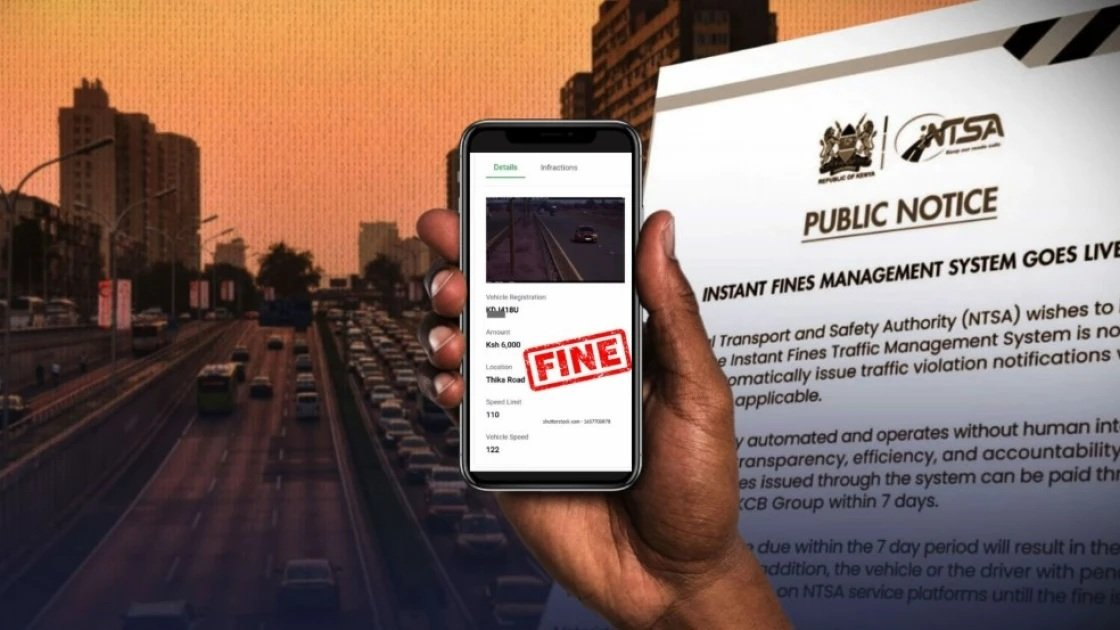
NTSA instant fines are now being enforced through Kenya’s traffic camera system, changing how drivers receive and pay speeding and other traffic penalties.
The National Transport and Safety Authority has begun using 1,000 cameras to detect road violations automatically. The system includes 700 fixed cameras and 300 mobile cameras placed along highways and in urban areas.
The cameras are designed to capture offenses such as speeding and lane violations. Once a violation is recorded, the system identifies the vehicle owner and sends an SMS notification to the phone number registered to that vehicle.
For motorists, the most important detail is the payment process. NTSA says instant fines are not paid through eCitizen, mobile money links, or third-party collectors. Drivers must pay in person at Kenya Commercial Bank branches or KCB agents.
NTSA Instant Fines Use SMS Notifications
Drivers who are flagged by the camera system receive a message from NTSA’s official short code, 22847_NTSA.
A genuine notification includes the traffic offense, the penalty amount, and payment instructions. Motorists should confirm the message is from the official short code before taking any action.
That verification step is critical because NTSA has warned of scams involving fake SMS notices. Fraudsters have used unofficial payment links or accounts to trick motorists into paying bogus fines.
The agency’s current process is designed to reduce that risk by requiring physical payment through KCB. That gives drivers a more verifiable payment channel and makes it harder for scammers to direct people to fake online accounts.
Drivers Have Seven Days to Pay
Once a driver receives a valid NTSA notice, the fine must be paid within seven days.
If the fine is not paid within that period, it begins accruing interest. The vehicle and driving profile may also be blacklisted from NTSA digital services.
That can block important transactions. A driver may be unable to renew a license or transfer a vehicle logbook until the outstanding fine is cleared.
NTSA also uses a merit and demerit points system to track driver behavior. Repeat traffic offenders can face more serious consequences, including possible license suspension.
How to Pay NTSA Instant Fines
The payment process is straightforward, but it must be followed carefully.
First, wait for a valid SMS from 22847_NTSA. The message should identify the offense, the amount due, and the payment instructions.
Second, verify the message before paying. NTSA does not ask drivers to pay instant fines through eCitizen, mobile money, online links, or private collectors.
Third, take the offense reference and details from the SMS to a Kenya Commercial Bank branch or KCB agent. This is the official payment route for NTSA instant fines.
Fourth, pay the fine directly into the NTSA account at the bank or agent location. After payment, keep the receipt as proof in case the fine is disputed later or the system fails to update immediately.
Drivers who are unsure whether a notice is genuine should confirm through NTSA’s official website or official customer-service channels before making any payment.
eCitizen Is Not Used for Instant Fines
Many drivers may assume that all government payments now go through eCitizen, but NTSA instant fines are handled differently.
eCitizen remains a major government payment platform and is used for many NTSA services. However, instant traffic fines issued through the camera enforcement system are not paid there.
This separation is intentional, according to the source information. NTSA introduced in-person payment after scams involving fake traffic-fine messages became a concern.
Any message asking a driver to pay through mobile money, a web link, eCitizen, or an unofficial collector should be treated as suspicious. For instant fines, the official channel is KCB branches and KCB agents.
Speeding Penalties Depend on the Limit Exceeded
Speeding is expected to be one of the most common violations detected by the new camera network.
The fine depends on how far above the speed limit a driver was traveling. A driver recorded at 1 to 5 kph above the limit receives a warning and no monetary fine.
Driving 6 to 10 kph above the limit attracts a KES 500 fine. Driving 11 to 15 kph above the limit attracts a KES 3,000 fine.
The penalty rises sharply for higher speeds. Driving 16 to 20 kph above the limit attracts a KES 10,000 fine.
Across the 37 violations covered by the instant fine system, penalties range from KES 500 to KES 10,000 depending on the seriousness of the offense.
What Motorists Should Watch For
The rollout creates a more automated traffic enforcement system, but it also places more responsibility on vehicle owners to keep their registration details current.
Because notices are sent to the phone number linked to the vehicle, outdated contact information could create problems. A driver may miss a notice and later face interest, blacklisting, or blocked NTSA services.
Motorists should also watch for fake messages. The official NTSA short code is 22847_NTSA, and payment should only be made through KCB branches or agents.
The next issue to watch is how consistently the system updates after payment and how NTSA handles disputes where drivers challenge a camera-issued violation. For now, drivers who receive valid notices should verify the SMS, pay within seven days, and keep their receipt.
Read Also: NTSA Vehicle Inspection Halted for Private Car Owners