


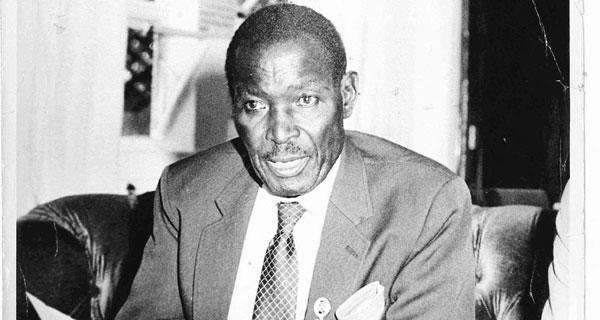
The Moses Mudavadi political dynasty began in the turbulent 1970s and blossomed into one of Western Kenya’s most enduring power centers. It has spanned generations—from the patriarch Moses Substone Mudavadi, who entered Parliament during the height of one-party rule, to his son Musalia Mudavadi, who rose to become Kenya’s Vice President and later Prime Cabinet Secretary under William Ruto.
Moses Mudavadi: The Patriarch Enters Politics
Moses Mudavadi emerged during a politically tense period. In 1975, following the assassination of J.M. Kariuki and the government’s crackdown on dissenters like Peter Kibisu and Martin Shikuku, President Daniel arap Moi rewarded loyalists with strategic appointments. Mudavadi, a close friend of Moi, was appointed to Parliament through a by-election in Vihiga, replacing the detained Kibisu.
His arrival signified the beginning of a new political order in Kakamega and Vihiga, as old firebrands were replaced by more regime-friendly figures. Mudavadi quickly climbed the political ladder and by the late 1970s had become a Cabinet Minister, making him the first Luhya leader from Kakamega to hold such power since independence.
Consolidation in the One-Party Era
By the 1983 elections, Moses Mudavadi had solidified his grip on power. Running unopposed in Sabatia, he avoided the violent nomination contests that plagued others. As President Moi deepened KANU’s control through queue voting (mlolongo), Mudavadi’s loyalty was rewarded with key ministerial roles.
His influence extended beyond Parliament. In 1988, he was appointed KANU Secretary-General, replacing Burudi Nabwera. This made him the most powerful Luhya politician in the KANU establishment—overseeing party discipline across the region and shaping the political careers of upcoming leaders.
A Dynasty is Born: Musalia Mudavadi Steps In
Tragedy struck in 1989 when Moses Mudavadi died while in office. His death, however, did not end the family’s political journey. In a swift by-election that same year, his son Musalia Mudavadi was elected to Parliament in his father’s Sabatia seat—beginning the second chapter of the Mudavadi political dynasty.
At just 29, Musalia was immediately appointed a Cabinet Minister, continuing his father’s legacy and elevating the family’s name to national stature. This smooth transition cemented the Mudavadis as Western Kenya’s political royal family.
The Rise of Musalia: From Finance Minister to Prime Cabinet Secretary
Musalia Mudavadi would go on to become Finance Minister in 1993 under President Moi, and later, Vice President in 2002 during Moi’s final months in office. Although he lost his Sabatia seat in the 2002 NARC wave, his reputation as a stable and principled politician endured.
In subsequent years, Musalia helped form the United Democratic Forum (UDF) and later the Amani National Congress (ANC). His role in the 2022 Kenya Kwanza Alliance delivered him a senior role as Prime Cabinet Secretary under President William Ruto.
Today, he is viewed as one of Kenya’s most influential political figures—his family’s name etched deeply into the country’s post-independence narrative.
The Mudavadi Legacy in Western Kenya
The Moses Mudavadi political dynasty exemplifies how loyalty, strategy, and legacy intersect in Kenya’s evolving political landscape. The family’s ability to navigate both authoritarian rule and multi-party democracy is unmatched in the region.
While many Luhya politicians have come and gone, the Mudavadis have maintained relevance for over four decades. From Moses’s alliance with Moi to Musalia’s strategic pivot in 2022, the dynasty reflects continuity, adaptability, and deep regional influence.
Conclusion
The Moses Mudavadi political dynasty remains a powerful symbol of Western Kenya’s political identity. It began in a one-party state and matured into a force that continues to influence national leadership. As Musalia navigates new roles in government, the legacy of his father Moses remains firmly embedded in the political fabric of Kakamega, Vihiga, and beyond.




