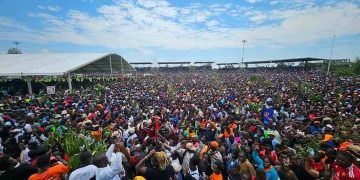
On December 30, 2002, Kenya witnessed a historic transition of power as President Daniel Toroitich arap Moi, after 24 years in power, prepared to hand over leadership to Mwai Kibaki at Uhuru Park. But what was meant to be a solemn moment of democratic pride was disrupted by visible public resentment, immortalized in a powerful image: a bodyguard leaping mid-air to deflect stones hurled at Moi by an angry crowd.
This unprecedented hostility captured the raw emotions of a nation ready for change.
Moi’s Tumultuous Legacy Meets Public Judgment
Daniel Moi had ruled Kenya since 1978, having succeeded founding president Jomo Kenyatta. His presidency was marked by authoritarian rule, economic stagnation, and widespread allegations of corruption and political repression—particularly during the single-party KANU era and the turbulent early days of multiparty democracy.
Though he had agreed to step down peacefully, his endorsement of Uhuru Kenyatta, then a political novice, as his successor in the 2002 elections had enraged many voters, who saw it as a bid to extend Moi’s influence by proxy.
The public overwhelmingly rejected Moi’s choice, handing a landslide victory to Mwai Kibaki under the National Rainbow Coalition (NARC).
Uhuru Park: A Ceremony Turned Hostile
As Moi stood on the presidential dais to take his final national salute, the crowd turned rowdy. Projectiles—stones, shoes, and bottles—began flying toward the stage.
In a scene captured by Getty Images photographer Pedro Ugarte, Moi’s bodyguards are seen frantically trying to shield him, with one officer even caught in midair, hands raised, in a desperate attempt to catch incoming missiles.
Despite the chaos, Moi stood calmly, expressionless, a man trained to show no emotion in public. But the message was clear: many Kenyans held him responsible for two decades of hardship, and they were not going to let him exit quietly.
A Defining Moment of Transition
The 2002 handover was a milestone for Kenya’s democracy—the first peaceful transfer of power from one elected president to another. However, the day’s events reflected deep-seated frustrations that had built up under Moi’s regime.
Ironically, despite the public rejection, Moi did keep his promise to step down, defying fears that he might cling to power like many African strongmen of the era.
And in doing so, he cemented a complex legacy—one of autocracy and survival, but also of eventual democratic maturity.
Legacy of the Final Salute
That chaotic handover day became symbolic for several reasons:
- It was the end of the Moi era and the birth of the Kibaki administration, which came with promises of reform.
- It underscored the power of public sentiment in transitional politics.
- And it highlighted the risk, intensity, and sacrifice faced by those entrusted with protecting heads of state—Moi’s bodyguards included.
Years later, that image remains one of the most iconic photographs in Kenyan political history: a bodyguard mid-leap, Moi stoic under fire, and Kenya standing at the crossroads of change.