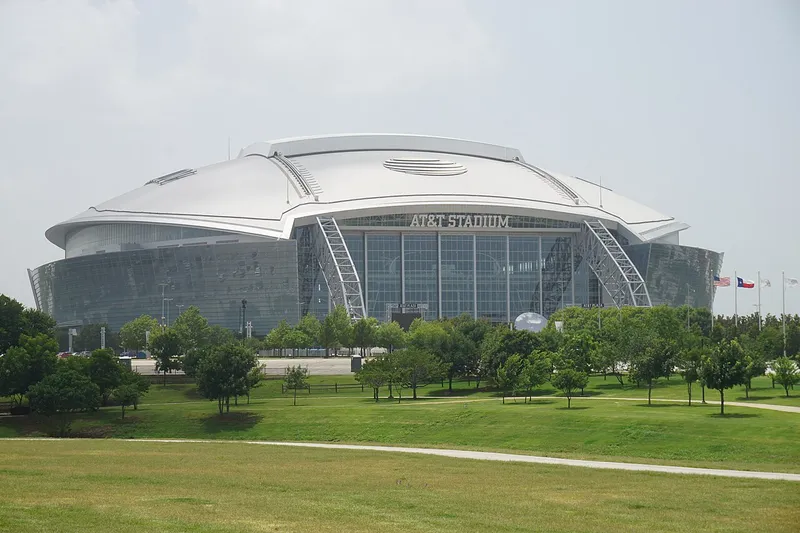
AT&T Stadium will be one of the most important venues at the FIFA World Cup 2026, hosting nine matches in Arlington, Texas, including a semi-final.
Known globally as the home of the Dallas Cowboys, the stadium will be referred to as Dallas Stadium during the World Cup because of FIFA’s neutral venue naming rules. For football fans, that temporary name will not change what the venue represents: a huge, modern, high-tech arena built for major events.
The stadium opened in 2009 and quickly became one of the most recognisable sports venues in the United States. Its retractable roof, giant centre-hung video board, massive glass doors and expandable capacity make it one of the tournament’s standout stadiums.
For World Cup 2026, AT&T Stadium will switch from synthetic turf to natural grass, giving international footballers the playing surface expected at elite FIFA events. That conversion will be one of the most important technical changes at the venue.
The stadium’s location between Dallas and Fort Worth gives it access to a large sports market, major airports and a strong event infrastructure. But it also comes with one clear challenge: public transport. Fans attending matches will need to plan carefully, especially because Arlington does not have the same rail access as some other World Cup host cities.
Quick Facts About AT&T Stadium
| Fact | Detail |
|---|---|
| Stadium name | AT&T Stadium |
| FIFA World Cup name | Dallas Stadium |
| Location | Arlington, Texas, USA |
| Address | 1 AT&T Way, Arlington, TX 76011 |
| Capacity | Around 80,000 seated; up to about 94,000 for FIFA configuration |
| Opened | 2009 |
| Roof | Retractable |
| Surface | Synthetic turf normally; natural grass for FIFA events |
| Main tenant | Dallas Cowboys |
| Competition focus | FIFA World Cup 2026 |
| World Cup matches | 9 matches |
| Biggest match | Semi-final |
| First World Cup match | June 14, 2026 |
| Known for | Retractable roof, giant video board, glass doors and major-event hosting |
Where Is AT&T Stadium?
AT&T Stadium is located in Arlington, Texas, at 1 AT&T Way. The city sits between Dallas and Fort Worth, making the stadium part of the wider Dallas-Fort Worth metroplex.
Its location is important for World Cup 2026 because many travelling fans will arrive through Dallas Fort Worth International Airport, one of the busiest airports in the United States. The stadium is also close to other major sports and entertainment venues, including Globe Life Field, home of the Texas Rangers.
Although it will be called Dallas Stadium during the tournament, fans should understand that the venue is not in downtown Dallas. It is in Arlington, about 20 miles from Dallas and about 15 miles from Fort Worth.
That difference matters when planning transport, hotels and match-day travel.
History of AT&T Stadium
AT&T Stadium was built as the new home of the Dallas Cowboys after the team left Texas Stadium, its previous venue in Irving. Texas Stadium had been famous for its partial roof with an opening above the field, a design that became part of the Cowboys’ identity.
The new stadium was designed to be bigger, more flexible and more commercially powerful. It opened in 2009 and was originally known as Cowboys Stadium before AT&T acquired the naming rights in 2013.
The project was closely associated with Cowboys owner Jerry Jones, who wanted a venue that could host more than NFL games. The result was a stadium designed for American football, concerts, basketball, boxing, wrestling, international football and major global events.
At completion, the stadium cost more than $1 billion, making it one of the most expensive sports venues ever built at the time. It was not just a stadium project. It was a statement about the Cowboys brand, Texas sports culture and the future of large-scale entertainment venues.
Construction and Design
AT&T Stadium was designed by HKS, Inc., with Bryan Trubey serving as lead architect. The design created one of the most ambitious stadium structures in American sport.
The most obvious feature is the retractable roof. It allows the venue to function in different weather conditions, which is especially important in Texas, where summer temperatures can be extremely high. For World Cup 2026, the roof gives organisers a major advantage because it can help control the match-day environment.
The stadium also has two huge glass end-zone doors. These doors can open independently, bringing air and light into the stadium bowl. Together with the retractable roof, they give the venue a flexible indoor-outdoor feel.
Another defining feature is the centre-hung Mitsubishi video board. Suspended above the field, it became one of the most famous video screens in world sport. For spectators inside the stadium, it changes how they experience replays, match information and live entertainment.
The venue also includes premium seating, luxury suites, club areas and a major contemporary art collection displayed across public and premium spaces.
AT&T Stadium and World Cup 2026
AT&T Stadium has one of the biggest roles of any venue at the FIFA World Cup 2026. It will host nine matches, more than any other stadium in the tournament.
That schedule includes group-stage matches, Round of 32 fixtures, a Round of 16 match and a semi-final. Hosting a semi-final places Dallas Stadium among the tournament’s elite venues.
The first World Cup 2026 match at the stadium is scheduled for June 14, 2026. The semi-final will be played on July 14, 2026. That means the venue will remain relevant throughout the tournament, from the early group-stage drama to the final week.
For global viewers, AT&T Stadium will offer one of the most visually distinctive backdrops of the competition. The massive roof structure, giant video board and huge crowd capacity will make it easy to recognise on television.
World Cup 2026 Matches at AT&T Stadium
| Date | Match |
| June 14, 2026 | Netherlands vs Japan |
| June 17, 2026 | Group-stage match |
| June 22, 2026 | Group-stage match |
| June 25, 2026 | Group-stage match |
| June 27, 2026 | Group-stage match |
| June 30, 2026 | Round of 32 |
| July 3, 2026 | Round of 32 |
| July 6, 2026 | Round of 16 |
| July 14, 2026 | Semi-final |
This match list gives the venue a strong tournament profile. It will host early action, knockout football and one of the two semi-finals. Few stadiums at the 2026 World Cup will carry that level of responsibility.
Why AT&T Stadium Was Chosen for a Semi-Final
AT&T Stadium was selected for a semi-final because it has size, technology, hospitality, climate control and major-event experience.
The venue can hold a huge crowd. It has hosted NFL games with more than 100,000 spectators, major concerts, college football, basketball, wrestling and international football. That experience matters because a World Cup semi-final requires more than a playing field. It requires broadcast infrastructure, security planning, crowd management, hospitality, media facilities and global event operations.
The retractable roof also gives AT&T Stadium a practical edge. Texas weather in June and July can be extremely hot. Closing the roof and using climate control can make conditions more manageable for players, fans, staff and broadcasters.
For FIFA, that combination makes the stadium a reliable choice for one of the tournament’s biggest matches.
Natural Grass for FIFA Events
AT&T Stadium normally uses synthetic turf for Dallas Cowboys games. For the FIFA World Cup 2026, that surface will be replaced with natural grass.
This is a crucial change. Elite international football is usually played on natural grass because it supports the type of ball movement, footing and player comfort expected at the highest level.
The conversion will likely involve a modular grass system. That approach allows the stadium to install a temporary football pitch while preserving the venue’s long-term American football use.
The venue has hosted football matches before with temporary natural grass. That experience will help organisers prepare for the World Cup, where pitch quality will be watched closely by players, coaches and fans.
The Retractable Roof Advantage
The retractable roof is one of AT&T Stadium’s biggest World Cup advantages.
Arlington can be extremely hot in summer, with high temperatures and intense sun. An open-air stadium under those conditions can create difficult match conditions. AT&T Stadium gives organisers more control.
If the roof is closed, the stadium can protect fans and players from direct heat. The climate-control system can also make the bowl more comfortable. That could help the quality of football, especially in matches played during the day.
For teams, this matters tactically. Cooler conditions can support a faster game, more pressing and better technical execution. For fans, it can make the match-day experience safer and more comfortable.
Major Events Hosted at AT&T Stadium
AT&T Stadium has already hosted some of the biggest events in American sport and entertainment.
It staged Super Bowl XLV in 2011, when the Green Bay Packers defeated the Pittsburgh Steelers. It has also hosted major college football games, the College Football Playoff National Championship, NBA All-Star events, WrestleMania and large concerts.
The stadium has drawn huge crowds for NFL games, wrestling and music events. Its design allows it to operate as both a sports venue and a major entertainment arena.
That history explains why FIFA trusts it with nine World Cup matches. AT&T Stadium is used to major events, global attention and complex operations.
Transport and Fan Access
Transport will be one of the biggest issues for fans attending World Cup matches at AT&T Stadium.
Unlike some major stadiums, AT&T Stadium does not sit next to a downtown rail station. Arlington has limited public transit compared with Dallas and Fort Worth. That means many fans will depend on cars, rideshare services, event shuttles and organised transport.
The nearest major rail connections are linked to the Dallas-Fort Worth transport network, but fans should not assume they can simply take a train and walk to the stadium.
For World Cup 2026, shuttle services are expected to play a major role. Fans travelling from Dallas, Fort Worth or airport areas should check official transport guidance before match day.
The safest plan is to arrive early, allow extra time and avoid treating match-day travel like a normal local journey.
Driving and Parking
AT&T Stadium is built for car access. It sits near major roads, and the wider stadium district includes official parking and private lots.
Fans driving from Dallas can use routes toward Arlington, while those travelling from Fort Worth will approach from the opposite side of the metroplex. Dallas Fort Worth International Airport is relatively close by car, although event traffic can change travel times quickly.
Parking should be booked in advance where possible. For World Cup matches, demand will be high, prices may rise and road closures or security zones may affect normal routes.
International fans should also remember that American stadium districts often require more walking than expected after parking. Comfortable shoes, early arrival and patience will help.
Rideshare and Airport Access
Uber, Lyft and other rideshare services will be popular for visitors who do not rent cars. However, surge pricing and long waits are likely after World Cup matches.
Fans should expect designated pickup and drop-off areas. These zones may not be directly outside the stadium gates because security and traffic control will shape the match-day layout.
Dallas Fort Worth International Airport is the closest major airport. Dallas Love Field is another option, especially for domestic travellers. Both airports can connect fans to hotels in Dallas, Fort Worth, Arlington and surrounding areas.
For major matches, especially the semi-final, fans should avoid tight flight schedules on the same day.
Nearby Attractions
AT&T Stadium sits in a sports and entertainment district with several attractions nearby.
Globe Life Field, home of the Texas Rangers, is close to the stadium. Choctaw Stadium, the Rangers’ former home, is also nearby. Six Flags Over Texas is within short driving distance and may attract families visiting for the tournament.
For fans who want a stronger Texas cultural experience, Fort Worth Stockyards offers rodeo history, cattle-drive traditions, food and live entertainment.
The wider Dallas-Fort Worth area also offers museums, shopping, restaurants, nightlife and sports tourism options. That gives travelling World Cup fans plenty to do before and after matches.
What Fans Should Know Before Visiting
Fans attending AT&T Stadium during World Cup 2026 should prepare for a large-scale event.
The stadium is massive, and security checks will take time. Ticket holders should check official FIFA policies before travelling, especially on bags, prohibited items and entry procedures.
Weather is another important factor. Even with the roof, fans will still spend time outside before and after the match. Texas heat can be intense, so hydration, sunscreen and light clothing may be important.
Transport planning will matter as much as the match itself. Because the stadium is not in central Dallas, visitors should decide early whether they will use shuttles, rideshare, parking or organised transport.
Why AT&T Stadium Matters to World Cup Fans
AT&T Stadium matters because it represents the scale of the 2026 World Cup.
This tournament is the biggest in FIFA history, with 48 teams and matches across the United States, Mexico and Canada. AT&T Stadium fits that ambition. It is large, modern, dramatic and built for spectacle.
For African fans, Kenyan readers and global football supporters, Dallas Stadium will be one of the venues to watch closely because of its semi-final role. By the time the tournament reaches July 14, only four teams will remain in the race for the trophy. One of them will earn a place in the final in Arlington.
That makes the stadium more than a group-stage venue. It will be part of the tournament’s decisive story.
Key Takeaways
- AT&T Stadium is located in Arlington, Texas.
- It will be called Dallas Stadium during FIFA World Cup 2026.
- The stadium opened in 2009.
- It is the home of the Dallas Cowboys.
- The venue has a retractable roof.
- It normally uses synthetic turf but will use natural grass for FIFA events.
- AT&T Stadium will host nine World Cup 2026 matches.
- It will host a semi-final on July 14, 2026.
- The first World Cup match at the venue is scheduled for June 14, 2026.
- Transport planning will be important because Arlington has limited rail access.
- The stadium is known for its giant video board and huge glass doors.
- It is one of the most important U.S. venues at World Cup 2026.
Frequently Asked Questions
Where is AT&T Stadium located?
AT&T Stadium is located at 1 AT&T Way in Arlington, Texas, between Dallas and Fort Worth.
What will AT&T Stadium be called during World Cup 2026?
During the tournament, AT&T Stadium will be called Dallas Stadium because FIFA uses neutral venue names.
What is AT&T Stadium’s capacity?
AT&T Stadium has around 80,000 regular seats and can expand for major events. For World Cup 2026, the expected configuration is around 94,000 for larger matches.
When did AT&T Stadium open?
AT&T Stadium opened in 2009.
Which team plays at AT&T Stadium?
AT&T Stadium is home to the Dallas Cowboys of the NFL.
Does AT&T Stadium have a roof?
Yes. AT&T Stadium has a retractable roof that can open or close depending on event needs and weather conditions.
Will AT&T Stadium use natural grass for World Cup 2026?
Yes. The stadium will use natural grass for FIFA World Cup 2026 matches.
How many World Cup 2026 matches will AT&T Stadium host?
AT&T Stadium will host nine matches at World Cup 2026, more than any other venue in the tournament.
Will AT&T Stadium host a World Cup semi-final?
Yes. AT&T Stadium will host a FIFA World Cup 2026 semi-final on July 14, 2026.
Is AT&T Stadium easy to reach by public transport?
It is not one of the easiest World Cup venues for public transport. Fans should plan ahead and use official shuttles, rideshare, parking or organised transport.
Conclusion
AT&T Stadium will be one of the defining venues of the FIFA World Cup 2026. Its size, retractable roof, giant video board and semi-final assignment make it one of the tournament’s most important stadiums.
For Dallas, Arlington and the wider Texas sports market, the World Cup will bring global football attention to a venue already known for American football and major entertainment events.
For fans, the stadium promises spectacle. It will host more matches than any other World Cup 2026 venue and play a decisive role when the tournament reaches the semi-final stage.
On July 14, 2026, Dallas Stadium will become one of the most watched football venues in the world. AT&T Stadium was built for moments like that.
Read Also: MetLife Stadium World Cup 2026 Guide: Capacity, Location, Matches and Final Venue